You have probably tried the advice before. Paint it white. Buy a loveseat instead of a sofa. Add mirrors everywhere. And yet your small living room still feels exactly the same: crowded, a little chaotic, and nothing like the spaces you save to your phone.
Here is the honest truth about small living room decorating: most of the advice floating around online is generic, untested, and written by people who have never actually lived in a small space. The ideas that actually work are more specific, more counterintuitive, and far more satisfying to execute.
What follows is not a list of vague suggestions. These are seven specific, actionable decorating ideas for small living rooms, ordered by impact. Start at the top and work your way down.
1. Fix Your Lighting Before You Change Anything Else
Most small living rooms are lit by a single overhead fixture, and that single overhead light is quietly making your room feel smaller every evening you are in it.
Overhead-only lighting removes shadow from a space. Shadow is what creates depth. Without depth, your room loses the visual layering that makes a space feel expansive and interesting. What you are left with is flat, even light that reveals every corner at once and makes the whole room feel as large, or as small, as it actually is.
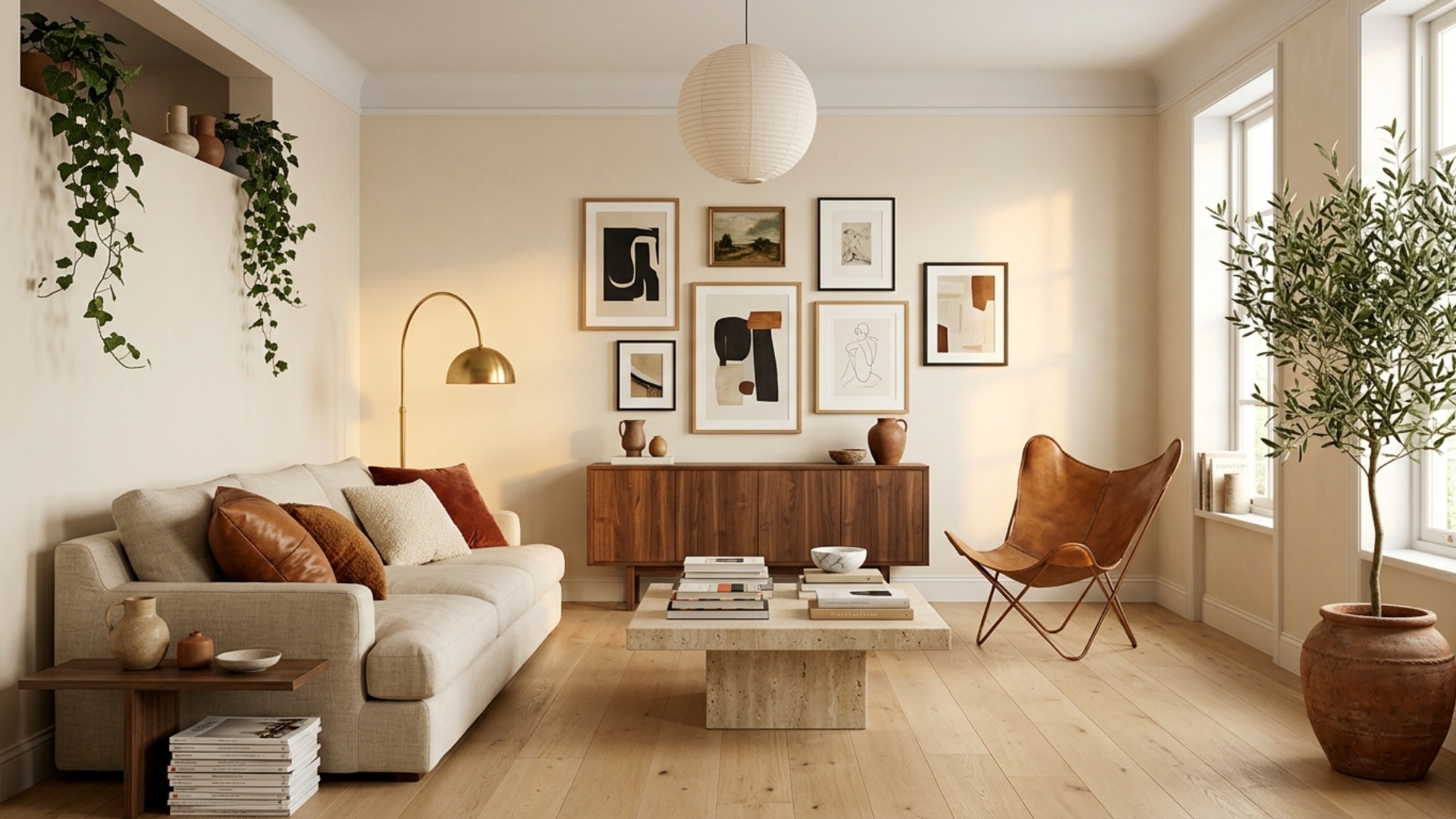
The fix is straightforward: add a floor lamp in the corner opposite your primary seating. Aim it toward the ceiling or wall rather than straight down. This single change adds warmth, creates shadow, and transforms how the room reads at night. From there, you can layer in a table lamp or two as budget allows.
Also: replace any bulbs cooler than 3000K. Warm light in the 2700K to 3000K range makes every space feel more lived-in and generous. Cool white light belongs in offices, not living rooms.
2. Choose a Color Story, Not a Color Palette
There is a difference between picking colors you like and building a color story. One gives you a room full of things you love that somehow still feel like they belong in different houses. The other gives you a room that holds together visually and feels designed.
For small living rooms, the 60-30-10 rule is the clearest framework available. Sixty percent of the room reads in one dominant color. This is usually your largest piece: the sofa, the rug, or the wall color. Thirty percent is your secondary color, carried through curtains, pillows, or a chair. Ten percent is your accent, one or two pieces that add personality without competing.
The key is proportion. When these three layers are in the right ratio, even rooms with bold colors feel calm and cohesive. When the proportions are off, even neutral rooms feel unsettled.
Not sure what color story is right for your taste and your space? The Design Aura quiz at framehouse.design takes about two minutes and gives you a clear, specific design direction based on your actual preferences, not a generic style category.
3. Size Up Your Rug (Seriously)
The most common small-room rug mistake is buying a rug that is too small. It is counterintuitive, but a rug that is sized correctly for your seating area will make a small living room feel larger, not more crowded.
Here is why: a properly sized rug creates a defined zone. It tells the eye where the seating area begins and ends. That clarity creates a sense of visual order that reads as spaciousness, even in rooms where not much has actually changed.
The standard guidance: at minimum, the front two legs of every seating piece should sit on the rug. In a typical small living room, this means an 8x10 is almost always more effective than a 5x8. The 5x8 floats. The 8x10 anchors.
4. Pull Your Sofa Away From the Wall
This is the one decorating change that requires zero money and about thirty seconds of effort. Pull your sofa six to eight inches away from the wall behind it.
Every design instinct tells you to push furniture toward the edges to maximize floor space in the middle. But what that actually creates is a wide, empty center and furniture that looks like it is trying to escape through the wall. It reads as cramped, not spacious.
That small gap between the sofa and the wall does something remarkable to how a room feels. It creates breathing room. It makes the arrangement look intentional. It signals to the eye that this is a curated space, not a default one.
Try it before you change anything else. The center of your room will feel less, not more, constricted.
5. Add Vertical Visual Interest
Small living rooms almost always underuse vertical space. The furniture hugs the floor, the art hovers at eye level in the middle of the wall, and the space between the top of your largest piece and the ceiling goes completely unused.
Vertical interest pulls the eye upward, which creates the impression of height even in rooms with low ceilings. A few specific ways to do this: hang curtains as close to the ceiling as possible rather than at the window frame. Use tall bookshelves or a leaning ladder shelf. Hang a gallery wall that extends from near the floor to near the ceiling rather than floating in the middle of a wall.
Each of these moves adds a dimension to the room that flat, horizontal arrangements completely miss.
6. Swap Out One Bulky Piece for a Lighter Alternative
You do not need to replace all your furniture to make a small living room feel different. You need to identify the one piece that is doing the most visual damage and replace it with something lighter.
In most small living rooms, that piece is the sofa. A high-backed sofa with solid sides and no visible legs blocks sightlines, traps visual weight low to the ground, and makes a room feel full even when it is not particularly full.
A lower-profile sofa with exposed legs solves this immediately. You can see the floor beneath it, which opens up the visual field. The room gains depth. The sofa still functions exactly the same way. It just stops making the room feel like a storage problem.
Before you buy, see it in your actual space first. Framehouse lets you upload a photo of your living room and visualize how a new piece will look before you spend a dollar. That is the only way to know for certain whether a change will work in your specific room rather than in someone else's photo.
7. Edit, Do Not Add
The last small living room decorating idea is the one people resist the most, because it does not involve buying anything. It involves taking things away.
Visual clutter makes rooms feel small even when the furniture is correctly scaled and the lighting is perfect. Too many accent pillows. Too many small decorative objects on every surface. Too many competing frames on the wall. Each individual item might be something you love. Together they create visual noise, and visual noise makes the eye work harder, which the brain reads as chaos, which registers as cramped.
Go through your living room and remove roughly thirty percent of what is on display. Put it in another room for two weeks. Notice how the space feels. If you miss something, bring it back. If you do not, that item was probably not doing the work you thought it was.
Editing is the most underrated skill in interior design. A well-edited room always feels more intentional and more generous than a full one.
The Fastest Way to Know Where to Start
The hardest part of decorating a small living room is not any individual decision. It is knowing which decision to make first, and whether the change you are imagining will actually work in your specific room.
That is what Framehouse is built for. Take the Design Aura quiz at framehouse.design. Two minutes, six questions, and you walk away with a clear design direction grounded in your real taste. Then upload a photo of your living room and see redesigns tailored to your aura, before you move a single piece of furniture or spend a single dollar.
Your small living room has more potential than the current arrangement is showing. You just need to see it clearly first.