Industrial Kitchen Ideas That Maximize a Small Studio
Industrial is the one style that makes an exposed studio kitchen look deliberate instead of apologetic. The trick is keeping the materials and losing the loft scale.
The real problem
Why this is harder than it looks
Industrial gets chosen for a studio kitchen because it is the only style that makes a kitchen sitting in your living room look intentional rather than apologetic. Then the loft scale comes with it: a huge reclaimed island, three oversized pendants, a full wall of black steel, and the kitchen quietly swallows the apartment it was supposed to sit inside.
What makes a real industrial space work is the structure, not the finishes. In a converted warehouse the beams, the concrete, and the factory windows carry the entire style, so the kitchen itself can be plain. In a studio you almost never have those bones, which means the finishes are asked to do all the work, and finishes on their own read as a theme rather than a building. The way through is to let industrial govern the material palette and let the studio govern the scale.
The starting point is usually 400 to 600 square feet, one room, a galley or an L along a single wall, landlord appliances in white that you cannot replace, no pantry, and no door. The kitchen is the first thing a guest sees and the last thing you look at before you sleep. Storage is the real constraint here, not style, and any decision that does not buy back floor area or a cleaner sightline is not worth making.
The failure pattern arrives in two shapes. The first is open shelving everywhere, which photographs beautifully for a week and then holds every object you own, turning industrial restraint into visible clutter. The second is going so dark that a room with one window becomes a cave. Blackened steel in this style is a line weight, not a wall colour, and a small studio needs the pale half of the palette for the dark half to mean anything.
A clear path
How to plan it
-
01
Design the kitchen for the hours you are not cooking
In a studio the kitchen sits in your living room and your bedroom, so it is on display roughly twenty three hours a day and in use for one. Before buying anything, sit on the bed and then on the sofa and look at it. Whatever is ugly from those two positions, the dish rack, the microwave, a row of mismatched boxes, is the actual design problem, and it matters far more than the cabinet fronts.
-
02
Keep closed storage low, and allow yourself exactly one open shelf
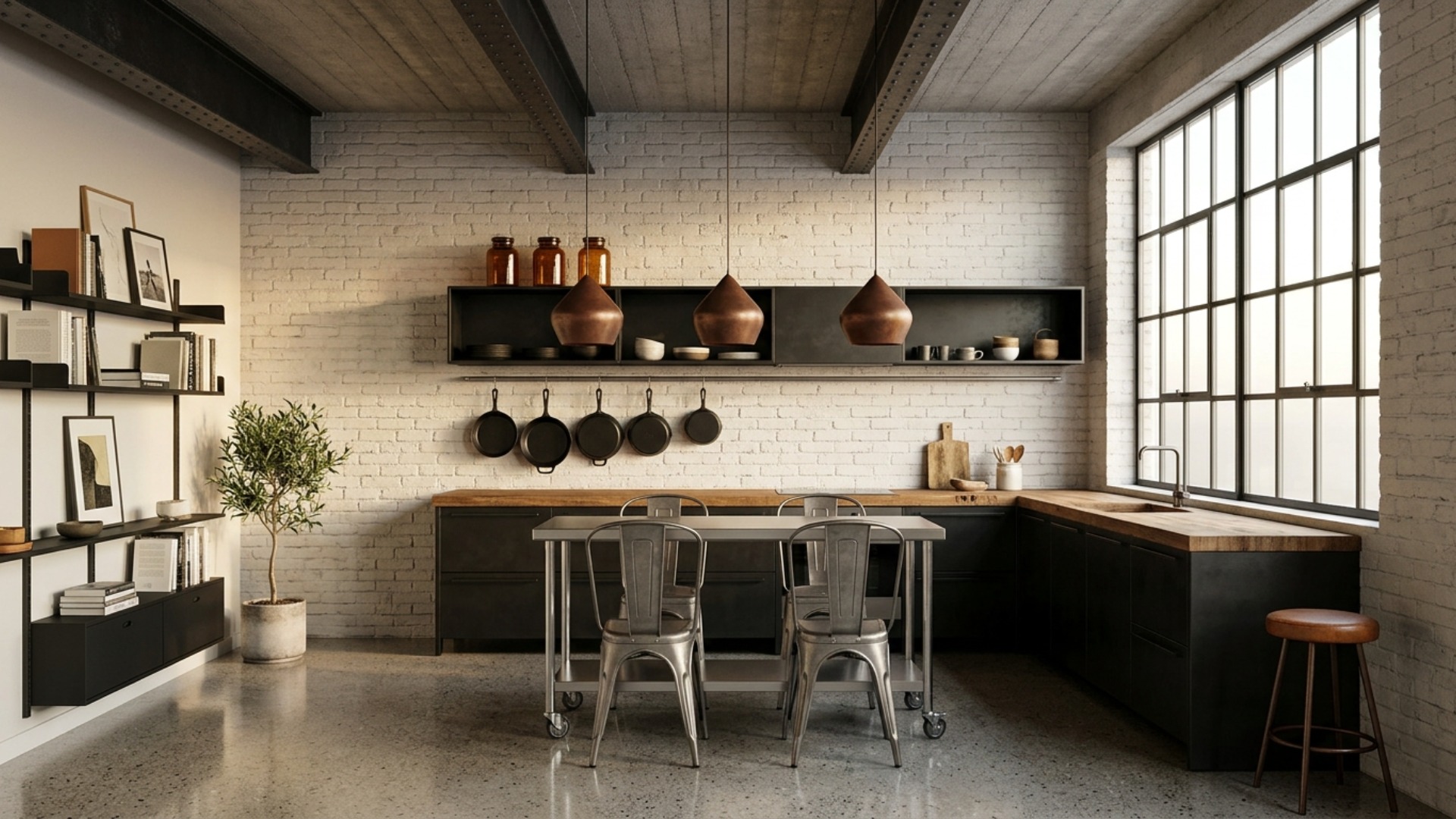
Full open shelving is the classic industrial studio mistake. Keep the base run closed behind blackened steel or dark matte fronts, then allow one open shelf and one hanging rail for the things that genuinely look good: cast iron, a few amber glass jars, a wooden board or two. Everything else goes behind a door, because in a room with no walls between functions, visible clutter is the thing that kills the style.
-
03
Make the island mobile and make it earn three jobs
A fixed island is the wrong move under 600 square feet. A narrow steel framed prep cart on locking castors, roughly 30 by 20 inches, gives you counter space while you cook, a dining bar with two stools when you eat, and a desk when you work, then rolls out of the sightline entirely. Buy one with a lower shelf, since it is the only extra storage you are likely to get.
-
04
Use the dark as line weight, not as surface area
Industrial fails in a small studio when blackened steel becomes wall colour and a room with one window turns into a cave. Keep black to the frames, the rail, the shelf brackets, and the window mullions, and let the large surfaces stay pale: whitewashed brick, warm grey concrete, or a soft grey plaster such as Benjamin Moore Classic Gray. The contrast is what reads as industrial, so you need the light half to make the dark half work.
-
05
Check the sightline from the bed in Framehouse before you spend
A studio kitchen is judged from across the room rather than from the counter, and that is exactly the view no sample or swatch can show you. Photograph the apartment from the bed and from the sofa, then use Framehouse to test a dark base run against a pale wall, or an open shelf against a closed cabinet, before you commit. Steel fronts and a rolling island are not cheap things to get wrong.
Built for studio maximization
Moves that pay off
In a studio the kitchen competes with everything else in the room for both floor space and attention. Every decision should buy back one of the two.
- Measure the sightline from the bed and the sofa before you measure the counter.
- Choose the mobile piece over the fixed piece wherever the choice exists.
- Put the microwave and the dish rack where they are not visible from the sofa.
- Use the full ceiling height for storage, since vertical is the only spare space you have.
- Keep the flooring continuous under the kitchen so the studio does not read as two small rooms.
- Do not replace landlord appliances. Frame them with a darker run and they recede on their own.
industrial cues
What to keep, what to skip
Industrial without warehouse bones has to earn the style through material and contrast rather than structure. Aim for these.
- Palette: pale concrete grey and whitewashed brick as the base, blackened steel as the line, and one burnt sienna or copper accent.
- Materials: blackened hot rolled steel, reclaimed elm or oak with visible saw marks, polished concrete, and aged leather.
- Signature: one honest structural gesture, an exposed conduit run, a steel rail, or a factory style window frame.
- Lighting: two or three small pendants at 2700K rather than one oversized loft fixture the ceiling cannot carry.
- Restraint: one open shelf, one hanging rail, and closed storage everywhere else.
- What to skip: Edison bulb clusters, fake distressed signage, full black walls, and a fixed island under 600 square feet.
Use it for
What people plan with Framehouse
- Test a dark base run against a pale brick or plaster wall
- See the kitchen from the bed before committing to open shelving
- Try a rolling island in three positions to find the one that clears the floor
- Check whether two pendants or three suit your ceiling height
- Plan how to frame landlord appliances instead of replacing them
Quick answers
Common questions
Make a plan you can act on
Skip the spiral of mood boards. Three minutes in the Aura Quiz turns your taste into a direction.
Take the Aura Quiz