Mid Century Modern Bedroom Ideas for a Small Space
A small bedroom is where mid century modern earns its keep, because the style was born in compact postwar homes and designed to make little rooms work hard. This page shows how to get that warm, functional look when floor space is the thing you have least of.
The real problem
Why this is harder than it looks
Mid century modern gets treated as a look you buy: a walnut credenza, a couple of tapered legs, a starburst clock, done. In a small bedroom that shopping-list version backfires, because every themed object you add is one more thing eating the little floor you have. The style reads as busy instead of easy, which is the opposite of what drew you to it.
What is actually going on is that mid century modern was a space-saving movement before it was an aesthetic. It came out of small postwar houses, so its real toolkit is low horizontal lines, legs that let light run under furniture, and built-in storage that disappears into the wall. Those are exactly the moves a cramped bedroom needs, and they are the ones people skip in favor of decorative pieces.
Your starting point is usually a room where the bed already fills most of the floor and there is nowhere obvious to put a dresser. That constraint is not a problem to decorate around; it is the brief. The question is not what to add but how to make each piece hold its ground while feeling light.
The failure pattern to avoid is buying a matching bedroom set. A bulky headboard, two nightstands, and a tall dresser in the same walnut finish will crowd a small room and flatten it into a furniture showroom. Mix scales instead, keep the pieces low and legged, and let the walls do the storage work.
A clear path
How to plan it
-
01
Choose a low, legged bed and let the floor breathe
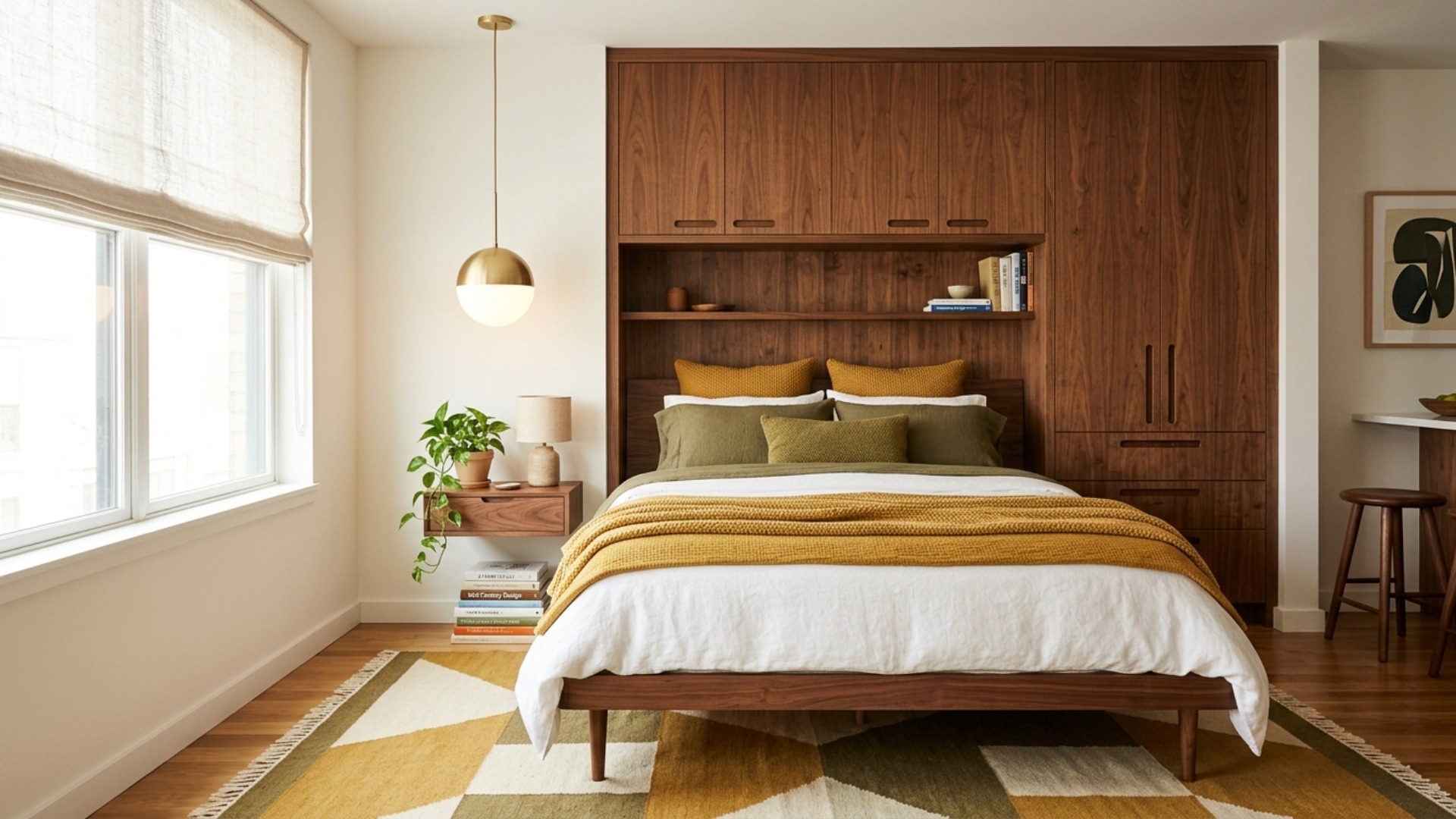
The single biggest move in a small mid century bedroom is a low platform bed on slim tapered legs, so the eye reads the floor continuing underneath and the room feels larger than it is. Skip the tall upholstered headboard. A simple walnut or cane-backed frame at a lower height keeps the horizontal line the style is built on.
-
02
Push storage up the walls, not across the floor
Floor space is the scarce resource, so move storage vertical. A wall of shallow built-in walnut cabinets, a pair of floating nightstands instead of freestanding ones, and a narrow ledge for books all keep the floor clear. If you buy freestanding, a low three-drawer dresser doubling as a nightstand earns its footprint twice.
-
03
Warm it up with walnut, wool, and two accent colors
Mid century warmth comes from wood tone and a tight accent palette, not from clutter. Anchor with walnut or teak, add a wool rug with a simple geometric weave, and pick two period accents such as mustard and olive, or rust and teal. Keep the walls a warm white so the wood reads rich rather than muddy in a small room.
-
04
Add one sculptural light instead of a bulky lamp
A freestanding lamp eats a nightstand you do not have room for, so go sculptural and off the surface. A brass globe pendant hung low beside the bed, or a slim wall-mounted sconce, frees the surface and adds the one strong shape the style loves. Use a warm 2700K bulb, since mid century interiors depend on a golden, lamp-lit quality of light.
-
05
See it in your real room before you buy
A small room punishes a wrong-sized purchase more than a large one does, and walnut tones and warm whites shift a lot depending on your light. Before you order the bed or commit to a wood finish, visualize the finished mid century bedroom in Framehouse using a photo of your actual room, so you can check the scale and the palette against your real walls instead of guessing from a product page.
Built for studio maximization
Moves that pay off
Maximizing a small bedroom is a sequencing problem before it is a style problem. Spend on the pieces that buy you floor and defer the decorative ones.
- Measure the walk-around clearance before buying the bed, since a frame six inches narrower can be the difference between a room that works and one that does not.
- Put money into vertical or built-in storage first, because that is what actually frees the floor and it is the hardest thing to add later.
- Defer the dresser if a closet plus two floating drawers can carry you, and reclaim that footprint.
- Skip the matching bedroom set. Buying pieces separately lets you keep each one low and small instead of showroom-scale.
- Choose a bed with drawers underneath only if you lack closet space, since under-bed storage trades a clean floating look for capacity.
- Wait on art and objects until the furniture is placed, so you are not decorating a room whose layout might still change.
mid century modern cues
What to keep, what to skip
Mid century modern is a precise style, and the small-room version is even tighter. Hit these and it reads warm and intentional.
- Palette: warm white walls, a walnut or teak wood tone, and two period accents such as mustard, olive, rust, or teal, used sparingly.
- Materials: rich wood grain, wool, leather, and a little brass, with cane or spindle detailing for lightness.
- Line: keep everything low and horizontal, with legs on the bed and seating so the floor reads continuous underneath.
- Storage: wall-hung and built-in wherever possible, with flat fronts and recessed or slim pulls rather than bulky hardware.
- One signature: a single sculptural light or a spindle-back chair carries the period feel without turning the room into a theme.
- What to skip: the full themed set, the starburst-clock cliches, tall heavy headboards, and cool gray tones that kill the warmth.
Use it for
What people plan with Framehouse
- Test a walnut frame against your floor color before ordering, so the wood does not clash.
- Check that a low bed leaves real walk-around clearance in your actual footprint.
- See how a wall of built-in storage reads before you commit to the carpentry.
- Compare mustard against olive as your accent so you pick one and stop second-guessing.
- Show a partner or roommate the finished look so you agree before anything ships.
Quick answers
Common questions
Make a plan you can act on
Skip the spiral of mood boards. Three minutes in the Aura Quiz turns your taste into a direction.
Take the Aura Quiz