Coastal Studio Apartment Ideas for a Small NYC Apartment
Coastal is the rare style that makes 400 square feet feel bigger, because everything in it is light, low, and a little transparent. This page walks through how to get that ease in a New York studio without a single anchor, stripe, or rope in sight.
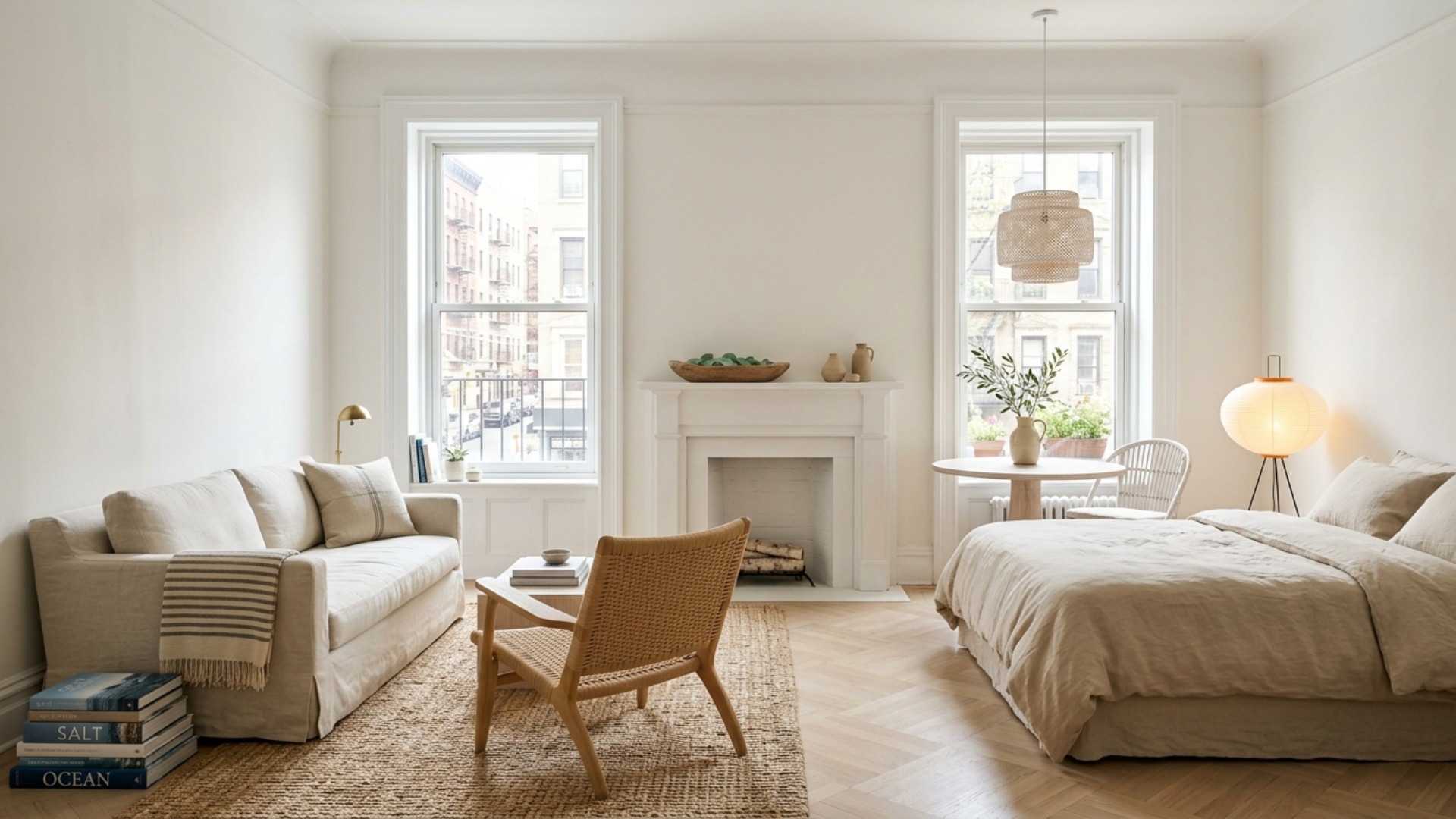
The real problem
Why this is harder than it looks
The usual mistake with coastal style is treating it as a theme instead of a light strategy. People buy the navy throw pillows, the rope mirror, the LIVE LAUGH BEACH sign, and end up with a souvenir shop in Murray Hill. Real coastal rooms are not about the ocean at all. They are about how much light a room holds and how little visual weight sits in it.
That matters double in a New York studio, because you are usually working with one or two windows, a radiator you cannot move, and a single room that has to be living room, bedroom, and office at once. Every dark, heavy, high-backed piece you add eats a measurable share of the light you have. Coastal works here precisely because its core moves, pale surfaces, low furniture, and woven texture, are also the classic small-space moves.
The failure pattern to avoid: keeping the landlord's dingy white walls as they are, then layering coastal accessories on top. Builder white with a gray undertone reads cold and institutional, and no amount of linen fixes it. The wall color is the foundation of this style, and in a studio it is 60 percent of the effect. Get the envelope right first and the room starts doing the work for you.
A clear path
How to plan it
-
01
Repaint before anything else, even as a renter
Most NYC landlords allow painting if you return the walls white, and one coat changes more than any purchase you will make. Use a warm white like Benjamin Moore White Dove or Swiss Coffee in matte, around $60 a gallon, and skip anything with a blue or gray undertone.
-
02
Choose low, leggy, light-colored furniture
A slipcovered sofa in washed linen or an off-white loveseat on visible legs keeps sightlines open across the room. Anything you can see under and through makes the studio read larger, so favor cane, rattan, spindle legs, and glass over solid boxy pieces.
-
03
Zone the room with texture instead of walls
Lay a bound jute or sisal rug under the living zone and a soft flatweave beside the bed, and the one room becomes two without losing a foot of space. An open-backed shelf or a linen curtain on a ceiling track works as a divider that light still passes through.
-
04
Stretch the light you already have
Hang sheer linen curtains as high and wide as the window allows so the glass reads bigger than it is. Then place your largest mirror on the wall perpendicular to the window, not opposite it, which spreads daylight deeper into the room instead of bouncing it straight back out.
-
05
Preview the whole room in Framehouse before you buy
Upload a photo of your studio to Framehouse and test the coastal palette against your actual floors, radiator, and light before spending anything. Sand, off-white, and sea-glass tones shift dramatically in a north-facing NYC room, and seeing the finished space first is far cheaper than returning a sofa.
Built for small apartment nyc
Moves that pay off
A New York studio has constraints a beach house never faces, so sequence your spending around them.
- Paint and curtains first: they are the two highest-impact moves and together run under $400.
- Buy the sofa for the room you have, not the one you want. Under 78 inches wide, legs visible, slipcover washable.
- Skip the bed frame with a tall headboard. A low platform keeps the sleeping corner from dominating the room.
- Use the radiator: a custom cover in white becomes a windowsill bench or plant shelf instead of an eyesore.
- Storage goes vertical and white. Tall, shallow, wall-colored shelving disappears; deep dark bookcases shrink the room.
- Defer the dining table. A round pedestal cafe table for two does the job until you know you host more than four.
coastal cues
What to keep, what to skip
Coastal in 2026 is quiet: more driftwood and linen, less lighthouse. Keep the palette and materials disciplined and the style carries itself.
- Palette: warm white walls, sand and oatmeal textiles, one sea-glass green or faded blue accent, nothing darker than driftwood.
- Materials: washed linen, cotton slub, rattan, cane, jute, and pale or bleached oak. One weathered wood piece is plenty.
- Light: sheer curtains only. Heavy drapes are the fastest way to kill the style in a small room.
- Signature: one woven pendant or rattan chair reads as coastal from the doorway. You do not need both plus baskets.
- Ceramics and glass: sandy stoneware, clear or sea-toned glass, nothing glossy black.
- Skip entirely: navy stripes, rope details, shell art, anchors, and anything with a beach word printed on it.
Use it for
What people plan with Framehouse
- Test White Dove against your actual afternoon light before committing to a gallon
- See whether a slipcovered sofa or a leggy loveseat fits your window wall better
- Compare jute against a pale flatweave under your real floor color
- Show a partner what the finished studio looks like before splitting the cost
- Check that a woven pendant suits your ceiling height before ordering
Quick answers
Common questions
Make a plan you can act on
Skip the spiral of mood boards. Three minutes in the Aura Quiz turns your taste into a direction.
Take the Aura Quiz