Mid Century Modern Kitchen Ideas for a Small NYC Apartment
Mid century modern was invented for small urban rooms, which makes it the rare style that gets better as the kitchen gets smaller. Here is how to pull it off in a New York galley without a renovation.
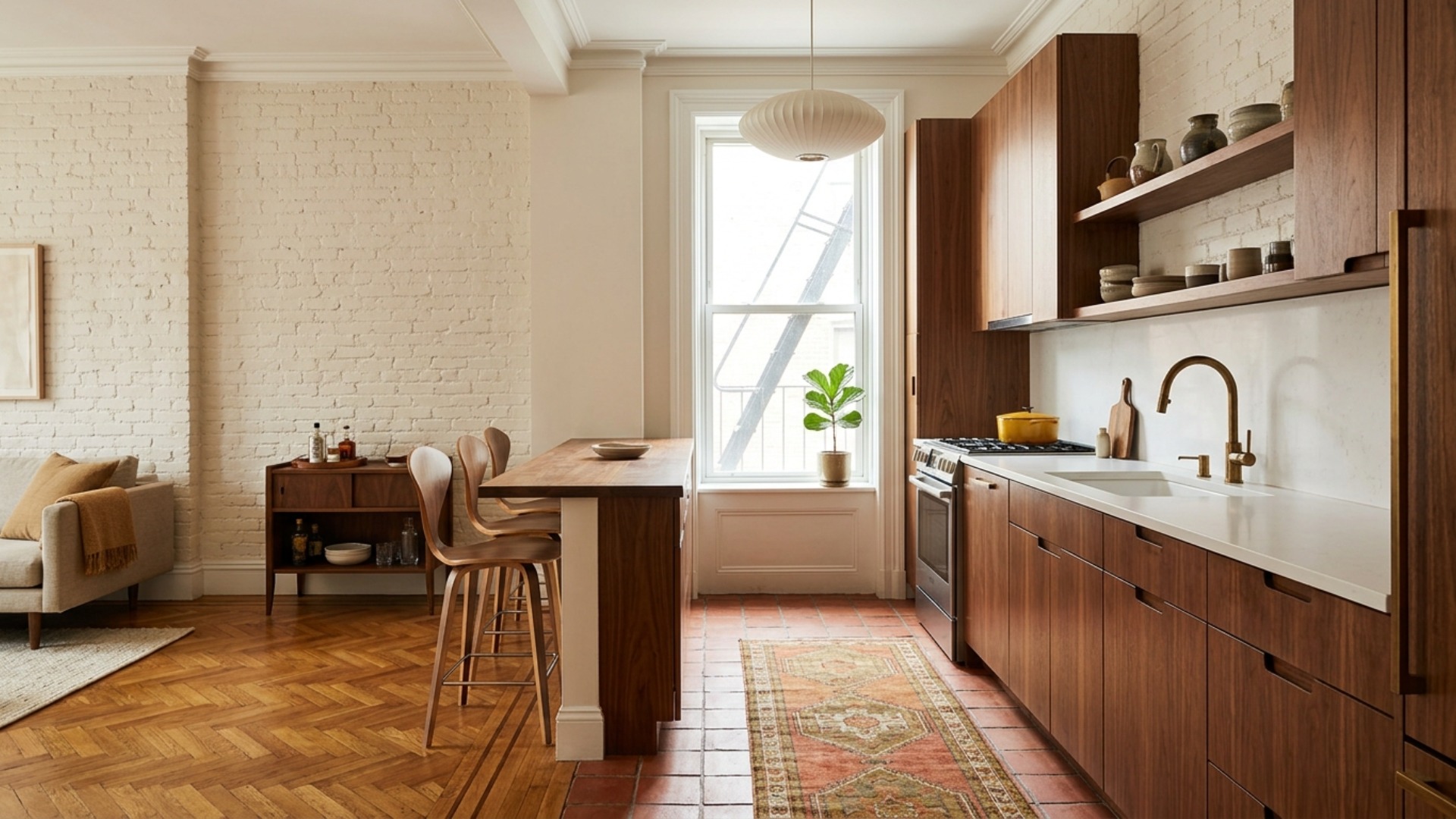
The real problem
Why this is harder than it looks
The common misreading of mid century modern is that it is a furniture style, so people try to bring it into a kitchen with a starburst clock and a set of reproduction bar stools. In a small New York kitchen that approach lands as theme decor bolted onto a landlord white box, and the room ends up neither modern nor mid century.
What the style actually runs on is warmth and restraint in the permanent surfaces: flat cabinet fronts, continuous wood grain, considered hardware, one sculptural light. The originals were designed for compact postwar apartments, which is why the language fits a 60 square foot galley better than almost any other style. Nothing about it needs a big room.
Your starting point in New York is usually specific: a narrow galley or L, cabinets painted landlord white, a radiator eating one wall, and either a rental lease that forbids renovation or a co-op board that makes it painful. That rules out the gut job, and it should. The style transfers through fronts, hardware, lighting, and objects, all of which are reversible.
The failure pattern is accessorizing instead of editing. Open shelves crowded with matching mid century knickknacks, a boomerang print backsplash, three competing woods. The originals were disciplined: one wood, one white, one accent. Hold that line and even a tiny kitchen reads as designed.
A clear path
How to plan it
-
01
Warm the boxes first: fronts, film, or paint
If the cabinets are yours to change, replacement flat fronts in walnut or teak veneer from a fronts company like Semihandmade transform an IKEA or builder box for a fraction of a renovation. In a strict rental, a quality wood grain film or a coat of deep olive or warm white paint on the existing fronts does the same visual work and peels off when you leave.
-
02
Swap the hardware to slim brass or black pulls
Landlord kitchens ship with bulky brushed nickel. Replace it with slim edge pulls or round knobs in aged brass or matte black, kept consistent across every door. It is a $60 to $150 change, takes one screwdriver and one afternoon, and reads as a decade of taste. Keep the old hardware in a bag for move out.
-
03
Hang one sculptural pendant and dim everything else
A Nelson style bubble pendant or a small globe fixture over the sink or counter is the single strongest mid century signal in a kitchen. If the ceiling box cannot be touched, a plug in version with a cord swag does the same job. Aim for warm bulbs around 2700K, because cool light kills wood tones.
-
04
Add real wood and one vintage piece at counter level
A long walnut cutting board left out, a teak tray corralling oils, and one true vintage object, a Dansk pepper mill or a Cathrineholm bowl found for under $80, carry more authenticity than a wall of reproductions. If there is room for seating, two moulded plywood stools in the Cherner manner earn their footprint.
-
05
Test the scheme in Framehouse before buying fronts
Cabinet fronts and film are the one purchase here that hurts to get wrong, because the wood tone has to work with your counters and floor. Framehouse renders your actual kitchen in mid century modern, so you can compare walnut against teak against painted olive on your real geometry before ordering anything.
Built for small apartment nyc
Moves that pay off
A small New York kitchen rewards reversible moves and punishes renovation fantasies. These pay off first.
- Change hardware before anything else. It is the highest return dollar in a rental kitchen.
- Keep every mid century move reversible: film over refacing, plug in pendant over hardwiring.
- Clear the counters to two objects per run. Small kitchens read cluttered at three.
- Use the radiator top: a cut walnut board turns the eyesore into a shelf for the kettle.
- One wood species only. Walnut and teak together read as a thrift store, not a kitchen.
- Photograph everything before changing it, so move out restoration is a checklist, not a memory test.
mid century modern cues
What to keep, what to skip
Mid century modern in a kitchen is a materials discipline, not a decor theme. These cues keep it honest.
- Palette: warm white, one wood in the walnut family, and a single accent in olive or mustard.
- Materials: flat fronts with visible grain, honed white counters, aged brass or matte black hardware.
- One structural signature: a Nelson style bubble pendant or a slim globe light, nothing ornate.
- Counter objects in period materials: teak, stoneware, enamel. Two or three pieces, not a display.
- Keep uppers closed. Open shelving is Scandinavian; mid century kitchens hide their storage.
- What to skip: starburst clocks, boomerang prints, reproduction sets, and anything labeled retro.
Use it for
What people plan with Framehouse
- Compare walnut against painted olive fronts on your actual cabinets
- See whether a bubble pendant clears your ceiling height before buying
- Test brass against black hardware across the whole run before ordering thirty pulls
- Show a landlord or partner that the plan is fully reversible
- Decide if two counter stools fit the galley or just block the fridge
Quick answers
Common questions
Make a plan you can act on
Skip the spiral of mood boards. Three minutes in the Aura Quiz turns your taste into a direction.
Take the Aura Quiz