Industrial Kitchen Ideas for Small NYC Apartments
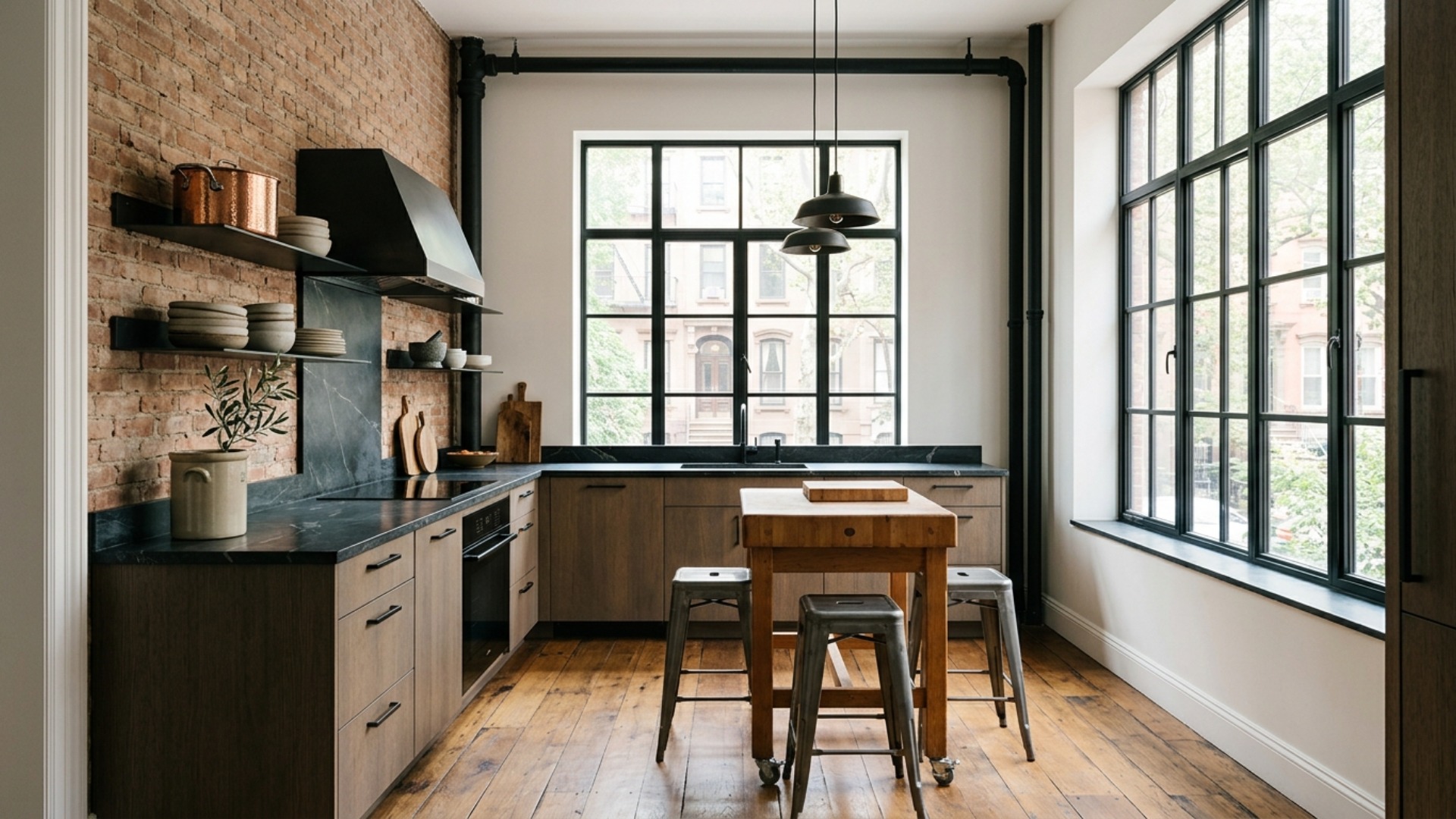
Industrial style was born in buildings like yours, which is why it works in a New York kitchen where softer styles fight the architecture. This page shows how to get the warmth of a loft kitchen into a footprint the size of a closet.
The real problem
Why this is harder than it looks
Industrial style has a scale problem, and most advice ignores it. The look was born in factories and lofts: fourteen-foot ceilings, steel windows the size of walls, brick by the acre. A New York kitchen is often six feet of counter in a room that also holds your sofa. Copy the loft photos literally and you get a dark, heavy corner that swallows what little light the room gets.
What industrial actually is, underneath the brick and pipe, is honesty about materials and structure. Wood that shows grain, metal that shows its fixings, surfaces that improve as they wear. None of that requires square footage. A small kitchen can be more convincingly industrial than a staged loft, because in a prewar walkup the bones are already real.
Your starting point is probably a rental or a co-op with a galley or one-wall kitchen, cabinets in landlord white, and a floor you cannot change. You cannot demolish anything, and the room has to keep working every day. That rules out the renovation-first advice most industrial guides lead with, and it leaves finishes, hardware, lighting, and one run of open shelving to carry the entire style.
The failure pattern is buying the props instead of the materials: Edison bulb fixtures, faux-rust signs, a pot rack sized for a restaurant. Each one adds visual noise to a room that has no space to absorb it. The fix is a small number of honest surfaces doing the work, wood, steel, and stone, one strong light fixture, and everything decorative held to a ruthless minimum.
A clear path
How to plan it
-
01
Fix the palette before you buy anything
Industrial in a small room needs contrast, not darkness. Keep walls in a warm white like Benjamin Moore Simply White so the room holds its light, then bring the dark tones in through hardware and shelving. If you own, one wall in a charcoal like Benjamin Moore Wrought Iron reads industrial without shrinking the room.
-
02
Swap the hardware and faucet first
Matte black or gunmetal pulls and a black bridge-style faucet convert white landlord cabinets surprisingly far, usually for under $150 and thirty minutes with a screwdriver. Keep every finish in the same family, since three metals in six feet of kitchen reads as clutter.
-
03
Add one run of steel-and-wood open shelving
One shelf, not a wall of them. A blackened steel bracket shelf in oak or reclaimed wood above the counter gives the style its honest-materials note and adds storage a small kitchen is starved for. Keep what lives on it disciplined: everyday plates, glass jars, and a cast-iron pan or two.
-
04
Get the lighting down to one strong fixture
Swap the ceiling flushmount for one or two pendants in blackened steel or aged brass with warm bulbs around 2700K. Skip the Edison-bulb cage cluster, the most copied and quickest dated move in the style. A plug-in under-cabinet strip fixes the shadow line where you actually chop.
-
05
Preview the dark moves before you commit
Dark shelving, black hardware, and a charcoal wall are exactly the choices that go wrong in a small, light-starved room, and paint chips will not warn you. Photograph your kitchen and test the finishes in Framehouse first, so you can see whether the room can afford the darkness before you spend.
Built for small apartment nyc
Moves that pay off
A small New York kitchen rewards reversible moves and strict sequencing. Spend where the room works hardest and defer the rest.
- Start with hardware, faucet, and lighting: the whole conversion stays under $400 and reverses in an afternoon when you move.
- If you rent, keep every change at screwdriver level: swapped pulls, a tension rail, peel-and-stick only where it will peel back off.
- Measure your counter run before buying anything. Most industrial shelving is sized for lofts, and a 36-inch shelf fits where a 60-inch will not.
- Skip the rolling island and the bar cart. In this footprint the open floor is worth more than the storage.
- Use the vertical: a steel rail with S-hooks for pans keeps counters clear and reads more honestly industrial than any decor purchase.
- Save appliance upgrades for last. A stainless dishwasher changes the room less than $60 of hardware does.
industrial cues
What to keep, what to skip
Industrial lives on honest materials, visible function, and restraint with decoration. Hold these lines and a six-foot galley reads as considered rather than themed.
- Palette: warm white walls, blackened steel, aged oak, one russet or cognac accent. Keep it to four.
- Materials: wood with visible grain, steel with visible fixings, stone or butcher block counters. Nothing glossy except tile.
- One structural signature: a single run of steel-bracket open shelving, or an exposed pipe left proudly unpainted.
- Hardware in one finish family, matte black or gunmetal, across every pull, the faucet, and the light fixture.
- Texture over ornament: a waxed butcher-block board and cast iron on show beat any piece of wall decor.
- What to skip: Edison bulb clusters, faux-rust signs, fake brick panels, and anything distressed at the factory.
Use it for
What people plan with Framehouse
- Test whether a charcoal accent wall makes your galley feel intentional or just darker
- Check black hardware against your actual cabinet color before ordering thirty pulls
- See if open shelving reads calm or cluttered on your real wall before drilling
- Compare butcher block against dark stone counters in your actual light
- Show a landlord or partner the finished plan before you argue for it
Quick answers
Common questions
Make a plan you can act on
Skip the spiral of mood boards. Three minutes in the Aura Quiz turns your taste into a direction.
Take the Aura Quiz