Minimalist Bedroom Ideas for a Small NYC Apartment
In a bedroom that measures nine feet by eleven, minimalism stops being an aesthetic choice and becomes the only strategy that works. Here is how to make a tiny New York bedroom feel calm and intentional instead of merely empty.
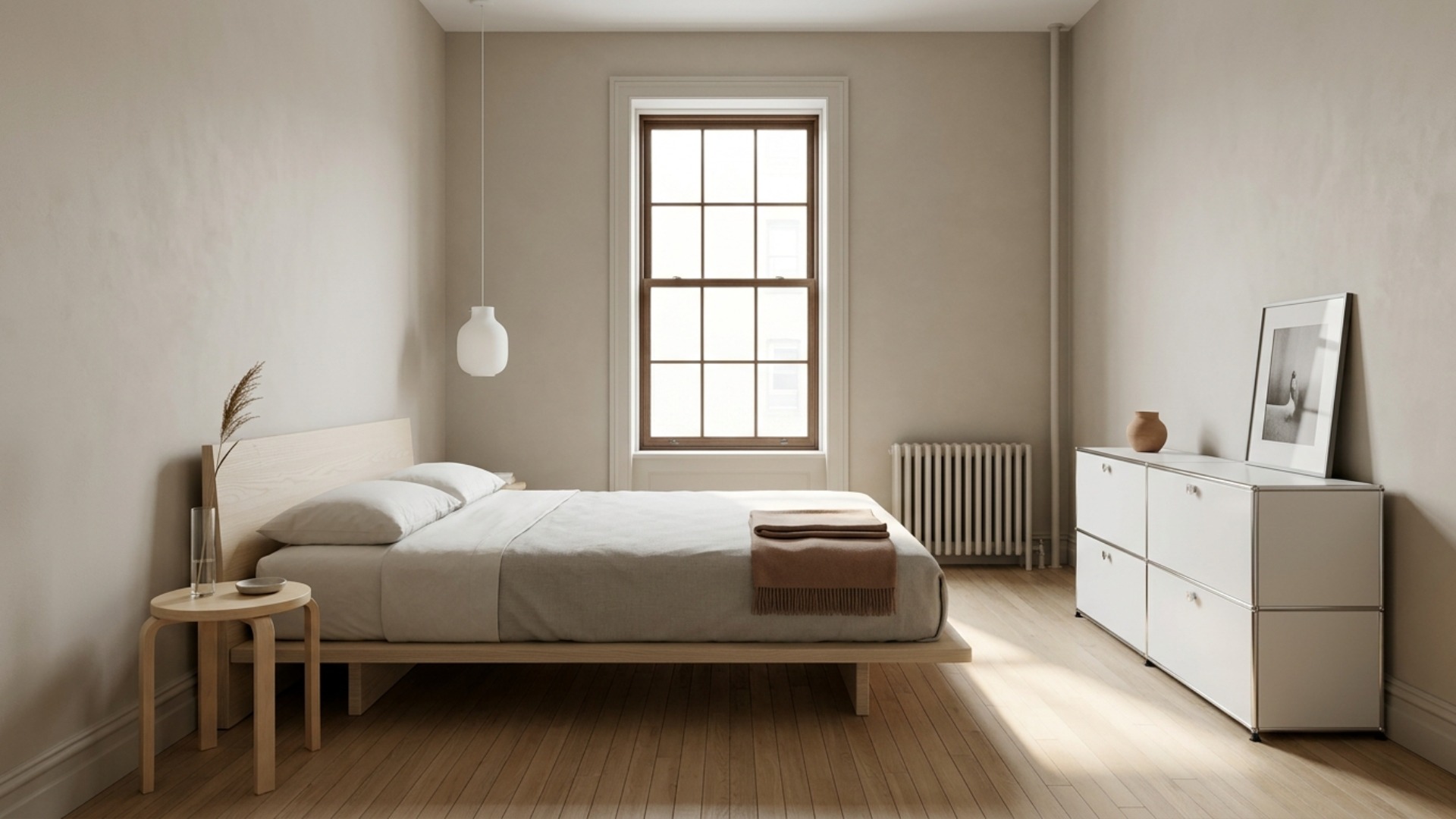
The real problem
Why this is harder than it looks
Minimalism gets sold as an act of subtraction: remove enough stuff and serenity appears. In a small New York bedroom that advice collapses on contact, because the problem was never decorative clutter. It is that the room physically cannot hold a queen bed, a dresser, a desk, and a place to stand at the same time. Emptying the shelves does not fix a floor plan.
What minimalism actually offers a tiny bedroom is a decision framework. One material story, one place for everything, nothing on the floor that does not earn its footprint daily. The style works in 100 square feet not because it looks spare but because every choice is doing double duty: the bed stores, the walls hold light, the palette makes the ceiling feel further away than it is.
The specific trap for NYC renters is buying small furniture instead of fewer pieces. Six little things read as clutter even when each one is tasteful. A tiny room wants three substantial, quiet pieces, not six apologetic ones. The second trap is going cold: white walls, grey bedding, black frame, and the room feels like a dorm at a research station. Warm minimalism, wood tones and off-whites, is what keeps spare from becoming bleak.
Start with the bed, since it is 60 percent of the room's visual field, and make every later decision defer to it.
A clear path
How to plan it
-
01
Commit to a low platform bed with storage built in
A low profile makes the ceiling read higher, and drawers underneath replace the dresser you do not have room for. Look at a Thuma or a simple Muji-style ash platform, and resist the tall upholstered headboard, which eats a foot of visual height in a room that has none to spare.
-
02
Pick one wood and one white, then stop
Choose a single wood tone, pale ash or white oak, and one warm white for walls such as Benjamin Moore Simply White. Every new purchase must match one of the two. This single rule prevents the accumulation of almost-matching pieces that makes small rooms feel busy.
-
03
Get every surface off the floor except three
Bed, one seat or stool, one plant or lamp: that is the floor's whole job. Shelving becomes one wall-mounted rail or picture ledge, the nightstand becomes a wall-hung shelf or a stool, and the laundry basket lives inside the closet, not beside it.
-
04
Solve lighting in layers you can mount without wiring
A plug-in wall sconce on each side of the bed frees both surfaces, and a paper or opal glass pendant swapped onto the existing ceiling fixture softens the whole room for under $150. Skip the big floor lamp; it is one more thing standing in a room with no spare floor.
-
05
Preview the pared-down room in Framehouse before buying
Photograph your bedroom and test the platform bed, the wall color, and the sconce placement in Framehouse before you spend. In a room this small every piece is load-bearing, and seeing the finished space first tells you whether three pieces are enough or you have cut one too many.
Built for small apartment nyc
Moves that pay off
A small New York bedroom rewards ruthlessness about sequence and scale, so spend in this order.
- Declutter and donate first. In a minimalist room the free move is the biggest one, and it tells you what storage you actually need.
- Bed and mattress next: it is the anchor, and everything else is negotiable until it is placed.
- Measure the door swing and radiator before ordering anything. Standard furniture assumes clearances prewar rooms do not have.
- Choose closed storage over open. Open shelving in a bedroom this small demands daily discipline; drawers forgive.
- Put money into blackout curtains and the mattress, the two purchases you feel every single day.
- Defer art until the room is done. One large piece beats five small ones, and you will not know the right one until the furniture settles.
modern minimalist cues
What to keep, what to skip
Minimalist works when the restraint feels warm rather than clinical. Keep these cues in view.
- Palette: warm white walls, one pale wood, undyed or oatmeal textiles, and a single muted accent like clay or fog grey.
- Materials: ash or oak, cotton percale, linen, wool, matte ceramic. Nothing glossy, nothing chromed.
- Surfaces: one object per surface is the resting state. The nightstand holds a lamp and a book, not a tray of things.
- Structure: a low bed, clean-lined storage, and legs you can see under. Bulk sits low; light sits high.
- Texture carries the room: with color restricted, the interest comes from weave, grain, and plaster. Layer three textures minimum.
- Skip: matching bedroom sets, tall headboards, mirrored furniture, and open clothing racks, which are clutter with good posture.
Use it for
What people plan with Framehouse
- Check whether a platform bed clears your radiator and window sill line
- Test Simply White against your north-facing light before painting
- See the room with a wall-hung shelf instead of a nightstand
- Compare an oatmeal linen headboard wall against bare plaster
- Show a partner the three-piece version of the room before donating furniture
Quick answers
Common questions
Make a plan you can act on
Skip the spiral of mood boards. Three minutes in the Aura Quiz turns your taste into a direction.
Take the Aura Quiz