Japandi Bedroom Ideas for Small NYC Apartments
Japandi works best when the room is small, because its whole logic is subtraction rather than addition. This page shows how to build a calm, warm bedroom in a tight New York footprint without it reading as sparse or unfinished.
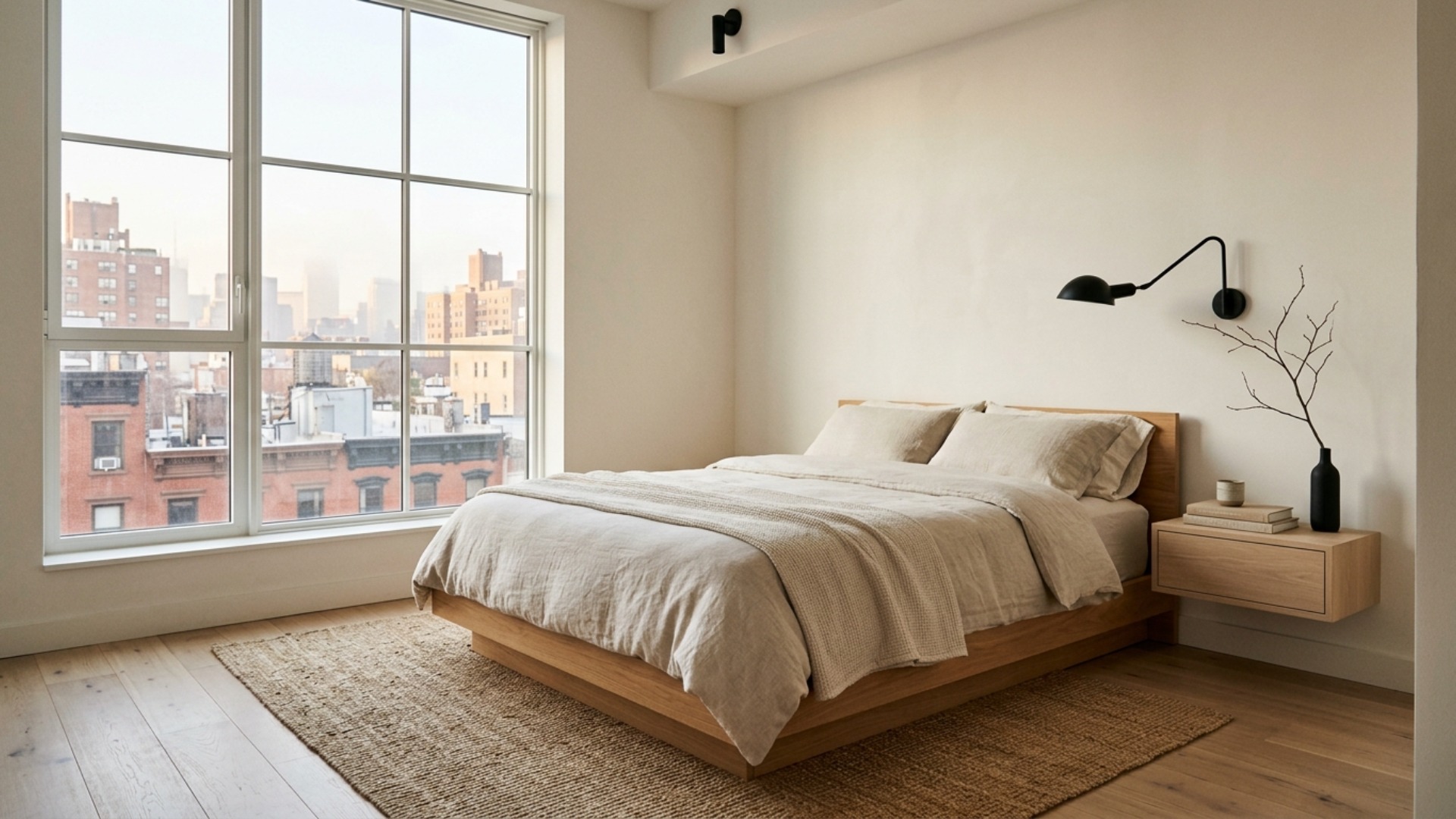
The real problem
Why this is harder than it looks
Most people read Japandi as a look: light wood, a low bed, a neutral palette, maybe a paper lantern. So they buy those objects, arrange them in a small bedroom, and end up with a room that feels more like a showroom than a place to sleep. The style gets blamed for feeling cold.
What Japandi actually is: a discipline about what you remove and how few things you let remain. It pairs Japanese restraint with Scandinavian warmth, and the warmth is the part a small New York bedroom usually loses first. When every surface is bare and every material is pale, there is nothing for the eye to rest on, so the room reads as empty rather than calm.
Your starting point is a hard one. A New York bedroom is often eight by ten feet, shares a wall with the living room, and has one window facing a shaft or a brick wall. There is no room for a bench at the foot of the bed or a reading chair in the corner, and the light you do get is limited. Every piece has to earn its place twice: once for function, once for how it feels.
The failure pattern is buying for the photo instead of the footprint. A platform bed that looks right in a loft eats the entire floor of a small room. A pale rug over pale floors erases the one bit of contrast that would have grounded the space. The fix is not more Japandi objects. It is fewer, warmer, and better placed, with texture doing the work that square footage cannot.
A clear path
How to plan it
-
01
Start with the bed height, not the bed frame
In a small room the bed is the largest object, so its proportions set the mood before anything else. Choose a low platform, roughly 8 to 12 inches off the floor, in warm oak or a warm-toned veneer, which makes the ceiling feel taller and the room calmer. Skip the tall upholstered headboard a queen frame usually ships with, since it pushes the bed further into the room and adds bulk you cannot afford.
-
02
Warm up the palette before you subtract
Japandi fails cold when the whites are gray. Paint the walls a warm off-white like Benjamin Moore White Dove or Swiss Coffee rather than a stark builder white, and let the wood tones lean honey rather than ash. Add one grounding dark, a matte black sconce, a charcoal linen throw, or a single black-framed print, so the eye has an anchor.
-
03
Solve storage vertically and out of sight
A small bedroom cannot afford a dresser footprint, so go up and go hidden. Use the wall above the bed for one slim floating shelf, choose a bed with drawers underneath, and put a narrow three-drawer chest inside the closet rather than the room. The Japandi rule is that visible surfaces stay almost empty, which only works if there is somewhere for everything else to go.
-
04
Layer texture so bare does not become blank
Texture is what separates calm from empty. Combine oatmeal linen bedding, a low-pile wool or jute rug a shade darker than the floor, a raw-edged ceramic lamp, and one woven basket. Keep the palette to warm white, oatmeal, oak, and black, but let every surface have a different hand, so a nearly monochrome room still feels rich.
-
05
See it in your actual room before you buy
Paint chips and product photos lie about scale and undertone, and returning furniture up a walk-up is its own punishment. Photograph your bedroom and use Framehouse to test the low bed, the warm white, and the rug against your real window and wall color before you spend. It is the cheapest way to catch a too-gray white or a bed that swallows the floor.
Built for small apartment nyc
Moves that pay off
A small New York bedroom rewards sequencing and restraint over a big one-time haul. Buy in this order and defer the rest.
- Start with paint and bedding, the two changes that shift the whole room for under two hundred dollars.
- Choose a bed frame with built-in drawers before you buy any standalone storage.
- Measure the door, the stairwell, and the elevator before ordering anything larger than a nightstand.
- Skip the reading chair; the room reads calmer with the floor left open, and the bed does that job.
- If you rent, use tension-mounted or peel-and-stick solutions on the walls so your deposit survives.
- Hold one wall completely empty for the first month and see whether the room actually needs more.
japandi cues
What to keep, what to skip
Japandi lives in a narrow, warm, low-contrast palette with one dark anchor and a lot of natural texture. Hold these and it will not read as generic minimalism.
- Palette: warm white, oatmeal, and honey-toned oak, with matte black used once, not everywhere.
- Materials: solid or veneered light wood, linen, wool, paper, and unglazed ceramic. Avoid high gloss and chrome.
- One structural signature: a low horizontal line, whether the bed, a floating shelf, or a long low dresser.
- Keep visible surfaces almost empty; three considered objects beat a full styled tableau.
- Choose handmade over perfect. A slightly irregular vessel or a visible wood grain is the point.
- What to skip: cool gray tones, glossy lacquer, and brass overload, which pull the room toward a different style.
Use it for
What people plan with Framehouse
- Test a warm off-white against your actual wall and window light before buying paint
- See whether a low platform bed leaves enough walking room in your real footprint
- Compare oak against walnut bed frames in the room instead of in a catalog
- Show a roommate or partner what the finished bedroom will feel like
- Check that a darker rug grounds the space before you commit to a size
Quick answers
Common questions
Make a plan you can act on
Skip the spiral of mood boards. Three minutes in the Aura Quiz turns your taste into a direction.
Take the Aura Quiz