Industrial Kitchen Ideas for a Rental Makeover
Industrial is the style that depends most on the building, which makes it the hardest one to want in a rental kitchen you are not allowed to touch. It is still very doable, as long as you stop trying to disguise the cabinets.
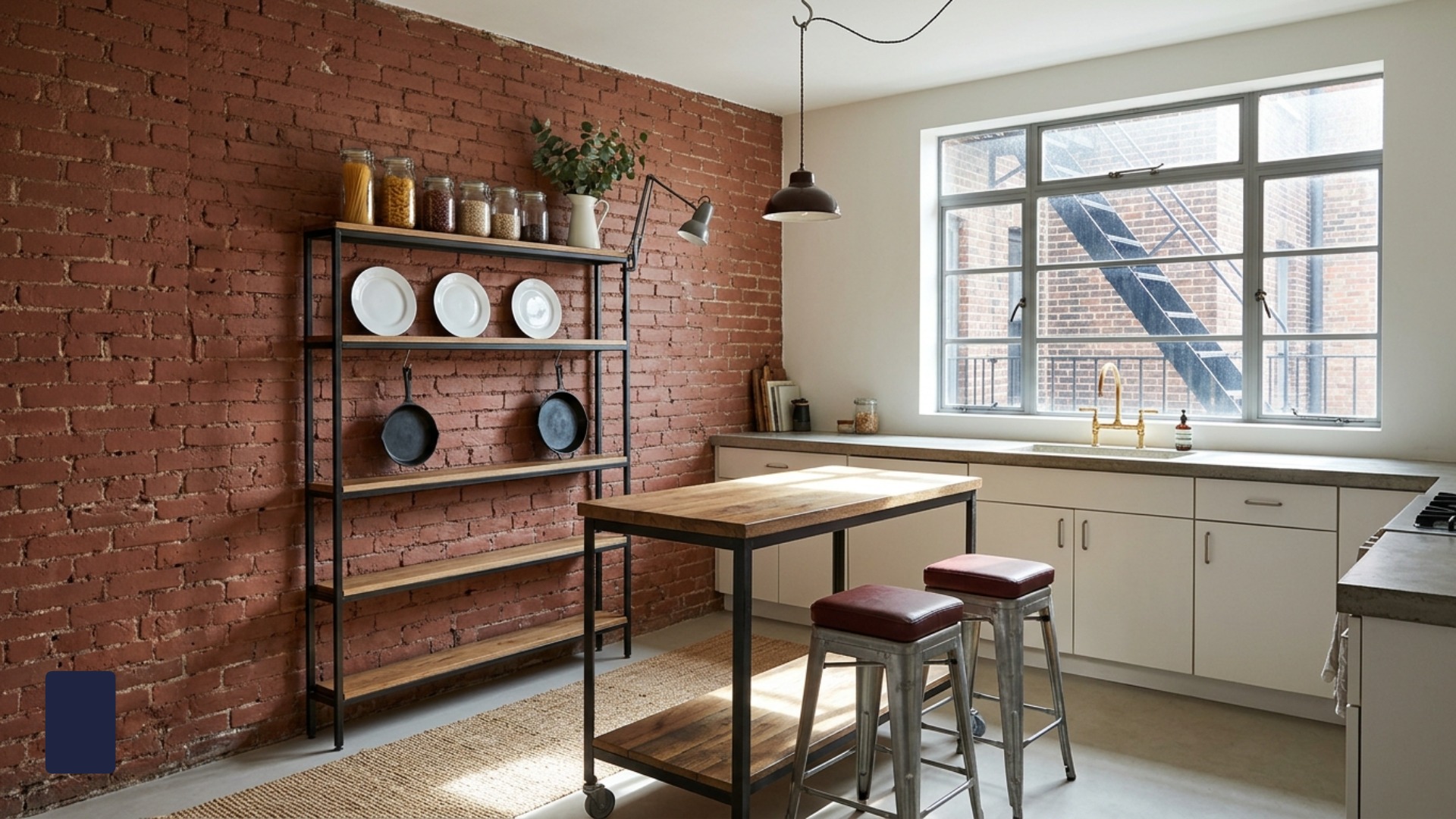
The real problem
Why this is harder than it looks
Every other style on this list lives in furniture. Industrial lives in the building. It reads as industrial because of brick, concrete, steel sash windows and services left visible on the ceiling, and a rental kitchen has almost none of that. What it has instead is white MDF cabinet doors, a laminate worktop, a vinyl floor and a ceiling light that came with the lease. Nearly every industrial kitchen article opens with painting the cabinets black and installing open shelving, and both of those are off the table before you start.
Strip the renovation advice out and what is actually left is more portable than it looks. Industrial is a position about honesty: materials shown as what they are, structure left visible, nothing dressed up to look like something more expensive. Translated into things you can buy and carry out at the end of the lease, that is raw metal, unfinished or reclaimed wood, and light coming from a bare functional fixture. Those three do most of the work, and none of them touch the building.
The hardest thing to accept is that the cabinets are not the problem. A plain white kitchen is a neutral background, and neutral backgrounds are exactly what a style built on strong materials wants. The trouble starts when people try to hide them, because a disguised surface reads as a disguised surface no matter how good the product photography was.
Which is the failure pattern here: peel and stick. Faux brick panels, marble effect contact paper, vinyl worktop wraps. They photograph acceptably, they read as costume in person, and on painted MDF they regularly take the finish with them when they come off. A deposit deduction costs considerably more than the steel shelving unit that would have worked.
A clear path
How to plan it
-
01
Leave the cabinets completely alone
This is the permission most renters need and almost nobody gives them. Plain white doors are a neutral field, and every strong material you bring into the room will read more clearly against them than against a half successful paint job. If the doors are genuinely dated, swap the handles for matte black or raw steel bar pulls at about $3 each and keep the originals in a bag for move out.
-
02
Bring in one real piece of metal, freestanding
A rolling island or a heavy duty shelving unit in blackened or galvanised steel with a reclaimed wood top is the single move that changes the room, and it typically costs $150 to $400. Buy the version with a real steel frame rather than a powder coated tube imitation, because the whole style rests on the material being genuine. Castors are worth paying for in a rental, since it can follow you to a kitchen with a different footprint.
-
03
Change the light, which is the cheapest structural move available
Hang a bare enamel or glass dome pendant from a ceiling hook with a fabric flex and plug it into the nearest socket, no electrician and no holes beyond one hook. Swap any under cabinet strips for warm 2700K, and add a clamp lamp like an Anglepoise 1227 on a shelf edge. Industrial light should look like it has a job, which is the opposite of a decorative flush fitting.
-
04
Put the tools on display instead of installing open shelving
You cannot fix a shelf to the wall, but you can lean a two tier steel unit against it, stand a knife block out, run a tension rod across a window reveal with S hooks for pans, and decant dry goods into plain glass jars. Cast iron, copper and steel earn their place on show. This gets you the honesty of open shelving with no drilling and nothing to make good later.
-
05
Test it against your actual kitchen before you buy the island
A rolling island is the largest object most renters put in a kitchen and the hardest to store if it turns out to be four inches too wide. Photograph the room and run it through Framehouse to see the steel and reclaimed wood against your own cabinet white, work out where the island can sit without blocking the oven door, and check whether the pendant hangs somewhere you will actually walk under.
Built for rental makeover
Moves that pay off
A rented kitchen has more fixed surfaces than any other room, so almost the whole budget should go into things that roll out with you. Six rules.
- Avoid peel and stick on cabinet doors and worktops entirely. On painted MDF it takes the finish off, and the deduction costs more than the furniture would have.
- Swap the cabinet handles and keep the originals bagged and labelled. It is reversible, it takes an hour, and it changes the room more than any adhesive product will.
- Put a washable runner on the vinyl. Kitchens are the one room where a rug earns its keep in comfort as well as looks.
- Spend on the island, the shelving unit and the lighting. Spend nothing on anything screwed to a wall or cut to fit one worktop.
- Ask about painting the walls, not the cabinets. Most landlords will agree to a neutral wall colour in writing and refuse cabinets, and the walls are the bigger surface anyway.
- Photograph the kitchen the day you move in, including inside the cabinets. Kitchens generate more deposit disputes than any other room.
industrial cues
What to keep, what to skip
Without the building on your side, industrial comes down to material honesty. Six things to hold.
- Palette: warm greys and blacks, raw metal, weathered wood and one deep saturated note. Oxblood, rust and forest green all work. Avoid cool blue grey.
- Materials: blackened and galvanised steel, reclaimed elm or pine, cast iron, unlacquered brass, enamel, glass and thick vegetable tanned leather.
- Structural signature: visible fixings. Bolt heads, welds, exposed flex on the pendant, castors left as castors. Anything that hides how a thing is made is working against you.
- Lighting: bare and functional. Enamel domes, caged glass, clamp lamps, warm bulbs, and nothing decorative for its own sake.
- Let the white cabinets be white. The style needs a quiet field to read against and the rental gave you one for free.
- Skip: faux brick panelling, printed concrete effect anything, Edison bulbs used as the whole idea, and signs with the word factory on them.
Use it for
What people plan with Framehouse
- Check whether a steel and reclaimed wood island actually fits with the oven door open
- See how blackened steel reads against your builder white cabinets before buying
- Test matte black handles on the existing doors without unscrewing anything
- Work out where a plug in pendant can hang without anyone walking into it
- Show a housemate the plan before a delivery that will not fit back in the box
Quick answers
Common questions
Make a plan you can act on
Skip the spiral of mood boards. Three minutes in the Aura Quiz turns your taste into a direction.
Take the Aura Quiz