Industrial Home Office Ideas for a Rental Makeover
Industrial is a hard style, and a home office is the one room you sit in for eight hours at a stretch. Getting both at once in a rental comes down to which surfaces you actually touch, and which ones only have to look right.
The real problem
Why this is harder than it looks
Industrial is a style of hard surfaces. Steel, concrete, brick, bare bulbs, unfinished timber. That is fine in a living room you pass through and much less fine in a room where you sit for forty hours a week, and this is the tension nobody writing about industrial offices seems to acknowledge. A steel stool looks superb in a photograph and is unusable by Wednesday. Sound is the other half of it, because hard rooms are loud rooms, and a home office is a room full of calls.
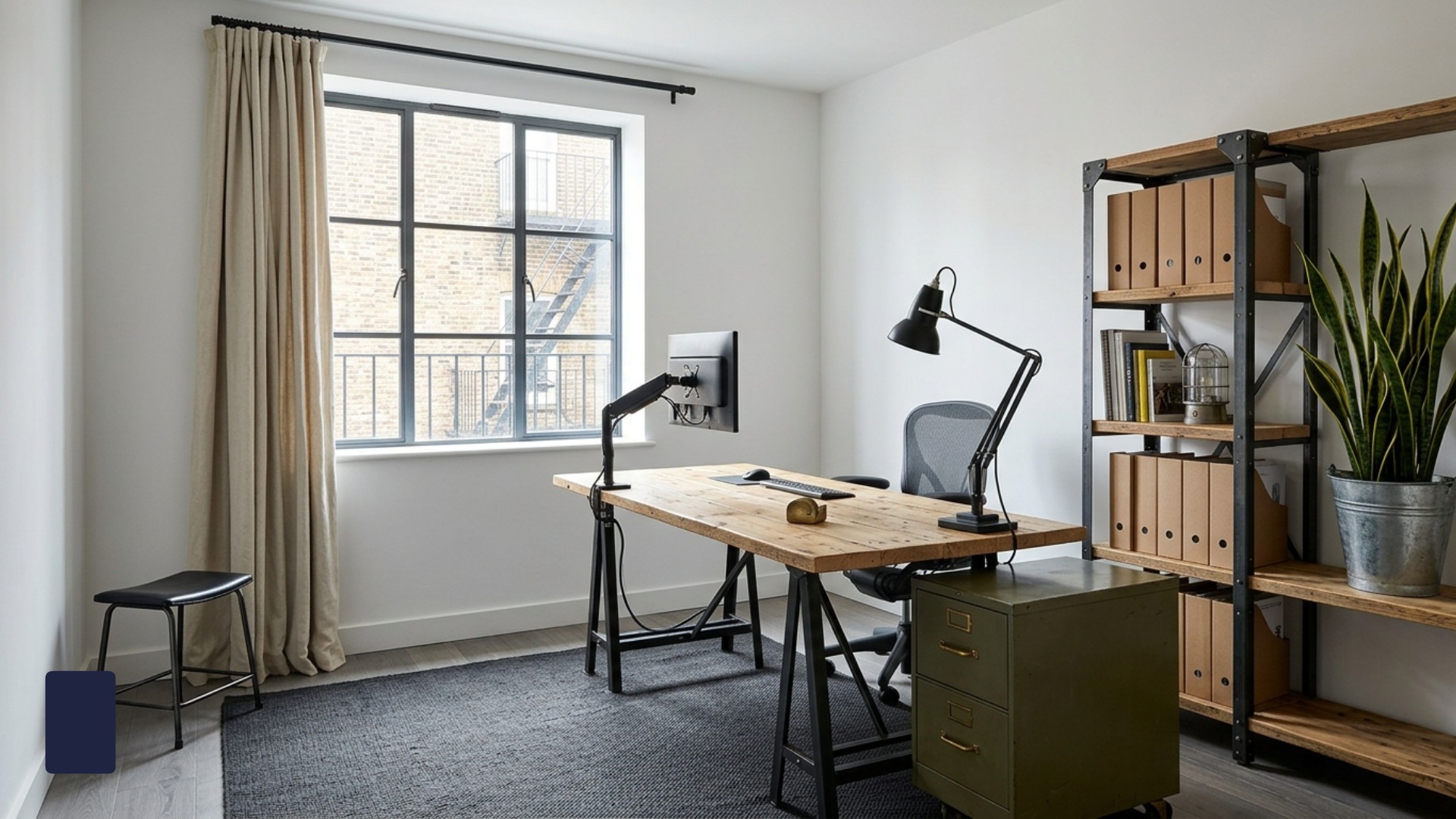
The resolution is straightforward once you name it: be industrial in everything you look at and soft in everything you touch. The desk top, the shelving, the lighting, the storage and the floor can all be raw steel and reclaimed timber. The chair, the rug and the window are where you break the rules on purpose. A good mesh task chair does not undermine an industrial room, and a thick wool rug under the desk is the cheapest acoustic treatment there is.
Renting removes the two moves this style usually depends on. You cannot expose brick and you cannot fix scaffold shelving to the walls, which is what most of the reference photography is actually showing you. What remains is more than enough: bolted freestanding shelving, a trestle desk with a visible frame, steel filing drawers on castors, and clamp lighting that grips the desk edge rather than the ceiling.
The failure pattern in an office specifically is cable management, or the absence of it. Industrial is a style built on showing how things are made, so a visible braided flex running cleanly along a skirting board reads as correct, while four white cables in a tangle behind a reclaimed pine desk reads as an unfinished room. It is twenty dollars of sleeving and an hour, and it does more than any single purchase after the desk.
A clear path
How to plan it
-
01
Buy the ergonomic chair and stop apologising for it
A mesh task chair in black on a black steel base sits inside the industrial vocabulary perfectly well, and a leather sling or a steel stool will hurt by the second week. Spend $300 to $700 here if you can, or buy a used Herman Miller or Steelcase, which turn up refurbished at around half of new and outlast everything else in the room. This is the one place where the style loses to your spine, and it should.
-
02
Put a thick wool rug under the desk before you buy anything else
Hard surfaces make a room echo, and echo is audible on every call you take. A dense low pile wool rug of at least 5 by 8 under the desk and chair kills most of it for $150 to $300, and it protects the floor from castor wear at the same time. Charcoal or heathered grey keeps the palette right without adding softness you can see.
-
03
Use a trestle or bolted frame desk, and let the frame show
A reclaimed pine top on a blackened steel A frame or a bolted trestle is the piece that establishes the style, typically $250 to $600, and it works because you can see how it is put together. Pull it four inches off the wall so the frame reads as a frame. Avoid anything where the metal is a decorative wrap around a particleboard core, since the whole style rests on materials being what they claim.
-
04
Clamp the light to the furniture instead of the building
An Anglepoise Original 1227 or a caged industrial clamp lamp grips the desk edge or a shelf upright and needs nothing from the ceiling, which is exactly the workaround a rental requires. Add a second source at a different height so you are not working in one flat pool of light, run both on warm 2700K, and let the flex be visible and tidy rather than hidden.
-
05
See the whole corner assembled before the desk ships
A trestle desk and a bolted shelving unit are both awkward to return and neither packs down small in an apartment. Photograph the corner and run it through Framehouse to check how blackened steel reads against your particular wall white, whether the desk can pull off the wall without blocking a doorway, and how much of the floor the rug needs to cover.
Built for rental makeover
Moves that pay off
A rented office is a room you will disassemble one day and sit in every day until then. Six rules that respect both.
- Every piece should be liftable by two people and rebuildable with an allen key. Bolted flat frames travel, welded one piece units frequently do not fit the next stairwell.
- Weight the budget toward the chair and the desk. Shelving, storage and lighting are all cheap in this style and look better secondhand anyway.
- Sleeve or clip your cables on day one. In a style built on visible construction, untidy wiring is the thing that reads as unfinished.
- Lean or stand your shelving, never fix it. A tall bolted unit with a wide base is stable against a wall without a single fixing.
- Buy used for anything steel. Old filing drawers, workshop shelving and lab stools are cheaper, better made and already have the patina the style wants.
- Photograph the room on move in and be careful with adhesive hooks on freshly painted walls. Rentals are repainted between tenancies and new paint releases easily.
industrial cues
What to keep, what to skip
In an office the style has to survive being used, so the rules bend in specific places. Six things to hold.
- Palette: blackened steel, reclaimed pine or elm, charcoal and landlord white, with one muted natural accent. Sage green, olive and rust all sit well.
- Materials: powder coated and raw steel, reclaimed timber with the nail holes left in, vegetable tanned leather, heavy canvas, kraft board, unlacquered brass.
- Structural signature: visible construction. Bolts, welds, trestle legs, exposed flex, castors left as castors, nothing boxed in or covered over.
- Lighting: clamp lamps and caged fittings, two sources at different heights, warm bulbs, and no decorative ceiling fixture.
- Break the rule where your body meets the room. Mesh chair, wool rug, canvas curtain. Everything you look at can stay hard.
- Skip: reproduction factory signage, Edison filament bulbs as the entire concept, faux rivets, and any steel look piece that is a laminate over particleboard.
Use it for
What people plan with Framehouse
- See whether a trestle desk can pull off the wall without blocking the door
- Check how blackened steel and reclaimed pine read against your particular wall white
- Work out how much floor a rug needs to cover to stop the room echoing
- Compare a mesh task chair against a leather one in the same corner before committing
- Show a housemate the layout before a desk arrives that cannot go back in the box
Quick answers
Common questions
Make a plan you can act on
Skip the spiral of mood boards. Three minutes in the Aura Quiz turns your taste into a direction.
Take the Aura Quiz