Organic Modern Studio Apartment Ideas for New Homeowners
Buying a studio changes the calculation completely, because for the first time the walls, the floor, and the kitchen are all yours to change. Organic modern is the style that rewards that permission most, since almost everything good about it is built in rather than bought.
The real problem
Why this is harder than it looks
Most studio advice is written for renters, which makes it quietly useless once you own the place. Renters are told to work around the surfaces: a rug over the bad floor, a screen in front of the bad wall, nothing permanent. As an owner you can change the surfaces themselves, and in a studio the surfaces are almost the entire room. Continuing to decorate around problems you are now allowed to fix is the most common and most expensive mistake in the first year.
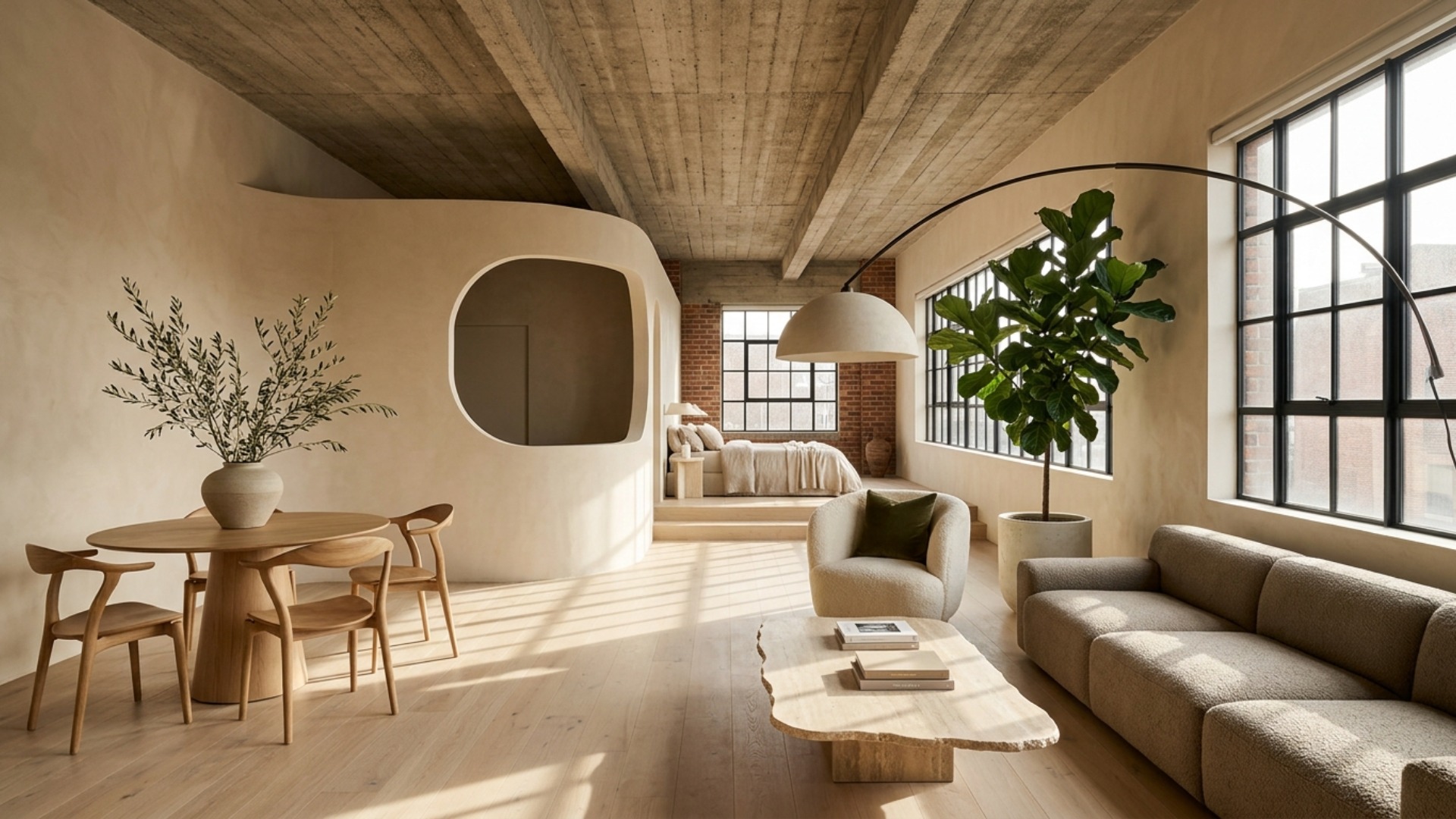
Organic modern is worth understanding properly here, because it is widely misread as a shopping category. It is not the bouclé chair and the arched mirror. It is a set of decisions about surface and form: plaster instead of flat emulsion, curves where a wall turns, one continuous floor, honest materials that show their making, and very few objects. Nearly all of that is fabric of the building rather than furniture, which is exactly why it suits an owner and frustrates a renter.
The studio you have bought is probably a rectangle with the kitchen at one end, one window wall, and a bathroom in the corner. The previous owner's choices are everywhere: a laminate floor in the wrong tone, gloss white cabinet doors, a ceiling light in the middle, and possibly a stud partition put up badly to make it a one bedroom. The instinct is to move in and furnish. The better instinct is to spend the first three months deciding what the shell should be.
The failure pattern is buying the furniture before touching the surfaces. A studio has room for roughly six pieces, so a sofa bought to suit the old floor commits you either to keeping that floor or to owning a sofa that fights the new one. Do the shell in the order that permanence dictates: floor, walls, kitchen fronts, then curves and joinery, then the six pieces.
A clear path
How to plan it
-
01
Decide the floor before you buy any furniture
One continuous floor running the entire studio is the single strongest move available to an owner, and it dictates every colour decision after it. Pale white oak engineered boards in a wide plank, laid in one direction throughout including under the kitchen, run roughly 60 to 110 dollars a square metre installed. Do not lay a different material in the kitchen zone. The break is what makes a studio read as small.
-
02
Replace the flat paint with plaster on at least one plane
This is the difference between organic modern and a beige room, and it is a finish rather than a purchase. Hand troweled lime plaster or a limewash in a warm cream gives walls depth that flat emulsion cannot, and it changes through the day as light moves across it. Doing the full studio is ideal at around 40 to 70 dollars a square metre, but even one plastered plane behind the sofa or the bed carries the whole room.
-
03
Reface the kitchen rather than replacing it
In a studio the kitchen is in the living room, so gloss white doors are visible from the bed. New fronts on the existing carcasses, in a pale oak veneer or a matte hand painted finish, typically cost a third of a new kitchen and take a weekend. Change the handles to something small in aged bronze or remove them entirely for a push catch, and the kitchen stops announcing itself.
-
04
Introduce one curve, and make it structural
The curve is the signature of organic modern and it is far more convincing built than bought. A curved plaster partition screening the sleeping area, a rounded opening instead of a square doorway, or a radiused plaster reveal at the window all cost a few hundred dollars in materials and a competent tradesperson's day. That is the version that reads as architecture. An arched mirror is the version that reads as a trend.
-
05
Model the shell changes in Framehouse before you commit to any of them
Floors, plaster tone, and a curved partition are permanent decisions taken in an empty room with no reference points, which is the hardest condition to judge anything in. Photograph the studio from the entry corner and use Framehouse to try the pale oak against the plaster cream, see where the curve should land, and check whether the kitchen disappears once the fronts change. These are five figure decisions in some cases, and this part costs nothing.
Built for new homeowner
Moves that pay off
Owning changes what is worth doing. The permanent work should happen first, while the studio is empty and there is nothing to move.
- Do the floor before you move in, or at least before the furniture is unpacked. It is twice the job afterwards.
- Budget for surfaces first, furniture second. In a studio the shell is most of what you see.
- Reface rather than replace the kitchen unless the carcasses are genuinely failing.
- If a previous owner built a stud partition, price removing it before you plan around it. It is often a day of work.
- Buy six good pieces rather than twelve adequate ones. A studio does not have room for a mistake.
- Do not buy the sofa first. It is the piece most likely to be wrong once the floor and wall tone are settled.
organic modern cues
What to keep, what to skip
Organic modern is mostly a set of surface and form decisions, which is why it belongs to owners rather than renters.
- Palette: warm plaster cream on the walls, pale white oak underfoot, honed travertine and warm greige in the furniture, one deep olive accent.
- Materials: hand troweled lime plaster, pale white oak, honed travertine, cream boucle, raw linen, blackened bronze, unglazed stoneware.
- Signature: a curve built into the room itself, a plaster partition or a rounded opening, rather than a curved object placed in it.
- Form: low, soft edged, and generous. Deep modular seating and organic edged tables rather than anything sharply rectilinear.
- Restraint: very few objects, each one large. Organic modern collapses into clutter faster than any other warm style.
- What to skip: cool grey, high gloss anything, three different metals, and the arched mirror as a substitute for a real curve.
Use it for
What people plan with Framehouse
- Test pale oak flooring against a warm plaster wall tone
- See where a curved partition should land before building it
- Check whether the kitchen recedes once the fronts are refaced
- Compare a deep modular sofa against a smaller frame at your real dimensions
- Show a partner the finished studio before committing to the floor
Quick answers
Common questions
Make a plan you can act on
Skip the spiral of mood boards. Three minutes in the Aura Quiz turns your taste into a direction.
Take the Aura Quiz