Organic Modern Kitchen Ideas for New Homeowners
Organic modern is the rare kitchen style that gets warmer as you live in it. Here is how to build it from the kitchen you inherited, in the order that actually matters.
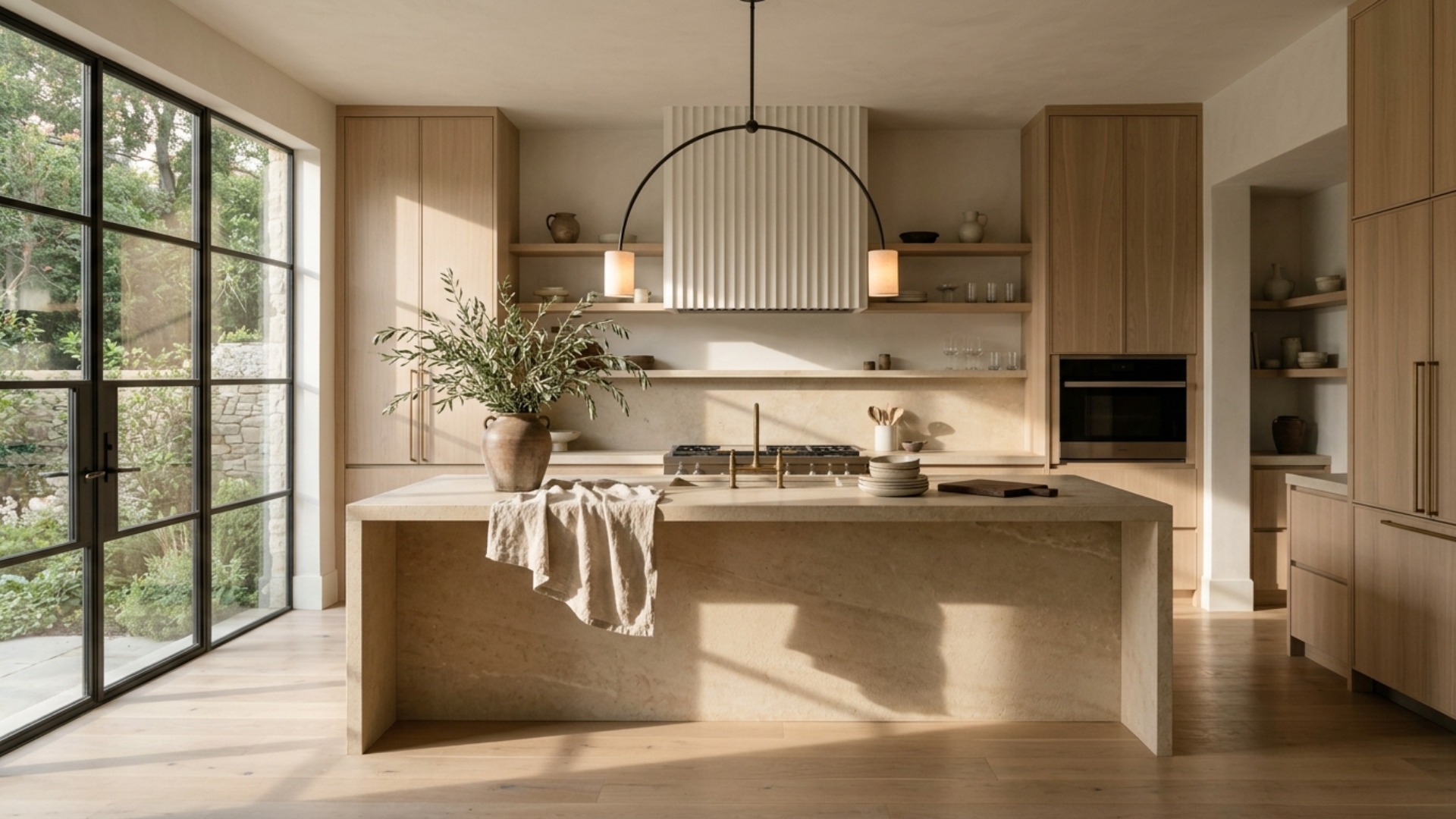
The real problem
Why this is harder than it looks
Organic modern is the most misread style in the kitchen. It photographs as warm minimalism, so people assume the work is subtraction, and they start by clearing the counters and painting everything white. Six months later the room is quiet and slightly lifeless, and nobody can say what is missing.
What is missing is texture. Organic modern is built on the tension between clean architectural lines and materials that show their origin: honed stone with visible movement, oak with real grain, unglazed ceramic, linen, plaster, aged brass. Take the texture away and you are left with plain contemporary. That is why the style is unusually forgiving for a new homeowner. You are not chasing perfect cabinetry, you are layering warmth onto whatever bones you have.
The typical starting point is a builder-grade kitchen: orange-toned oak or flat white shaker doors, speckled granite, a nickel bar-pull on every drawer, and a trio of small dome pendants. None of that is fatal. The palette and the hardware are doing most of the damage, and both are cheap to change. The counters are the one honest constraint, and there are ways to work with them for a few years rather than around them.
The failure pattern is buying the accessories first. A bouclé stool, a wooden bowl, a dried pampas stem in a vase. Objects cannot rescue a room whose color story is still fighting itself. Fix the palette, then the light, then the hardware. The styling is the last five percent, and by then you will already have the room.
A clear path
How to plan it
-
01
Audit the palette before you touch anything
Photograph the kitchen in daylight and name every color in it honestly. Orange oak, cool gray granite, and chrome are three separate stories. Organic modern needs one warm story, so decide which existing element you are building around and which you are neutralizing.
-
02
Neutralize the cabinets, warm the walls
Paint is the highest-leverage move in the room. A warm off-white or a soft greige on cabinets, paired with a wall in the same family one shade quieter, resets the whole space for a few hundred dollars. Avoid cool whites and anything with a blue undertone.
-
03
Change the hardware and the light in one weekend
Swap shiny nickel pulls for aged brass, bronze, or matte black in a slim tapered profile. Replace the builder pendants with one sculptural fixture in plaster, rattan, or blackened metal. These two changes read as a renovation and cost less than a single cabinet run.
-
04
Layer the textures that make it organic
Now add the materials that carry the style: a honed stone or wood cutting board left out, unglazed stoneware, a linen runner, one live branching stem in a heavy ceramic vessel. Aim for three or four textures repeated, not twelve introduced once.
-
05
Visualize it before you spend a dollar
Paint colors and hardware finishes are almost impossible to judge from a chip. Render your actual kitchen in organic modern first, test two or three cabinet colors against your existing counters, and only then buy. It is the difference between one paint order and three.
Built for new homeowner
Moves that pay off
New homeowners inherit a kitchen rather than choose one, and organic modern is unusually good at absorbing that. The moves that pay off first:
- Paint the cabinets a warm off-white or soft greige before you consider replacing a single door. Orange oak is a color problem, not a quality problem.
- Swap every pull and knob in the room. It is the cheapest change that alters how expensive the kitchen looks.
- Replace the builder pendant with one sculptural fixture. A single good light does more than three mediocre ones.
- Live with the existing counters for at least a year. You will know far more about how you cook, and about what the room actually needs, than you do on move-in week.
- Spend on the things you touch daily: a heavy wooden board, good stoneware, a linen runner. They are styling and equipment at the same time.
- Resist buying decor before the palette is settled. Objects bought to fix a room usually end up in a closet.
organic modern cues
What to keep, what to skip
Organic modern reads warm because of material contrast, not because of beige. The cues that hold up in a working kitchen:
- A palette of warm white, oatmeal, and oak, with one grounding accent in clay, bronze, or soft black.
- Stone with visible movement, honed rather than polished. Travertine, limestone, and warm-veined quartzite all belong.
- Wood with real grain left legible: white oak, ash, walnut used sparingly.
- Curves in at least one place. An arched fixture, a rounded stool, a soft-edged island profile.
- Living material somewhere: a branching olive or eucalyptus stem, not a symmetrical bouquet.
- What to skip: cool gray, high-gloss anything, three competing metals, and busy multicolor stone.
Use it for
What people plan with Framehouse
- Decide whether the inherited cabinets are worth painting or replacing
- Test warm off-white against your existing granite before buying paint
- Choose one pendant instead of relitigating it every week
- Sequence a first-year budget instead of spending it all in month one
- Show a partner what the finished kitchen will feel like
Quick answers
Common questions
Make a plan you can act on
Skip the spiral of mood boards. Three minutes in the Aura Quiz turns your taste into a direction.
Take the Aura Quiz