Japandi Home Office Ideas for New Homeowners
Japandi is the calmest way to turn a spare room into a place you can actually think. This page shows a new homeowner how to build a warm, uncluttered home office that works on day one and grows with the house.
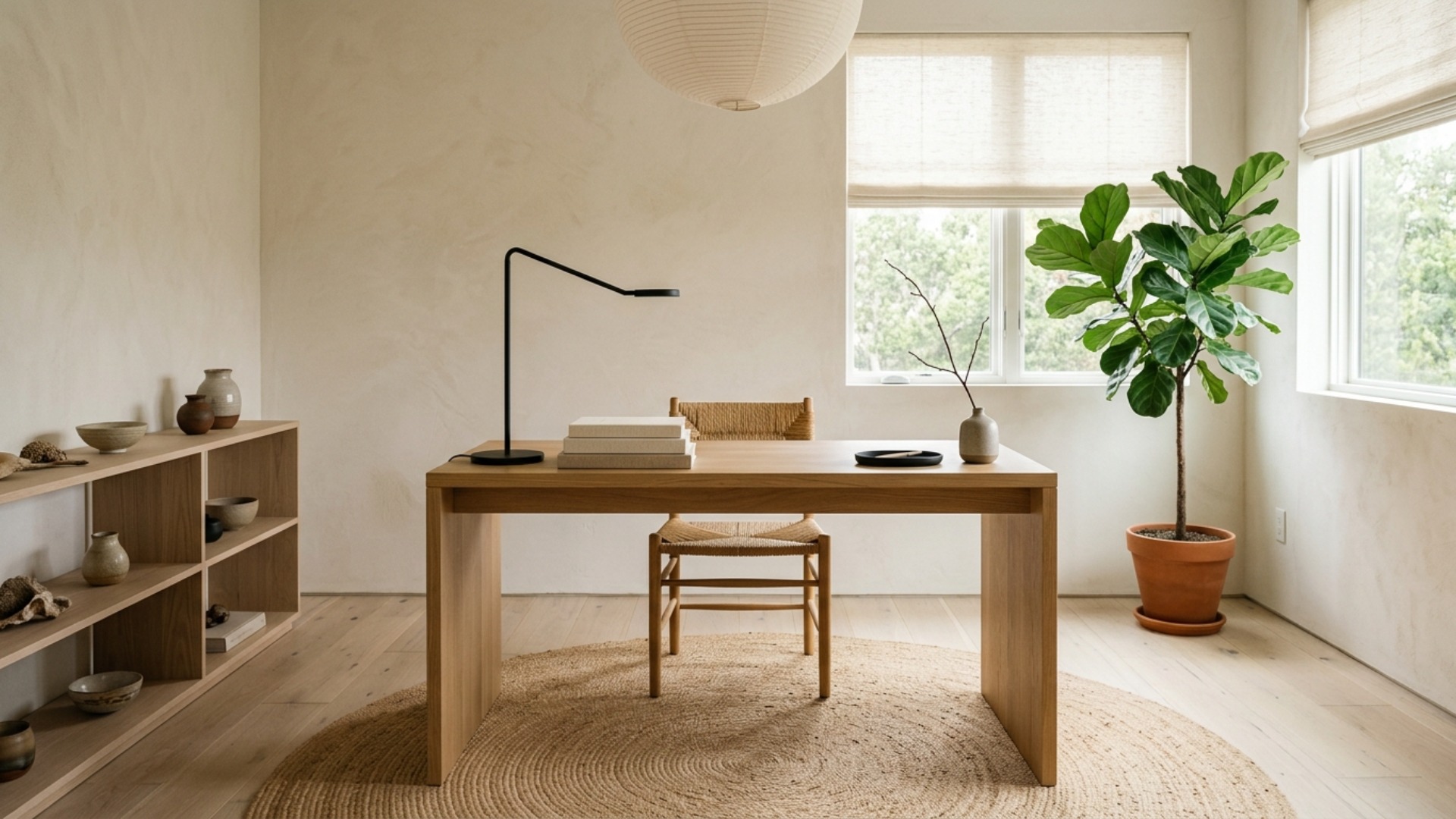
The real problem
Why this is harder than it looks
Japandi gets treated as a mood board: light wood, a beige rug, one spindly chair, and a caption about wabi-sabi. A new homeowner copies that mood board into a spare bedroom and ends up with a room that photographs well and works badly, because the desk faces a wall, the cables are everywhere, and there is nowhere to put the printer.
Japandi is not a color scheme, it is a discipline about what you allow into a room. It borrows the Japanese idea that empty space is a feature and the Scandinavian idea that everything should be useful and warm. In a home office that means the surfaces stay clear because storage is planned, not because you own nothing, and the calm is engineered rather than staged for a photo.
The situation for a new homeowner is that the office is usually the last room to get attention and the first to become a dumping ground. You are working in it before it is finished, boxes are still stacked in the corner, and every purchase competes with a kitchen or a roof. That pressure is real, and it is exactly why a restrained style is the right call: Japandi asks you to buy less, not more.
The failure pattern is spending on the visible props, the ceramic, the chair, the wall art, before solving the two things that actually decide whether the room works: where the desk faces and where everything hides. Get those right with what you own, and the room is already most of the way to Japandi before you buy a single beautiful object.
A clear path
How to plan it
-
01
Face the desk into the room, not the wall
Position the desk so you look out into the room or toward the window, not at a blank wall a foot from your nose. Japandi rooms feel calm partly because of sightlines, and an open view lowers the sense of confinement in a small office. If the only option is against a wall, hang one quiet piece at eye level and leave the rest of that wall bare.
-
02
Plan the storage before you buy a single object
Decide where the printer, cables, and paperwork live before you style anything, because visible clutter is the one thing Japandi cannot absorb. A low closed cabinet in pale oak, or a single set of matching boxes on a shelf, does more for the look than any decorative object. Aim for at least one closed surface for every open one.
-
03
Hold the palette to three warm neutrals plus black
Keep the room to warm white, oatmeal, and pale oak, with matte black as the only accent, on the lamp, the hardware, or a tray. This tight palette is what separates Japandi from generic beige, and it quietly hides the fact that your chair and your bookshelf came from different places. Avoid cool grays and any second wood tone.
-
04
Add warmth through texture, not color or pattern
Because the palette is so restrained, the room gets its life from materials: a wool or jute rug, a linen cushion, a paper shade, a ceramic mug. Layer three or four natural textures rather than reaching for a bright color or a bold pattern. This is the step that keeps a minimal office from feeling cold or unfinished.
-
05
Visualize the room before you commit spend
A new homeowner cannot afford to buy the wrong desk twice, and a pale oak finish is nearly impossible to judge from a website thumbnail against your own floor and light. Photograph the room and test the layout, the wood tone, and the wall color in Framehouse first. Seeing it finished before you spend is the difference between one confident purchase and three returns.
Built for new homeowner
Moves that pay off
A new homeowner should treat the office as a room that earns its budget slowly. Make it work first, make it beautiful second, and defer anything that can wait a season.
- Start with the desk and chair you already own, positioned well, and live with the room for a few weeks before buying furniture.
- Prioritize one good task chair over everything else, since it is the only piece you feel every working hour.
- Defer built-in shelving and any wall you would have to patch, because your use of the room may change once the house settles.
- Buy storage before decor. A single closed cabinet solves more than a cart full of ceramics and frames.
- Skip the matching office set. Japandi wants pieces chosen for proportion, and a set forces sizes that fit the catalog, not your room.
- Buy one item at a time and keep the receipts. Restraint is cheaper, and it is also the whole point of the style.
japandi cues
What to keep, what to skip
Japandi is Scandinavian warmth married to Japanese restraint. Keep the material list short and let empty space do the work.
- Palette: warm white and oatmeal on the walls and textiles, pale oak in the wood, and matte black as the single accent.
- Woods: light and matte, one tone only. Pale oak or ash, never glossy or orange, and never two competing wood species in one room.
- Signature move: negative space. Leave surfaces and walls deliberately empty, so the few objects present feel chosen rather than accumulated.
- Texture over ornament: wool, linen, paper, and unglazed ceramic carry the warmth, since no color or pattern is doing that job.
- Line and craft: low, clean-lined furniture with honest visible joinery, a woven chair, a paper lantern, nothing ornate.
- What to skip: clutter, cool grays, brass overload, and any decorative object that does not also earn its place.
Use it for
What people plan with Framehouse
- Test whether the desk should face the window or the room before you move anything heavy.
- Try a pale oak desk against a warm white wall in your actual daylight to see if the room reads warm or cold.
- Show a partner how a closed cabinet clears the clutter without shrinking the room.
- Check that a low bookshelf clears the window trim and radiator before you order it.
- Preview a matte black lamp against a pale oak desk to confirm the single accent lands.
Quick answers
Common questions
Make a plan you can act on
Skip the spiral of mood boards. Three minutes in the Aura Quiz turns your taste into a direction.
Take the Aura Quiz