Organic Modern Bedroom Ideas for New Homeowners
The bedroom is the one room a new homeowner can finish without a contractor, and organic modern is the style most forgiving of a just-moved-in budget. Here is how to build the calm, layered version rather than the beige showroom one.
The real problem
Why this is harder than it looks
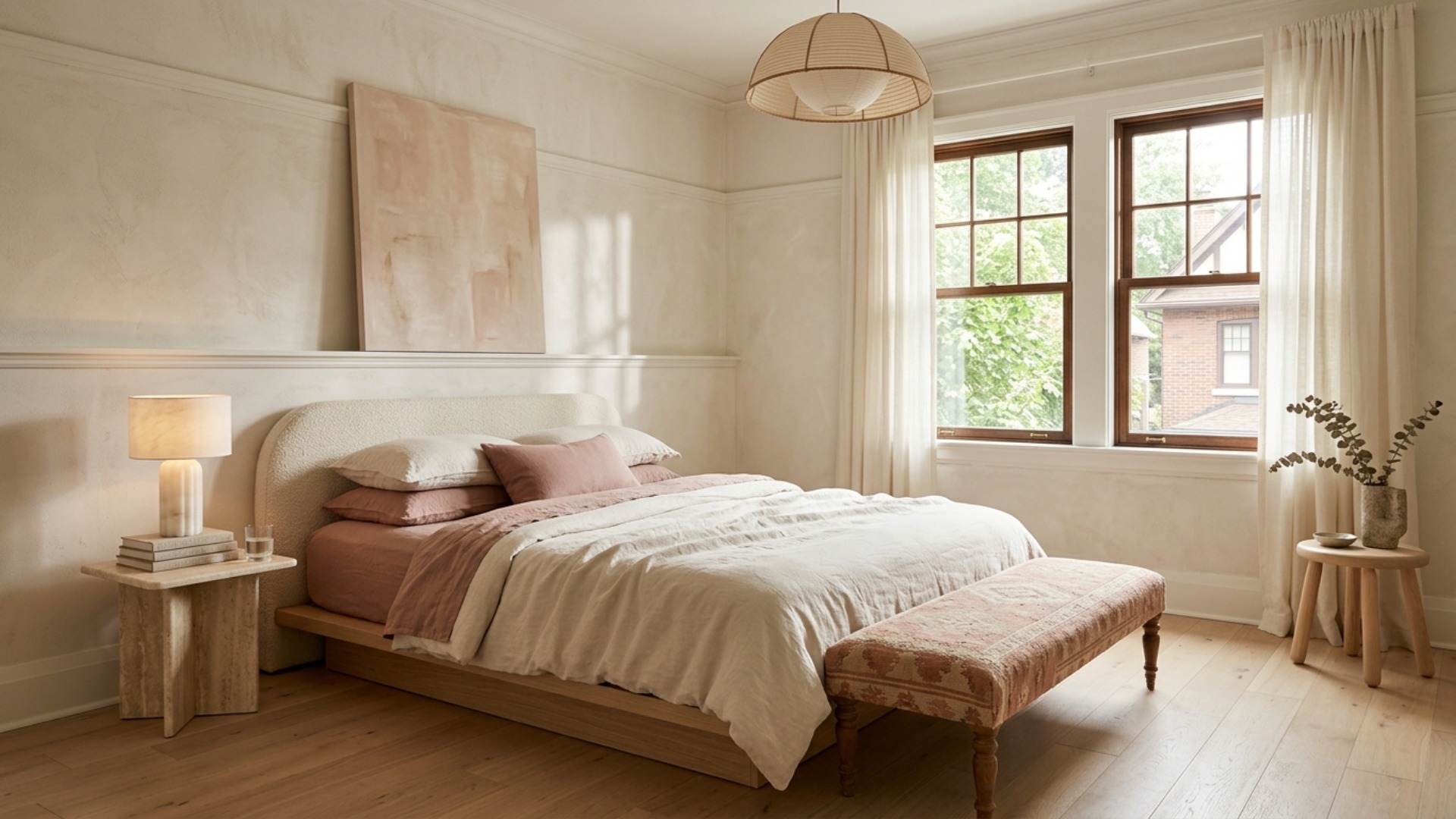
Organic modern gets flattened into a shopping list: boucle bed, travertine nightstand, arched mirror, done. That list produces the same beige room the entire internet bought last year, and it misses what the style actually is. Organic modern is a materials discipline. It builds calm from plaster, wood, stone, and cloth in their natural tones, then lets curves and texture do the work color would normally do.
For a new homeowner the style has a specific advantage nobody mentions: it is sequenced like a budget. The foundational moves, warm white walls and good bedding, cost hundreds, not thousands. The expensive sculptural pieces are additive and can arrive one per year without the room ever feeling unfinished. Compare that with maximalist styles that only work fully assembled.
The trap is treating the just-bought house as a blank canvas that needs filling by Sunday. New homeowners overbuy in month one, then spend year two regretting the fast-furniture bed that anchors the room. The other trap is cool undertones. One gray-white paint choice and the whole organic palette curdles into something clinical. Every white in this style should lean cream, and every gray should lean greige.
Your bedroom is also the room where the house's quirks matter least, no plumbing, no appliances, no traffic, which is exactly why it should be the first room you actually finish. A done bedroom funds the patience the rest of the house will need.
A clear path
How to plan it
-
01
Paint first, and stay strictly warm
Benjamin Moore Swiss Coffee or Sherwin Williams Alabaster on walls, ceiling, and trim in one warm envelope is the single highest-leverage move, about $150 in paint for an average bedroom. Test against your floors before committing: if the sample turns pink at dusk or gray at noon, shift one notch warmer.
-
02
Invest in the bed, borrow everything else
A low bed with a curved upholstered or pale oak headboard is the room's one non-negotiable purchase. Put the real money here and let nightstands stay mismatched for a year. A stack of two vintage stools or a thrifted wood chair works fine while you wait for the right travertine piece to appear.
-
03
Layer bedding in cloth, not color
Stonewashed linen in ivory, oatmeal, and one muted accent like clay or dusty rose, layered loosely rather than tucked hotel-tight. The rumple is the style. A washed linen duvet cover and two euro shams cost about $250 and change the room more than any wall art will.
-
04
Add one stone and one curve
A single honed travertine or marble surface, even a $60 remnant cut as a nightstand top, and one curved silhouette, an arched floor mirror or a rounded pendant, are what make the room read organic modern instead of neutral. Stop at one of each; duplicates dilute the effect.
-
05
Visualize the room in Framehouse before the big purchases
Photograph the empty bedroom and test paint, bed placement, and the oak-and-stone palette in Framehouse before ordering furniture. New homeowners are buying for rooms they have slept in for a week; seeing the finished version first is the cheapest possible insurance against a $2,000 bed that fights the light.
Built for new homeowner
Moves that pay off
A new homeowner's bedroom budget should respect the fact that the house will keep asking for money.
- Do paint, bedding, and window treatments in month one: under $700 total and the room feels intentional immediately.
- Buy the bed once, correctly. It is the only piece in this room that punishes a cheap first pass.
- Live in the room a full season before adding rugs and art: winter light will change what the room needs.
- Defer built-ins, closet systems, and hardwired lighting a year. Plug-in sconces do the job while the real priorities surface.
- Let the house supply character: restored original floors, window casings, and a repainted door beat new decor at the same price.
- Keep one wall empty on purpose. The restraint reads as confidence, and future-you will want the space.
organic modern cues
What to keep, what to skip
Organic modern holds together through materials, and falls apart through shortcuts. The cues:
- Palette: cream and warm white, oat, sand, greige, one earthy accent such as clay, rust, or dusty rose. Nothing cool-toned.
- Materials: white oak, limewash or matte plaster walls, honed stone, linen, wool, boucle, unlacquered brass in small doses.
- Shapes: low horizontal furniture, curved headboards, rounded mirrors, soft-edged pottery. Hard right angles stay in the minority.
- Light: warm and diffused, through sheers or paper and fabric shades. No exposed bright bulbs.
- Texture over pattern: if a textile has a print, trade it for one with a weave.
- Skip: gray-beige big-box sets, glossy surfaces, black window frames in the bedroom, and buying all the travertine at once.
Use it for
What people plan with Framehouse
- Test Swiss Coffee against your bedroom's actual light before painting the whole room
- See a curved oak headboard against your wall color before ordering the bed
- Compare clay against dusty rose as the accent in your real bedding
- Check whether an arched mirror crowds the wall the closet door swings across
- Show a partner the finished room before agreeing on the bed budget
Quick answers
Common questions
Make a plan you can act on
Skip the spiral of mood boards. Three minutes in the Aura Quiz turns your taste into a direction.
Take the Aura Quiz