Mid Century Modern Bedroom Ideas for New Homeowners
Mid century modern is the one style people can name from across a room, which is exactly what makes it easy to overdo in a bedroom. The version that lasts is quieter than the showroom version, and it starts with two decisions rather than twelve.
The real problem
Why this is harder than it looks
Mid century modern is the most recognisable style in the catalogue, and recognisability is the trap. Because the vocabulary is so distinct, tapered legs, walnut, a starburst, a sunburst, it is very easy to assemble a bedroom that reads as a reference rather than a room. The result is a space that looks like a set from a period drama and feels faintly uncomfortable to sleep in.
What is actually going on underneath the look is quieter than the look itself. The original mid century houses were built around light, low horizontals, and honest materials, with warm wood doing almost all the emotional work. The furniture was designed for small postwar rooms, which is why it sits low and keeps its legs visible: it was trying to give back floor. In a bedroom that principle matters far more than any particular chair. Low furniture with air underneath makes a modest room read as generous.
A new homeowner is usually working with a mixed inheritance. Some of the previous owner's choices are staying for a while, the bedroom probably has one overhead light and a builder grade closet, and the furniture in the moving truck was bought for a different room. Money is spread thin across the whole house, so the bedroom competes with a water heater and a fence.
The failure pattern is buying the theme instead of the principle. A full walnut bedroom set, a starburst clock, a shag rug, and an orange accent wall, all delivered in the same week. Mid century works best diluted: two or three genuinely good wood pieces, warm light, and a lot of restraint around them. One excellent walnut dresser in an otherwise plain room reads as taste. Five of them read as a furniture showroom that nobody lives in.
A clear path
How to plan it
-
01
Fix the light before you buy any furniture
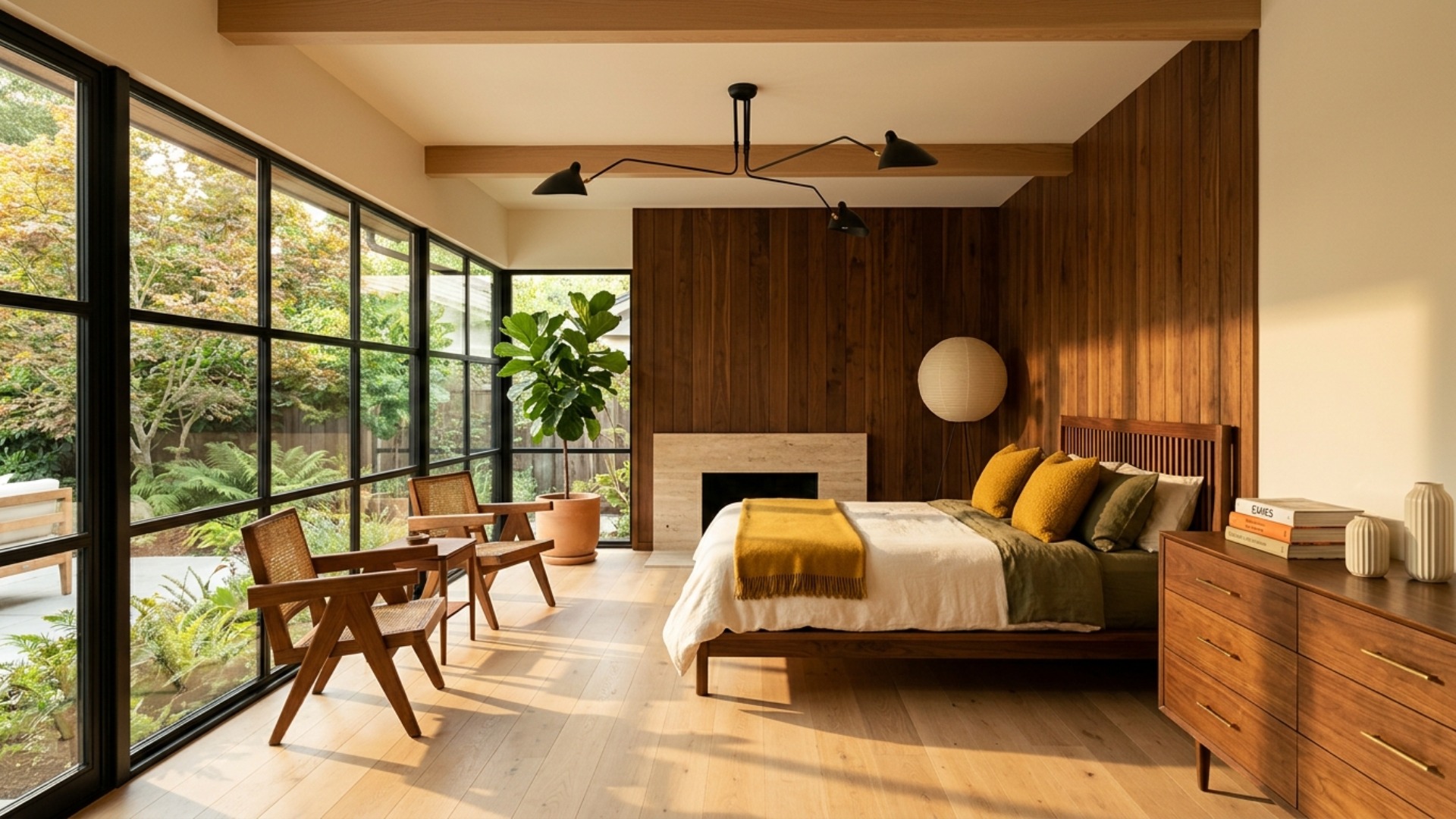
Mid century bedrooms live or die on warm low light, and almost every builder bedroom starts with one cold fitting in the middle of the ceiling. Put every bulb in the room at 2700K, add a dimmer, and get two light sources below eye level: a paper shade floor lamp in a corner and a small lamp or wall sconce beside the bed. This costs under 300 dollars and does more for the room than any single piece of furniture.
-
02
Buy one excellent walnut piece, not a matching set
Choose the dresser and make it the best thing in the room. A solid walnut nine drawer low dresser, vintage or new, in the 800 to 2000 dollar range will outlive three cheap ones and set the tone for everything else. Then let the bed frame be simple and the bedside tables be different from each other. A room where every wood piece matches reads as a set purchase, and mid century interiors were almost never furnished that way.
-
03
Keep everything low and leave the legs visible
This is the structural signature of the style and the reason it works in ordinary sized rooms. A platform bed at 30 to 40cm, a dresser under 90cm, and furniture that stands on legs rather than sitting on the floor all give back sightlines and make the floor read as continuous. If you are choosing between two dressers, take the lower one on legs even if it holds slightly less.
-
04
Add exactly one warm accent colour, and put it in textiles
Mustard, olive, burnt orange, and rust are all period correct, and one of them is enough. Put it in a wool throw, a cushion, or a rug rather than on a wall, because textiles are reversible and accent walls are not. If you want the colour permanently, walnut panelling or a single wood clad headboard wall does the job better than paint and will not date the way an orange wall does.
-
05
Test the walnut against your own light in Framehouse before ordering
Walnut photographs warmer than it looks in a north facing room, and bed height is nearly impossible to judge from a listing. Photograph the bedroom from the doorway and use Framehouse to try the walnut dresser against your wall colour, compare a low platform bed with a taller upholstered one, and see whether the mustard reads warm or dull in your light. A dresser is an expensive thing to return.
Built for new homeowner
Moves that pay off
Money is spread across a whole house in the first year, so the bedroom has to be built in stages that each look finished on their own.
- Do the lighting first. It is the cheapest change and the one that makes photographs of the room look right.
- Give the closet interior a weekend before you buy any extra storage. Most builder closets have a metre of wasted height.
- Buy the dresser used. Mid century is the one category where secondhand is both cheaper and better made than new.
- Live with the existing wall colour for a season. Walnut changes how a wall reads, and repainting twice is a wasted weekend.
- Defer the rug and the art until the furniture is placed, since both are sized against what is already in the room.
- Do not buy a bedroom set, a starburst clock, and a shag rug in the same month. Diluted is the whole point.
mid century modern cues
What to keep, what to skip
Mid century modern in a bedroom is warm wood, low horizontals, and one accent. Everything else stays plain.
- Palette: warm bone white walls, oiled walnut, white oak floor, deep olive, with a single mustard or burnt orange accent.
- Materials: oiled American walnut, woven cane, brushed brass, chunky wool, honed travertine, ribbed ceramic.
- Signature: low furniture on visible legs, so the floor reads continuous and the room feels wider than it is.
- Lighting: a paper shade floor lamp and a slim brass sconce, everything at 2700K and everything on a dimmer.
- Wood: mix walnut with oak or teak rather than matching. Two tones read as collected, one tone reads as a catalogue.
- What to skip: matching bedroom sets, starburst clocks, orange accent walls, and reproduction Eames anything.
Use it for
What people plan with Framehouse
- See how walnut reads against your bedroom wall colour before buying
- Compare a low platform bed with a taller upholstered frame
- Test mustard against olive as the single accent in the room
- Check whether a dresser fits the wall without blocking the closet swing
- Show a partner the finished room before committing to the big wood piece
Quick answers
Common questions
Make a plan you can act on
Skip the spiral of mood boards. Three minutes in the Aura Quiz turns your taste into a direction.
Take the Aura Quiz