Scandinavian Living Room Ideas for a Move-In Redesign
Moving in is the one moment when a Scandinavian living room is easy, because everything you own is still in a box and nothing has claimed a spot yet. This page covers what to place first, what to leave packed, and how to keep the room from filling itself.
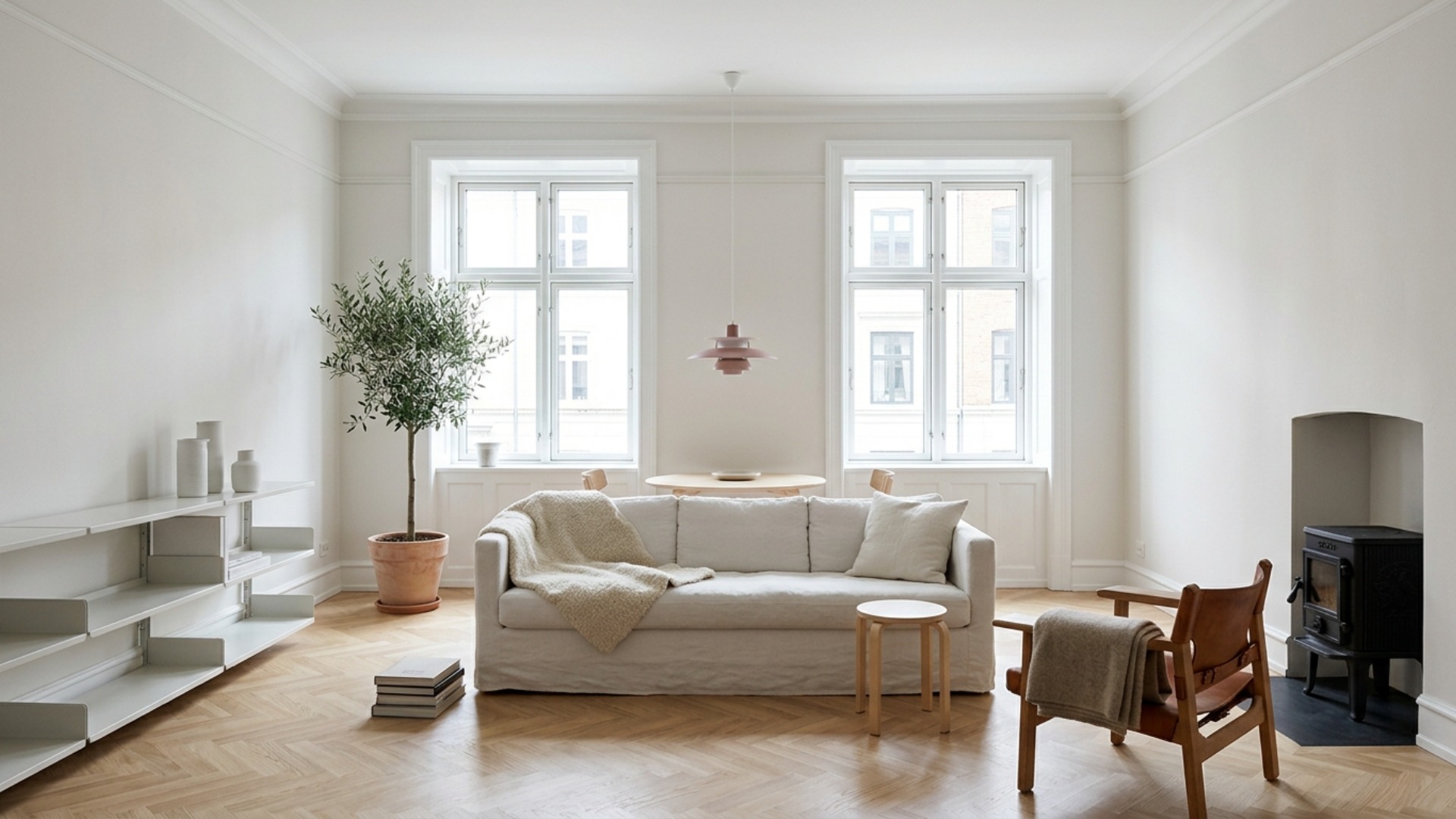
The real problem
Why this is harder than it looks
The common misreading is that Scandinavian is a shopping list. Buy the sheepskin, the paper pendant, the pale wood coffee table, the white sofa, and the look arrives. Then four boxes from the old apartment get unpacked on top of it and the room reads as a cluttered room that happens to contain Scandinavian furniture. The furniture was never the hard part.
Underneath, this is a subtractive style. Its actual signature is negative space and light: a lot of empty floor, one or two woods rather than four, walls left mostly bare, and a small number of objects that each earn their place. That is why it photographs so well and why it is so hard to hold onto. Every month a room gets slightly fuller, and Scandinavian is the first style to break when it does.
Which makes a move the best possible starting point, and most people waste it. For about two weeks everything you own is in cardboard, nothing has a home, and no habit has formed yet. That is the only time in the life of a room when leaving something packed costs nothing. Once a box is opened and its contents are distributed onto surfaces, getting them back off is a much harder conversation with yourself.
Two failure patterns dominate. The first is filling the room in week one: buying a rug before you have watched where the afternoon light lands, buying storage before you know what you actually kept. The second is going cold. Pure white walls, grey upholstery, and pale oak with no leather, no wool, and nothing older than six months produces a waiting room. Real Scandinavian interiors are full of worn things: a cognac leather chair, a hand thrown pot, one piece of furniture that belonged to someone else first.
A clear path
How to plan it
-
01
Stage the boxes anywhere except the living room
Put every unopened box in a bedroom or a garage and keep the living room empty while you work. This sounds like a logistics note and it is actually the whole method: a room you can see the floor of gets designed, and a room with a stack of cardboard in the corner gets tolerated. Give yourself two weeks of an underfurnished living room rather than two years of a full one.
-
02
Place the sofa in relation to the light, not the biggest wall
The instinct on day one is to push the sofa against the longest wall and be done. Instead, sit in the room at three in the afternoon and find where the light actually falls, then place the seating so people face into it or across it. In a prewar room with tall windows that often means floating the sofa a foot off the wall or running it perpendicular to the window, which costs nothing and changes the room more than any purchase.
-
03
Commit to one wood and one warm material
Pick a single wood tone for the room, usually blonde ash, birch, or a pale oak, and let everything structural agree with it. Then choose exactly one warm counterweight and repeat it two or three times: cognac leather, undyed wool, or raw terracotta. Two woods plus three textiles is where Scandinavian starts looking like a furniture catalog rather than a home.
-
04
Leave the rug, the art, and the shelving for month two
These are the three purchases people regret most after a move, because all three depend on information you do not have yet: how the room is actually used, where the traffic runs, and what the walls look like in evening light. Live with bare floor and bare walls for four to six weeks. A jute or flatweave wool rug and one large piece of art bought in week six will be better and usually cheaper than three small ones bought in week one.
-
05
Test the layout in Framehouse before anything heavy gets carried in
Sofa placement is the decision that is most expensive to change and easiest to test, especially in an unfamiliar room where you have no instinct yet for the proportions. Upload a photo of the empty living room, try the sofa floated versus against the wall, and see whether a pale ash palette actually reads warm in your light before the movers set it down and it stays there for a year.
Built for moving in redesign
Moves that pay off
A move gives you a short window of leverage. These are the moves that only work while the boxes are still closed.
- Do the painting before the furniture arrives, even if it means one more week on an air mattress. Painting around a furnished room is the job everyone postpones forever.
- Keep a written do not unpack list: the second set of dishes, the college posters, the decorative bowls, the spare lamps. Store the box for six months and donate it unopened if you never went looking.
- Bring the old sofa in last, or not at all. A sofa sized for a different room is the single most common reason a new living room never quite settles.
- Order window treatments in week one even though they take six weeks. Bare windows are the thing that makes a new apartment feel temporary, and the lead time is the constraint, not the decision.
- Buy nothing decorative for the first month. Buy function only: a lamp you need, a place to put keys, a chair to sit in.
- Take a photo of the empty room from the doorway before anything comes in. It is the best reference you will ever have for how much space the room actually had.
scandinavian cues
What to keep, what to skip
Scandinavian holds together on restraint and warmth in equal measure. Miss either one and it goes wrong in a predictable direction.
- Palette: chalk or bone white walls in a flat matte finish, blonde ash or birch on the wood, soft grey-taupe in the textiles, with one saturated accent such as dusty rose, ochre, or a deep green in a single cushion or pendant.
- Materials: birch plywood, blonde ash, natural linen, undyed wool boucle, cognac saddle leather, unglazed white stoneware, blackened cast iron. Matte throughout.
- The structural signature is bare walls and visible floor. Aim to leave two thirds of the wall area empty and to see a clear run of floor from the doorway.
- Warmth comes from age and hand work, not from color temperature. One leather piece, one hand thrown ceramic, one thing that is genuinely old will carry the whole room.
- Light needs three sources at three heights, all 2700K. Nordic interiors run bright by day and low and pooled at night, never a single ceiling fixture doing both.
- What to skip: grey on grey schemes, faux sheepskin on every chair, wall galleries of small frames, matched furniture sets, and anything in a cool blue white. Those are the four ways this style turns clinical.
Use it for
What people plan with Framehouse
- Test sofa placement in an unfamiliar room before the movers set it down
- See whether your old sofa is actually the right size for the new room
- Check a chalk white against the room's real afternoon light before painting
- Show a partner what an underfurnished room will look like finished
- Decide which pieces from the old apartment are worth keeping
Quick answers
Common questions
Make a plan you can act on
Skip the spiral of mood boards. Three minutes in the Aura Quiz turns your taste into a direction.
Take the Aura Quiz