Scandinavian Kitchen Ideas for a Move-In Redesign
The kitchen is the room a move fills fastest, and Scandinavian is the style that punishes clutter first. This page covers what earns counter space, what stays boxed, and how to keep all that pale wood from going cold.
The real problem
Why this is harder than it looks
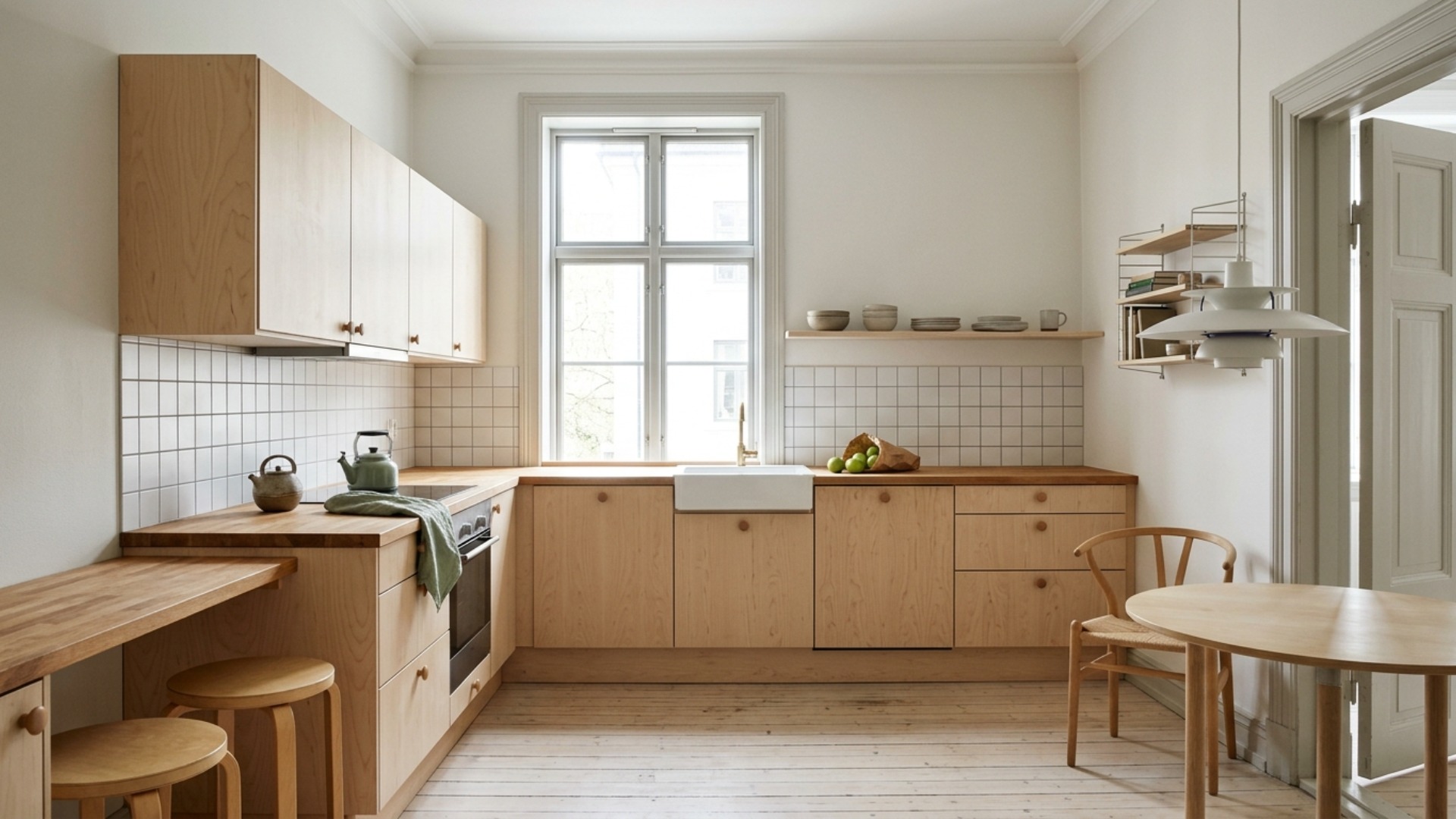
The common misreading is that a Scandinavian kitchen is a purchase: white cabinets, a butcher block counter, open shelves with a neat row of stoneware, done. But the kitchens people actually pin are not remarkable for what is in them. They are remarkable for what is not. No small appliance garage spilling onto the counter, no mug collection, no gadget drawer overflowing into view. The style lives or dies on visible surface, and no amount of birch can save a counter with a toaster, an air fryer, and a knife block fighting for it.
Underneath, Scandinavian is a subtractive style applied to the most additive room in the house. Kitchens accumulate faster than any other space because every object arrives with a justification: it is useful. That is exactly why the style breaks here first. A living room fills with things you chose. A kitchen fills with things you might need.
A move is the one chance to reset that math, and most people spend it badly. The first week in a new home, every kitchen box gets opened and every item gets a spot, because cooking dinner tonight feels urgent. Six months later the counters are exactly as full as they were in the old place, and the pale cabinets just make the clutter easier to see.
The other failure is temperature. An all-white kitchen with grey tile and no wood, no ceramic, and nothing handmade reads as a rental waiting for its next tenant. Scandinavian kitchens earn their calm through warm materials, not through emptiness alone. If you strip the counters and the room still feels cold, the problem is the palette, not the stuff.
A clear path
How to plan it
-
01
Unpack the kitchen in passes, not in one weekend
Open only the box marked daily: the pans you cook with, plates for the people who live there, the coffee setup. Leave everything else sealed for a month and unpack an item only when you go looking for it. Whatever is still boxed at day thirty is a donation, not a decision.
-
02
Set the counter rule before the toaster finds a home
Decide now what lives on the counter permanently, and keep the list to three: usually the kettle or coffee maker, one board, and a crock of the four utensils you actually reach for. Everything else gets a cabinet or a shelf. A rule made on day one costs nothing. The same rule imposed on a settled kitchen is a fight.
-
03
Commit to one wood and one warm accent
Pick a single pale wood, birch, ash, or white oak, and let the cutting boards, stools, and any open shelf agree with it. Then add exactly one warm accent repeated two or three times: a sage green enamel kettle, terracotta pots, or cognac leather stool seats. If the walls need paint, use a chalk white like Benjamin Moore Chantilly Lace, and avoid anything with a blue undertone.
-
04
Fix the lighting before you judge anything else
Most kitchens ship with one cold ceiling fixture, and it makes even a good kitchen look like a break room. Swap the bulbs to 2700K, add plug-in under-cabinet strips for the work zones, and hang one pendant low over the table or counter you eat at. This is an afternoon and about $150, and it changes the room more than any purchase twice its price.
-
05
Test the expensive moves in Framehouse first
Cabinet paint, open shelving, and new stools are the three purchases people regret in a kitchen, because all three are nearly impossible to judge from a swatch or a listing photo. Upload a photo of your actual kitchen, try the chalk white against your real light, and see the counters styled before you commit the weekend or the budget.
Built for moving in redesign
Moves that pay off
A move gives the kitchen a short window where restraint is free. These are the moves that only work while the boxes are still closed.
- Unpack in passes and keep a sealed do not unpack box for the duplicate gadgets, the novelty mugs, and the appliance you used twice last year. Donate it unopened if six months pass.
- Cook for the first two weeks with what fits in one cabinet. It tells you exactly which tools you actually use, which no amount of planning can.
- Measure the counter overhang and doorway clearances before bringing the old stools. Seating sized for a different kitchen is the most common carryover mistake.
- Order any cabinet hardware and window treatment in week one. The lead time is the constraint, and bare windows keep a kitchen feeling temporary.
- Buy nothing decorative for the first month. Function only: a lamp for the dark corner, a tray for the oils, a bin that fits the cabinet.
- Photograph the empty kitchen from the doorway before a single box comes in. It is the best record you will ever have of the room's actual surfaces.
scandinavian cues
What to keep, what to skip
Scandinavian holds together on restraint and warmth in equal measure. In a kitchen, both are decided at the counter.
- Palette: chalk or bone white on walls and cabinet fronts, blonde birch or ash in the wood, grey-taupe in the textiles, and one muted accent such as sage, dusty rose, or ochre in a single kettle or towel.
- Materials: beech butcher block, birch plywood, white square tile with pale grey grout, linen, unglazed stoneware, cast iron. Matte everything, including the faucet.
- The structural signature is one open shelf, not a wall of them. A single long run of ash holding eight objects reads as calm. Three crowded shelves read as storage.
- Warmth comes from wood and handmade ceramics, not from color. One hand thrown teapot does more than a whole accent wall.
- Light at three heights, all 2700K: under-cabinet for work, one low pendant for eating, one small lamp on the counter for evenings.
- What to skip: grey on grey schemes, glossy handleless fronts, crammed open shelving, matching canister sets, word art, and anything in a cool blue white.
Use it for
What people plan with Framehouse
- Test a chalk white against your kitchen's real light before painting
- See your counters styled with three objects instead of thirteen
- Check whether butcher block will fight your existing floor tone
- Show a partner the finished kitchen before the boxes are even open
- Decide if the old stools are worth moving or worth replacing
Quick answers
Common questions
Make a plan you can act on
Skip the spiral of mood boards. Three minutes in the Aura Quiz turns your taste into a direction.
Take the Aura Quiz