Japandi Kitchen Ideas for a Move-In Redesign
The best time to make a kitchen calm is the week you move in, before the counters fill and the habits set. Japandi is the ideal style for that window, and this page shows how to get its warm, uncluttered look without a renovation.
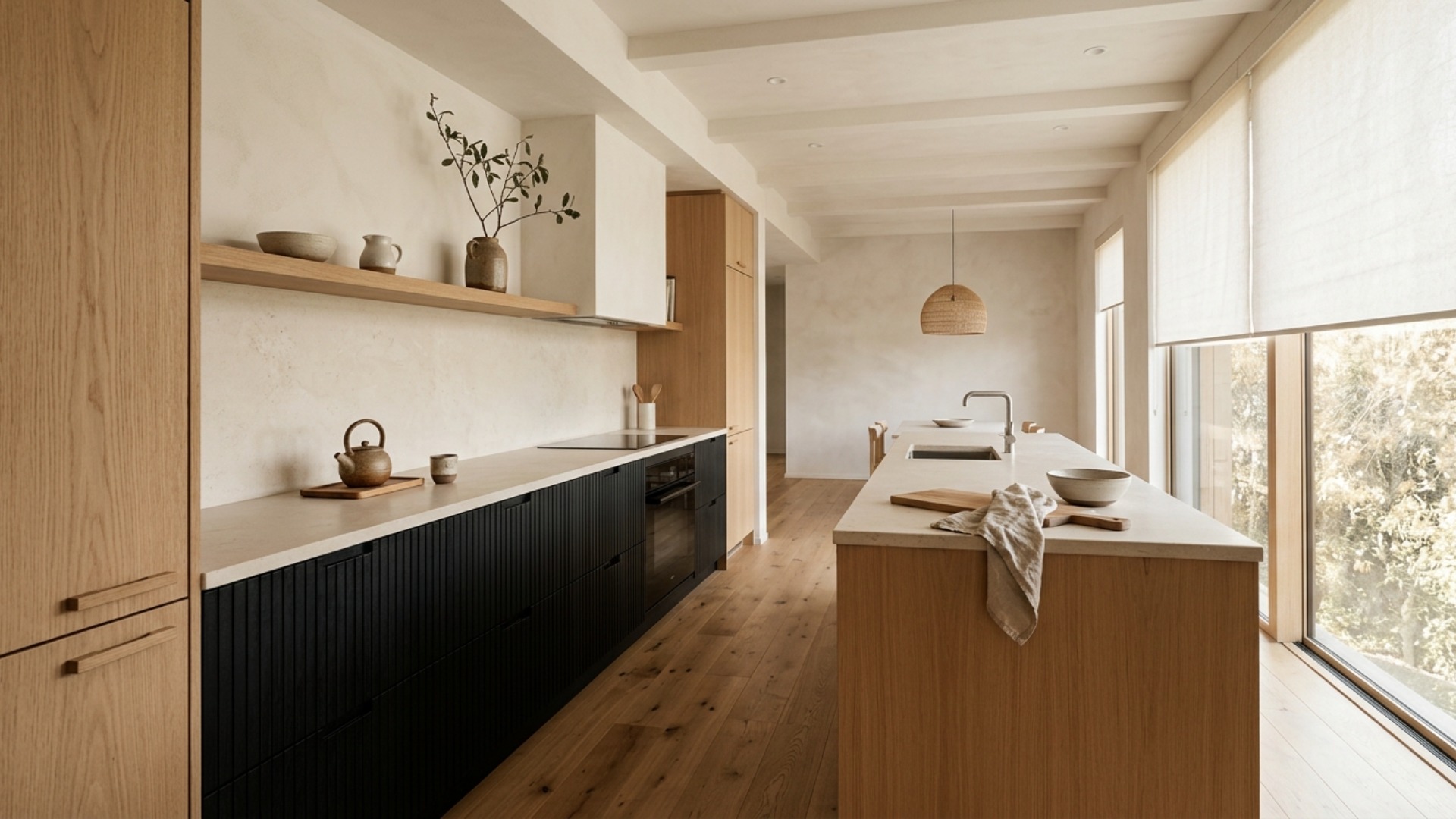
The real problem
Why this is harder than it looks
Japandi reads as a shopping list to a lot of people: get the light oak, the matte black handles, the beige stoneware, done. But a Japandi kitchen assembled from a moodboard usually lands as a showroom, pretty and slightly lifeless, because the style is not about the objects. It is about restraint and craft, two things you cannot buy in a single order.
Japandi is the meeting of Japanese minimalism and Scandinavian warmth, which means it lives on a tension: pared back but never cold, natural but highly considered. In a kitchen that translates to a few honest materials, visible craft, and almost nothing on the counter. The hard part is the discipline, not the palette, and that discipline is far easier to hold at the start than to claw back later.
Moving in is the rare moment when the kitchen is empty and every decision is still open. The cabinets are whatever the previous owner or builder left, the counter is bare, and you have not yet formed the habit of dropping keys and mail by the kettle. This is your one low-friction window to decide what the kitchen will hold and what it never will, before the boxes make those choices for you.
The common move-in mistake is unpacking everything onto open surfaces to feel settled, then buying storage later to deal with the result. Japandi asks you to reverse that: decide the calm state first, give every item a closed home as you unpack, and leave the counter almost bare from day one. Resist the urge to fill the new place, and the style holds itself together.
A clear path
How to plan it
-
01
Unpack into closed storage, not onto the counter
As you unbox the kitchen, put everything behind a door and keep the counter to one or two objects. This is the single most Japandi decision you will make, and it is free. The moving week is the only time the counter starts empty, so treat that blank surface as the goal state rather than a temporary phase.
-
02
Warm the existing cabinets before replacing them
You rarely need new cabinets. Swap the handles for slim matte black or unlacquered brass, and if the fronts are dated, peel-and-stick oak veneer or a warm off-white like Farrow and Ball Pointing gets you most of the way for under two hundred dollars. Japandi is about finish and restraint, both of which you can change without a renovation.
-
03
Add one wood and one stone gesture
Introduce visible craft with a couple of natural pieces: an oak cutting board left out, a stoneware crock, a small open oak shelf with three handmade bowls. Japandi wants a little warmth and texture against the calm, so one wood element and one ceramic grouping do more than a full styling haul, and they read as lived-in rather than staged.
-
04
Set a low, warm light and a single black accent
Swap a harsh ceiling fixture for one warm 2700K source, a paper-shade pendant or a slim under-cabinet strip, and let a single matte black element, the tap, the handles, or a slatted panel, be the one dark note. Warm light and one black line are the whole Japandi mood, and both are quick, reversible move-in changes.
-
05
Visualize it in Framehouse before you commit
Before you buy paint or veneer, test the oak tone and the off-white against your actual cabinets and light, because Japandi lives or dies on getting the warmth exactly right. Drop your new kitchen into Framehouse, try the finishes and the one black accent in place, and confirm the room reads calm and warm rather than flat before you spend a moving-week dollar.
Built for moving in redesign
Moves that pay off
The move-in window is short and valuable. Spend it on the decisions that are hard to reverse later and easy to make while the kitchen is empty.
- Decide the counter's calm state before you unpack, and give every appliance and utensil a closed home as it comes out of the box.
- Do the reversible finish changes first, handles, veneer, paint, while the cabinets are empty and easy to work on.
- Live with the layout for a week before buying anything. The kitchen the builder left may work better than you expect once it is decluttered.
- Skip the full appliance upgrade at move-in. Get the counter clear and the finishes warm first, then decide over the coming months what actually needs replacing.
- Keep the moving boxes as your filter: if something has not left a box in two weeks, it does not need a spot on the counter.
- Buy closed storage before decorative pieces. In Japandi, the storage is the styling, because it is what keeps the surfaces bare.
japandi cues
What to keep, what to skip
Japandi is Scandinavian warmth meeting Japanese restraint. These cues keep a kitchen calm and warm rather than cold or cluttered.
- Palette: warm white, light oak, and matte black, with one muted clay or sage accent. Keep it warm; a cool or gray Japandi tips into austere.
- Materials: light wood, honed stone, matte ceramic, linen, and paper. Visible grain and handmade texture are the point, so avoid anything high gloss.
- Craft: let a few handmade objects show, a stoneware mug, a wooden board, an imperfect bowl. Japandi values the mark of the maker over the flawless and machined.
- Line: strict, simple geometry with slim profiles. Slatted wood, recessed pulls, and clean horizontals give the calm its structure.
- Restraint: almost nothing on the counter, one small grouping on a shelf. The empty surface is a feature, not a lack.
- What to skip: warm brass overload, busy pattern, clutter, and cottage or farmhouse touches. Japandi is quiet and precise, not cozy-rustic.
Use it for
What people plan with Framehouse
- Test an oak veneer against your builder-grade cabinets before ordering a roll.
- Compare matte black against unlacquered brass handles on your actual doors.
- See whether a warm off-white or the existing color reads calmer in your light.
- Show a partner the calm counter goal before the boxes get unpacked.
- Decide which single element should carry the one black accent.
Quick answers
Common questions
Make a plan you can act on
Skip the spiral of mood boards. Three minutes in the Aura Quiz turns your taste into a direction.
Take the Aura Quiz