Industrial Bedroom Ideas for a Move-In Redesign
A move is the rare moment when a bedroom is a blank slate, and industrial style rewards that head start more than most. This page shows how to redesign a bedroom as you unpack, so the room feels warm and grounded rather than cold and half-finished.
The real problem
Why this is harder than it looks
Industrial style has a reputation problem in a bedroom. People picture a coffee shop: raw concrete, a wall of Edison bulbs, black pipe shelving, and a bed that looks like it belongs in a warehouse. Copied literally into a room you sleep in, that reads cold and a little performative, which is the opposite of what a bedroom is for.
The mistake is treating industrial as a set of props rather than a balance. Real industrial interiors work because hard materials, steel, brick, concrete, are offset by warm ones: walnut, aged leather, wool, and soft light. Take away the warm half and you get a garage. The whole skill of the style is the ratio, and a bedroom needs more warmth in that ratio than a living room does.
Moving in is the ideal time to get that ratio right, because you are placing everything from scratch and nothing is anchored yet. It is also the moment you are most likely to rush: you want the bed built and the boxes gone, so you buy a frame and a lamp fast and call it done. That speed is where the cold, unfinished version comes from.
The failure pattern is buying the hard, statement pieces first, the metal bed, the pipe shelf, the concrete lamp, before you have placed a single warm or soft thing. Reverse the order. Start with the bed you will actually sleep well in and the textiles that make the room feel human, then add the industrial edge in measured doses.
A clear path
How to plan it
-
01
Place the bed before you unpack around it
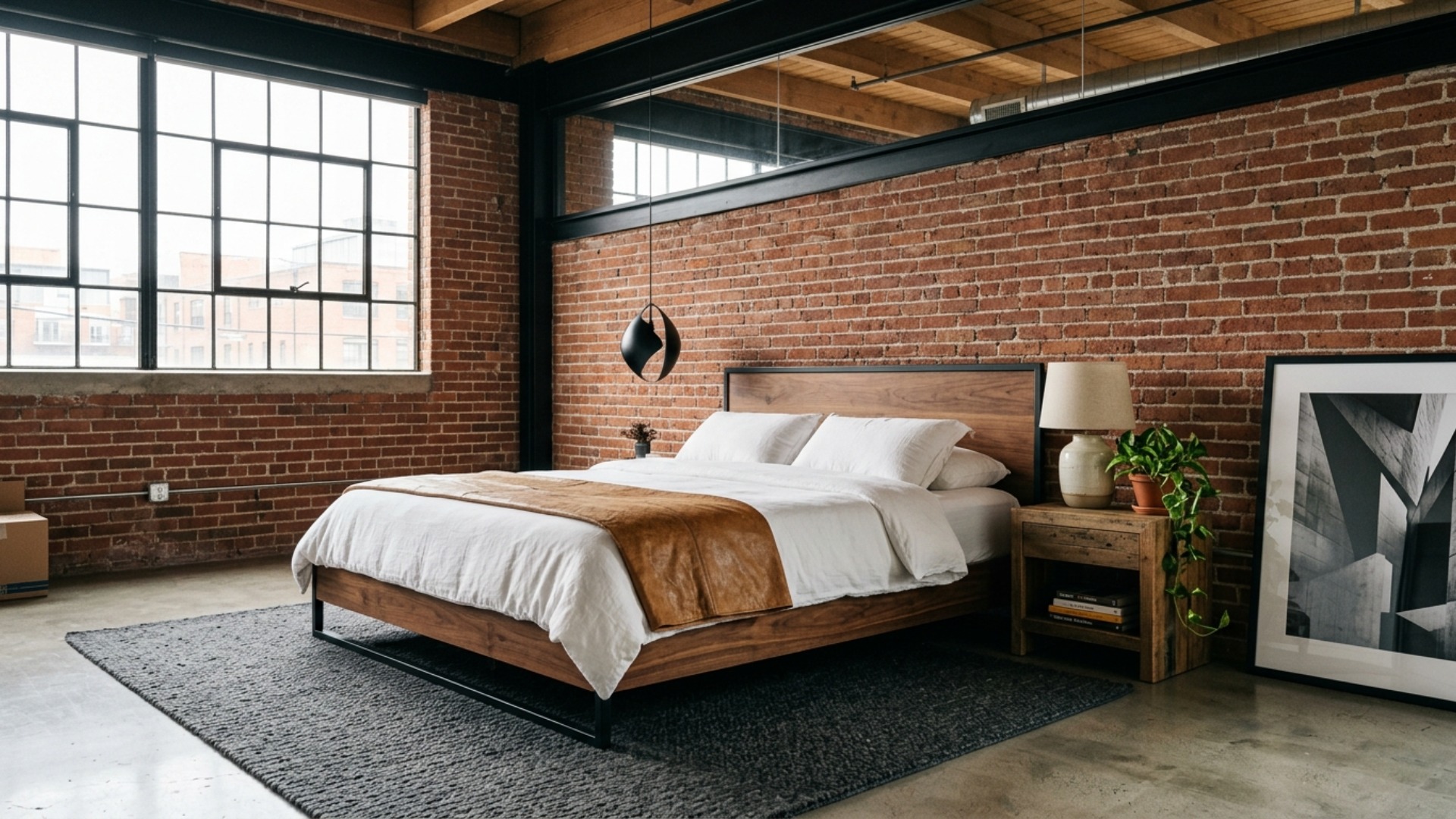
While the room is empty, decide where the bed goes based on the light and the wall you want it against, ideally an exposed brick or a plain wall that can carry a strong headboard. Industrial rooms lean on one dominant feature wall, so choose it now before boxes dictate the layout. A low walnut platform bed grounds the room and reads warmer than a bare metal frame.
-
02
Set the warm-to-hard ratio at about two to one
For every hard industrial material, brick, steel, concrete, add two warm or soft ones: walnut, leather, wool, linen. In a bedroom that means a walnut bed and nightstand, a wool rug, and linen bedding balancing a steel light and a brick or concrete surface. This ratio is the difference between a warm loft and a cold basement.
-
03
Light it warm and layered, and go easy on Edison bulbs
Skip the wall of exposed filament bulbs, which is the most dated move in the style. Use one sculptural black metal pendant or a matte task light by the bed, warm 2700K bulbs, and a dimmer so the room can go soft at night. Industrial lighting should read as considered fixtures, not a theme.
-
04
Add leather and wool to take the edge off
A caramel aged-leather bench at the foot of the bed, a charcoal wool rug underfoot, and a linen or wool throw are what make an industrial bedroom feel like a place to sleep. These warm textures are non-negotiable in a bedroom, since bare concrete and steel alone read institutional. Layer at least two of them near the bed.
-
05
Visualize the room before you commit spend
Moving in is expensive, and an industrial palette is easy to push too cold without noticing until the furniture arrives. A walnut tone or a leather color reads differently against your actual brick and light. Photograph the room and test the materials, the bed placement, and the balance in Framehouse first. Seeing it finished before you buy protects a move-in budget that is already stretched.
Built for moving in redesign
Moves that pay off
A move-in is a rare blank slate, so sequence the room deliberately rather than buying just to empty the boxes. Solve sleep and layout first, then add the industrial character.
- Place the bed and live with the layout for a few nights before buying anything large, since first instincts about a new room are often wrong.
- Unpack the bedding and a lamp first so the room is usable on night one, then design around that instead of rushing furniture.
- Prioritize the mattress and bed over statement decor, because it is the one thing you feel for eight hours a night.
- Defer open pipe shelving and heavy wall-mounted pieces until you know the room, especially with brick or plaster you would have to repair.
- Skip the matching industrial set. The look depends on mixing materials and eras, and a set flattens that into a showroom.
- Keep the flattened boxes for a month. You may reposition once you know how the light moves through the room.
industrial cues
What to keep, what to skip
Industrial is hard materials warmed by soft ones. Keep the hard elements honest and real, and let warmth and light do the balancing.
- Palette: warm walnut and caramel leather against blackened steel, brick red, and soft charcoal or concrete grey.
- Materials: real over faux. Genuine aged leather, solid walnut, actual brick or concrete, and matte black metal, never printed brick wallpaper or fake distressing.
- Structural signature: one honest hard surface as the anchor, an exposed brick wall, a concrete floor, or steel-framed windows, not all three at once.
- Warmth: walnut, leather, and wool carry it, since the hard materials cannot. A bedroom needs more of these than a living room.
- Light: sculptural matte black or aged brass fixtures on dimmers, warm bulbs, and restraint with exposed filament bulbs.
- What to skip: Edison bulb overload, black pipe everywhere, fake distressing, and any prop that is industrial for its own sake.
Use it for
What people plan with Framehouse
- Test whether the bed should sit against the brick wall or the window wall before you build the frame.
- Try a walnut versus a black metal bed to see which warms the room against your actual brick or concrete.
- Show a partner how a leather bench and a wool rug soften the hard materials near the bed.
- Check that a pendant clears the bed and nightstand before you mount anything.
- Preview a caramel leather against a charcoal rug to confirm the warm-to-hard balance before buying.
Quick answers
Common questions
Make a plan you can act on
Skip the spiral of mood boards. Three minutes in the Aura Quiz turns your taste into a direction.
Take the Aura Quiz