Coastal Kitchen Ideas for a Luxury Upgrade
At a high budget, coastal kitchens fail in a specific way: the money buys more of everything instead of fewer, better things. This page covers where a serious kitchen budget actually earns its keep, and which line items to cut without regret.
The real problem
Why this is harder than it looks
The misreading at this budget is that more money should buy more features. A coastal kitchen with six figures behind it usually comes back from a showroom with three cabinet colors, a mixed metal program, a pot filler, a beverage center, a second prep sink, shiplap on the island, and a rope wrapped pendant. Coastal cannot carry that load. It is a quiet style, and adding features to a quiet style does not make it luxurious, it makes it busy.
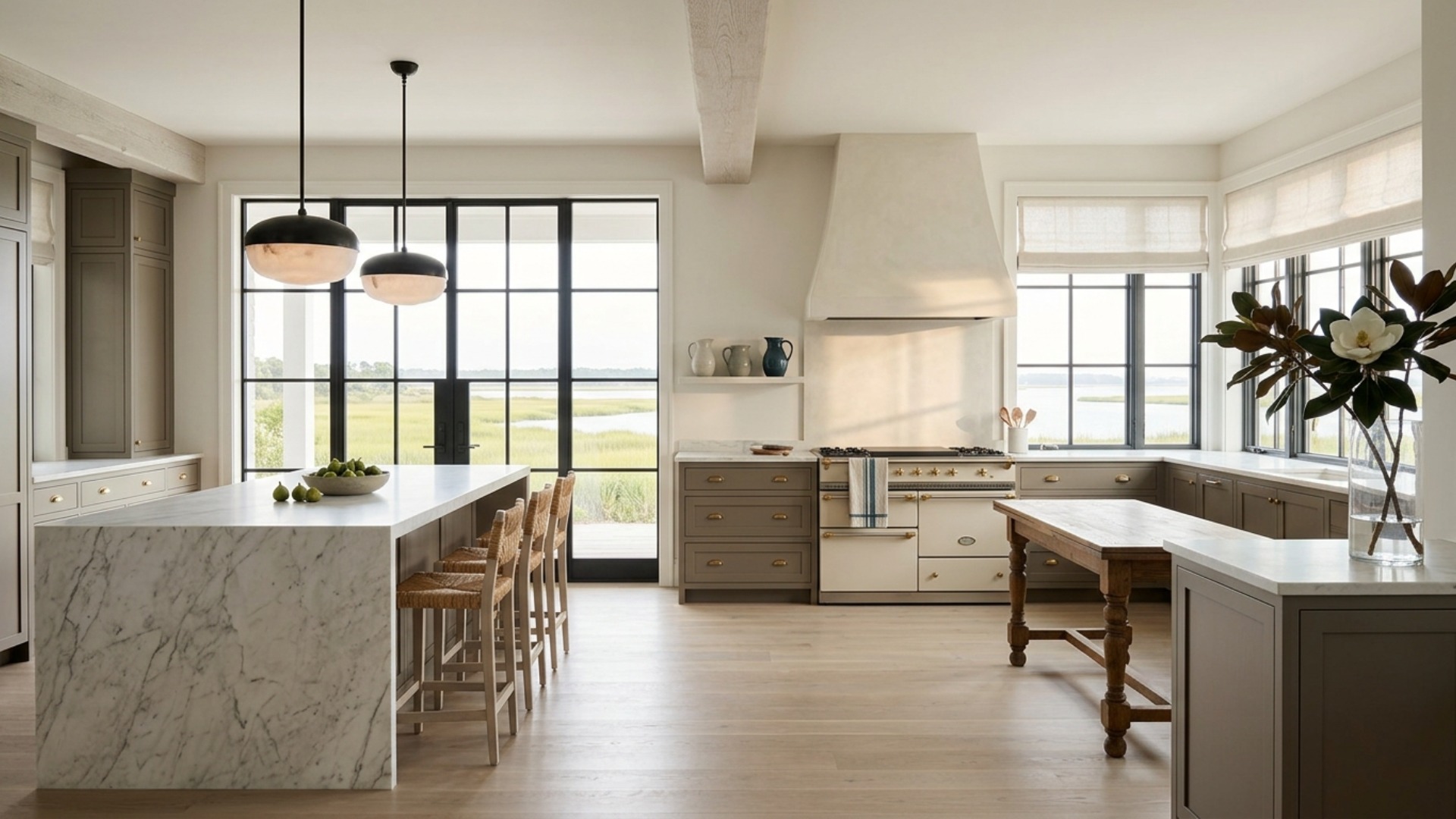
What actually signals money in a coastal kitchen is light, sightline, and material quality rather than component count. One extraordinary slab used once. Cabinetry with real inset construction and consistent reveals. Plaster with visible hand troweling instead of a flat roller finish. A range that will still be there in twenty years. None of those things photograph as features, and all of them are what a person feels when they walk in.
Most readers here are starting from a competent 2000s kitchen: cherry or espresso cabinets, a busy granite, a grid of recessed cans in the ceiling, and a window that has been half swallowed by upper cabinets on either side. The single most expensive looking change available is also the least glamorous one, which is opening that window wall back up and getting the uppers off it. Everything else is finishes.
The failure pattern is spending heavily on things a room cannot show and nothing on the planes that define it. Appliance packages and drawer organizers are invisible. The ceiling, the window, the lighting, and the cabinet color are what the eye reads first. The second failure pattern is white on white on white, which at this budget reads as an expensive spec house rather than a designed room. Coastal at the top end is warmer and greyer than most people expect.
A clear path
How to plan it
-
01
Buy the window wall before you buy the cabinets
Strip the uppers off the window wall and go as large as the structure allows, ideally steel framed or a slim aluminum profile with a dark finish. Budget $12,000 to $30,000 including the header work, and take it out of the cabinetry allowance rather than adding it on top. Storage can move to a pantry or to deep drawers on the opposite run, but daylight cannot be relocated later.
-
02
Choose one extraordinary stone and use it exactly once
Pick a single slab with real character, a honed Calacatta Viola, a Cristallo quartzite, or a soft veined Danby, and put it only on the island. Run a quiet honed limestone or a simple soapstone on the perimeter. A $9,000 slab reads as a decision when it appears once and as a warehouse when it appears everywhere.
-
03
Go inset, and let the cabinet color carry the warmth
Inset doors with consistent reveals are the clearest workmanship signal in a kitchen and typically add 15 to 25 percent over full overlay. Spend it. Then resist white: a warm greige such as Farrow and Ball Drop Cloth, a pale clay, or an oyster on the perimeter with limed white oak on the island gives coastal its warmth without going beige.
-
04
Replace the recessed can grid with three layers of warm light
Take the ceiling down to almost nothing: two or three decorative fixtures over the island, discreet linear under cabinet lighting on a separate switch, and a pair of sconces flanking the range or window. All 2700K, all on dimmers, and keep any remaining recessed cans to small aperture trimless housings. A ceiling free of a nine can grid is the difference between a renovated kitchen and a designed one.
-
05
Model the cabinet color and stone in Framehouse before the deposit goes down
Cabinet color at this budget is a five figure decision that cannot be undone, and warm greige, oyster, and clay read completely differently against a north facing marsh window than they do on a showroom door sample. Upload a photo of the room, try the color against your actual light, and see the island slab and the metal finish together before the cabinet order is signed.
Built for luxury upgrade
Moves that pay off
A luxury upgrade fails on allocation, not on budget. These are the trades that hold up two years later.
- Sequence the structural work first: window openings, ceiling plane, and any wall you are removing. Finishes chosen before the structure is settled get chosen twice.
- Put the largest single line into cabinetry construction rather than into appliances. A $28,000 inset cabinet package with a $9,000 range beats the reverse in every room I have seen.
- Buy one honest antique or vintage piece: a Belgian oak table, an old Turkish runner, a reclaimed beam. A kitchen where everything was purchased in the same six weeks always reads that way.
- Cut the beverage center, the second dishwasher drawer, and the pot filler before you cut the window or the stone. Those are showroom features, not room features.
- Hold 12 to 15 percent in contingency and expect to use it. Older houses reveal their surprises when the uppers come off the window wall.
- Do not chase a full appliance suite in one brand for the badge. A Lacanche or a Wolf plus panel ready everything else spends the money where it shows.
coastal cues
What to keep, what to skip
Coastal at a high budget is a discipline problem, not a shopping problem. These are the rules that keep it from sliding into resort decor.
- Palette: oyster and warm chalk on the plaster, greige or pale clay on the cabinetry, limed white oak on the island and floor, with one deep petrol blue or muted sea green accent in ceramics or a runner.
- Materials: honed marble or quartzite, unlacquered brass, limed white oak, hand troweled lime plaster, woven rush, unglazed stoneware. Nothing polished, nothing lacquered, no high gloss lacquer doors.
- The structural signature is the window. Coastal wants the largest possible uninterrupted glazing and nothing hung in front of it, with linen roman shades that stack above the frame.
- Let the brass go unlacquered. It will darken unevenly within a year and that patina is most of the reason the room will not look like 2026 forever.
- Keep the metal count to two. Unlacquered brass plus a blackened steel window is the whole program. A third metal is where kitchens start to look assembled.
- What to skip: shiplap on the island, rope wrapped pendants, glass float decor, navy shaker cabinets, and any stone with a polished finish. All of it is coastal as costume rather than coastal as place.
Use it for
What people plan with Framehouse
- Test a warm greige cabinet color against your own north facing light
- See the island slab and the perimeter stone together before ordering
- Check whether the uppers can come off the window wall without losing storage
- Compare limed white oak against painted cabinetry on the island
- Show a builder exactly what the ceiling should look like without a can grid
Quick answers
Common questions
Make a plan you can act on
Skip the spiral of mood boards. Three minutes in the Aura Quiz turns your taste into a direction.
Take the Aura Quiz