Organic Modern Home Office Ideas for a Luxury Upgrade
Organic modern is where a home office budget actually shows, because the style is built on materials you feel rather than logos you see. This page is about spending a luxury upgrade well: where custom pays off, where restraint matters more than money, and what to leave alone.
The real problem
Why this is harder than it looks
At the high end, organic modern is the style people reach for when they want calm rather than flash, and that is exactly where the money can go wrong. The instinct on a luxury upgrade is to add: more stone, more brass, a statement chandelier, a bigger desk. Organic modern punishes addition. Its whole effect comes from a few extraordinary materials given room to breathe, so an expensive office can end up looking busy and less serene than a restrained one a third of the price.
The deeper misread is treating luxury as a look you buy rather than a level of execution. What reads as expensive in organic modern is not a brand, it is honed stone with a real thickness, plaster with actual depth, solid oak with visible grain, and joinery that lines up. Those are execution decisions, and they are where a luxury budget earns its keep. Spend on the substrate and the craft, not on visible price tags.
The situation of a luxury upgrade is that you can afford to do it once and do it right, which is a rare thing to squander. The temptation is to buy the hero pieces first, the desk, the art, the light fixture, and let the room assemble around them. In organic modern the opposite sequence wins: the surfaces and the light set the tone, and the objects are the last, smallest decision.
The failure pattern at this budget is over-specifying: three metals, two stones, a feature ceiling, a bold rug, each beautiful alone and collectively loud. Organic modern wants one warm stone, one wood, one metal, and one accent, executed superbly. Restraint is not a compromise here, it is the product you are paying for.
A clear path
How to plan it
-
01
Spend on the surfaces first, not the furniture
In organic modern the walls and floor carry the room, so put the budget into a real limewash or plaster finish, wide-plank white oak, and one honed stone surface before you shop for a desk. These are the things that read as quiet luxury and that you cannot fake with an accessory. A superb plaster wall makes a modest desk look considered, while a grand desk cannot rescue a flat painted wall.
-
02
Choose one warm stone and one wood, and commit
Pick a single honed stone, travertine, limestone, or a soft-veined marble, and a single warm wood like white oak, then repeat them. The luxury version of organic modern is disciplined, not maximal, so resist a second stone or a contrasting wood. A monolithic stone credenza and an oak desk in the same room is the whole material story, and it should be.
-
03
Let curves and a single bronze accent do the warming
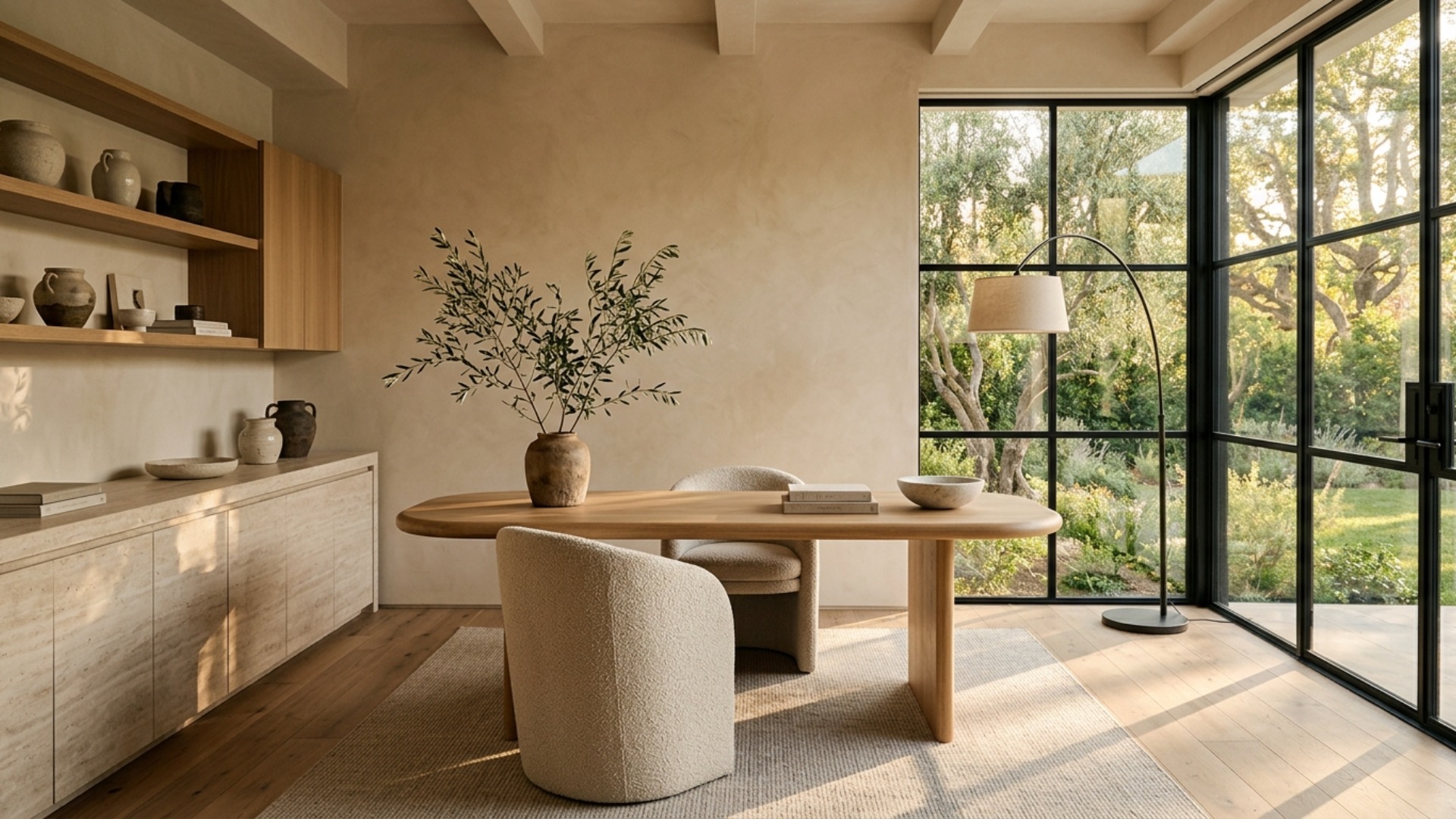
Organic modern softens a room with curves and one restrained metal, not with color. A rounded desk edge, a boucle chair, an arcing floor lamp in blackened bronze or aged brass, and you are done. Keep to one metal finish throughout, since the fastest way to make an expensive room look cheap is to mix three.
-
04
Invest in custom built-ins and hidden storage
This is where a luxury budget genuinely separates the room: built-in oak shelving and concealed storage that keep every surface clear, which is the precondition for the whole calm effect. Off-the-shelf furniture leaves gaps and visible clutter that organic modern cannot absorb. Custom joinery that lines up with the architecture is the single most expensive-reading decision you can make.
-
05
Visualize the materials before you commit spend
At this budget a wrong stone or an off oak tone is a costly mistake, and samples never read the same as a finished room in your actual light. Photograph the space and test the plaster tone, the stone, the wood, and the bronze together in Framehouse before you order anything custom. Seeing the full material palette resolved before you commit is worth the most precisely when the spend is highest.
Built for luxury upgrade
Moves that pay off
A luxury upgrade is a chance to do it once and do it right, which means spending on permanence and craft rather than on visible statement pieces. Sequence the surfaces and storage first.
- Put the largest share of the budget into the surfaces and built-ins, since those are the parts you cannot upgrade later without redoing the room.
- Commission custom joinery for storage and shelving, so every surface stays clear and the calm effect actually holds.
- Buy fewer, better objects. One extraordinary chair and one sculptural lamp outperform a room full of good ones.
- Specify one metal finish and hold to it everywhere, from the lamp to the drawer pulls to the window frames.
- Resist the feature ceiling, the second stone, and the bold rug. At this budget the discipline is the luxury.
- Leave the art until last and let the room tell you what it needs, rather than buying a statement piece to build around.
organic modern cues
What to keep, what to skip
Organic modern is warm minimalism built on natural materials and curves. At a luxury level the materials get better, not more numerous, so keep the palette tight and the execution flawless.
- Palette: warm white and oatmeal, white oak, one honed stone like travertine, and a single quiet clay or bronze accent.
- Materials: honed not polished, matte not glossy. Real plaster or limewash walls, solid oak with visible grain, honed stone with genuine thickness.
- Structural signature: soft curves and one monolithic stone element, a waterfall credenza or a rounded desk, given space around it.
- Metal: one finish only, blackened bronze or aged brass, used sparingly on the lamp, the hardware, and the frames.
- Light: soft and natural, tall undressed windows, warm bulbs, and one sculptural fixture rather than a statement chandelier.
- What to skip: cool gray, high gloss, three metals, and any addition that competes with the few materials you chose.
Use it for
What people plan with Framehouse
- Test a limewash plaster tone against your white oak floor in your actual light before commissioning the finish.
- Try a travertine versus a limestone credenza to see which warms the room without going busy.
- Show a partner how one bronze accent reads richer than a mix of metals across the room.
- Check that custom built-ins align with the window and ceiling lines before you order the joinery.
- Preview a rounded oak desk against a plaster wall to confirm the calm before the budget is committed.
Quick answers
Common questions
Make a plan you can act on
Skip the spiral of mood boards. Three minutes in the Aura Quiz turns your taste into a direction.
Take the Aura Quiz