Coastal Home Office Ideas for a Luxury Upgrade
A luxury coastal office is not a beach-house cliche with a laptop in it. It is a calm, high-functioning room where the light, the acoustics, and the materials are all worth the money you are about to spend, and this page is where to spend it.
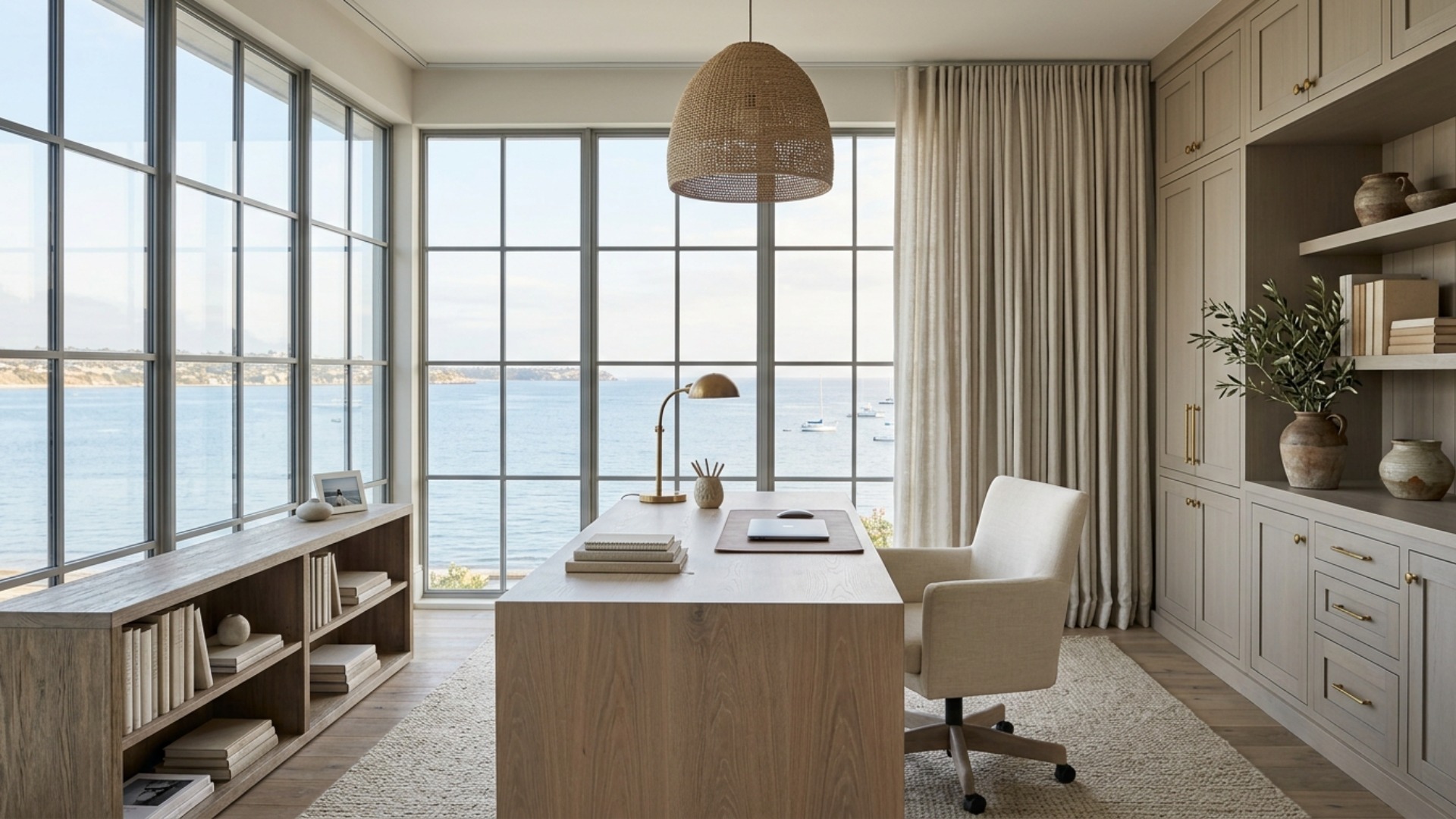
The real problem
Why this is harder than it looks
A luxury upgrade is where money most often gets spent loudly instead of well. The temptation with a coastal office is to buy the statement pieces: a sculptural desk, a designer chair, a dramatic pendant, and call the sum of expensive things a high-end room. But a coastal office reads as luxurious for the opposite reason. It is quiet, and the money sits in things you notice only after an hour in the room.
Coastal, done at this level, is a restraint exercise. The palette stays in warm off-whites, sand, and weathered oak, and the luxury comes from material quality and how the light is handled, not from color or ornament. The most common miss is treating coastal as a decorating theme, layering in blues and shells and rope until an expensive room reads like a rental near the beach. Spend the budget on solid oak, real stone, honest linen, and cabinetry that fits the wall to the millimeter, and the calm palette starts to feel considered rather than plain.
There is a second constraint people forget: this is a room you work in, often on camera. A gorgeous office that echoes on every call, glares at midday, or has nowhere to hide a printer is a failed upgrade no matter how it photographs. The features that make a workspace genuinely premium, quiet acoustics, layered light, real storage, and a considered video backdrop, are exactly the ones a decorating-first approach skips.
The failure pattern is buying the furniture before solving the room. People order the desk and chair first, then discover the window faces west and washes out every afternoon call, or that open shelving looks beautiful and hides nothing. Solve light, sound, and storage first, then let a small number of excellent pieces do the visible work.
A clear path
How to plan it
-
01
Put the budget into the surfaces you touch and see all day
In a luxury coastal office the desk and the flooring are what your eye and hands live on, so spend there first. A solid white-oak or bleached-oak desk with a real wood edge, over a wide-plank oak floor or a wool-and-jute rug, will outclass a roomful of cheaper accessories. Skip the veneer-and-chrome executive desk; it reads corporate, not coastal.
-
02
Design the light before you place the desk
Coastal depends on soft, abundant daylight, but a west or south window will glare on a screen and on camera by afternoon. Orient the desk perpendicular to the window rather than facing or backing it, add unlined linen or woven-shade layers you can diffuse, and plan warm 2700K to 3000K lamplight for evenings. Getting the light right is the single biggest driver of whether the room feels premium.
-
03
Build in storage and solve the acoustics
The luxury of a good office is that nothing clutters it, which takes real storage, not open shelving. Commission or buy built-in cabinetry in soft greige or warm white with aged-brass hardware to hide the printer, cables, and files, and soften hard surfaces with a wool rug, linen drapery, and an upholstered chair so the room does not echo on calls. Sound and concealment are what separate a workspace from a showroom.
-
04
Add warmth and one considered video backdrop
Coastal warmth comes from natural material and a few collected objects, not color. Style a low weathered-oak shelf behind your seat as an intentional call backdrop: a ceramic vessel with olive or eucalyptus, a stack of linen-bound books, one piece of soft washed art, kept sparse. Resist the shells and rope; at this budget a single beautiful natural object beats a themed vignette.
-
05
See the finished room before you commission anything
A luxury office is the most expensive room to redo twice, and built-ins and stone are not returnable. Photograph the space and use Framehouse to test the oak tone, the cabinet color, the drapery, and the desk placement against your real windows before you order, so a too-cool white or a glare problem shows up on screen instead of after the invoice.
Built for luxury upgrade
Moves that pay off
A luxury upgrade rewards spending on the permanent and the invisible before the decorative. Put the budget where it compounds.
- Invest first in built-in cabinetry and a solid-wood desk; these anchor the room and rarely need replacing.
- Spend on light control, blinds, layered lamps, and dimming, before you spend on accessories.
- Treat acoustics as a line item; a wool rug, drapery, and upholstery pay off on every call.
- Choose one excellent chair over two decent ones; you sit in it eight hours a day.
- Buy real materials, solid oak, natural stone, and honest linen, rather than more pieces in cheaper finishes.
- Leave the art and objects until last, and buy few; restraint is what reads as expensive.
coastal cues
What to keep, what to skip
Coastal at a luxury level is a narrow warm-neutral palette carried by exceptional materials and light, never by seaside decoration. Hold these and the room reads refined rather than themed.
- Palette: warm off-white, sand, greige, and oatmeal, grounded by weathered and bleached oak.
- Materials: solid oak, honest linen, wool, natural stone, rattan, and aged brass. Everything matte, nothing glossy.
- One structural signature: generous, well-controlled daylight through airy linen or woven treatments.
- Let material quality and craftsmanship carry the luxury; skip applied ornament entirely.
- Layer texture within the neutral range instead of introducing blue or bold accent color.
- What to skip: navy, shells, rope, driftwood signage, and any literal nautical motif.
Use it for
What people plan with Framehouse
- Test a bleached-oak desk tone against your floor and daylight before commissioning it
- Check desk placement against your windows to avoid on-camera glare
- Preview built-in cabinet colors before ordering millwork you cannot return
- See how linen drapery changes the light at your real work hours
- Show a designer or partner the finished room before approving the budget
Quick answers
Common questions
Make a plan you can act on
Skip the spiral of mood boards. Three minutes in the Aura Quiz turns your taste into a direction.
Take the Aura Quiz