Minimalist Bedroom Ideas for a Luxury Upgrade
A bedroom is the only room in the house judged in the dark, which is why the expensive minimalist ones spend most of the budget on things a photograph cannot show. This page covers what to buy before the furniture and what to leave out entirely.
The real problem
Why this is harder than it looks
The standard version of this project spends nearly all of its money above the mattress. An eighteen thousand dollar bed, a large commissioned canvas, two designer nightstands, one sculptural chair nobody sits in. It photographs beautifully and it sleeps exactly the same as the room did before, which means the money bought a picture rather than a bedroom.
What actually separates an expensive minimalist bedroom from an ordinary one is a list of absences. No visible storage. No wires anywhere. No light leaking around a blind at five in the morning. No sound from the hallway or the street. No switch plates or thermostats at eye level. Every one of those is a trade line item decided during construction rather than something you can buy afterward, and together they are what people are responding to when they say a room feels calm and cannot say why.
Most readers here are working on a full refit of a primary suite or a city apartment bedroom that is perfectly fine and simply feels ordinary. That is a harder brief than a broken room, because there is no obvious problem to solve and the temptation is to solve it with objects. The honest answer is usually that the room is too bright at night, too loud at six in the morning, and holding three pieces of furniture that exist to store things that could be built into a wall.
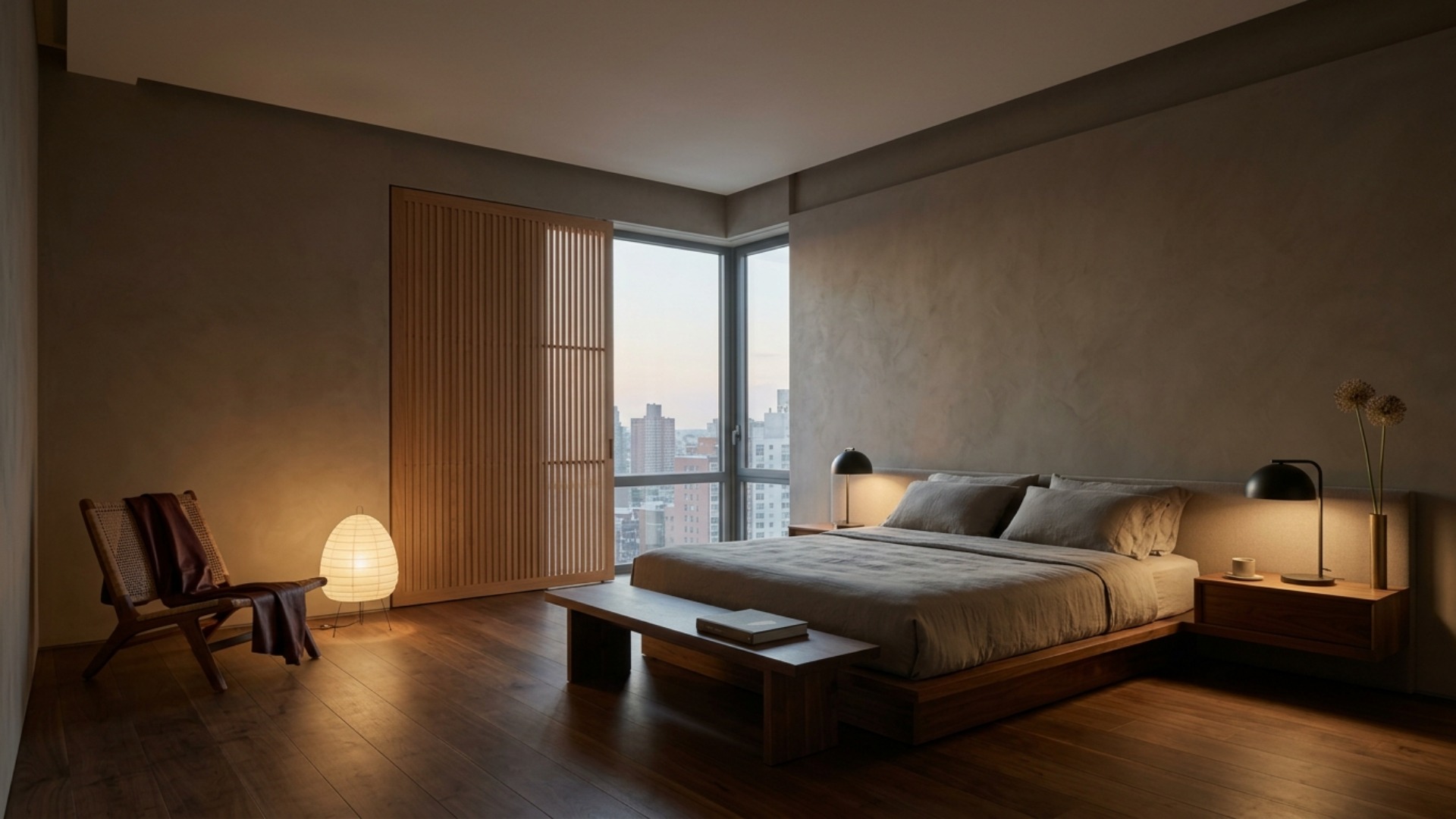
The second failure is temperature. Minimalist bedrooms go wrong toward grey: white walls, grey linen, chrome, hard downlights, and the result reads as a good hotel room rather than a bedroom you want to be in on a Sunday. The expensive versions are almost always darker and warmer than people expect, in deep greige or clay plaster, with walnut rather than oak, and lit low enough at night that the corners of the room fall away.
A clear path
How to plan it
-
01
Buy darkness and silence before you buy anything you can see
Recessed blackout blinds in a plastered pocket with side channels, so there is no halo at the edges, run roughly $1,800 to $3,500 per window and are the single best purchase in the room. Add a solid core door with a full perimeter seal and an acoustic drop seal at the threshold, and insulate the wall the bed sits against if it borders a hallway. This is unglamorous work and it is what people mean when they say a bedroom feels like a hotel in the good way.
-
02
Build the storage into the walls so nothing has to stand in the room
Floor to ceiling joinery with push latch doors and no visible hardware, run wall to wall and finished in the same color as the plaster, removes the dresser, the armoire, and the two bedside cabinets from the floor at once. Expect $700 to $1,200 per linear foot for a good cabinetmaker. Empty floor is the actual luxury signal in a minimalist bedroom, and it can only come from storage that has disappeared into a wall.
-
03
Take the light off the ceiling entirely
Nothing kills a bedroom faster than a downlight over the bed, and at this budget there is no reason to have one. Use an integrated cove or shadow gap wash for the ambient layer, two adjustable reading lights mounted into the headboard wall on individual dimmers, and one low floor lantern for late evening. Keep every source 2700K or warmer, put the whole room on a single scene control by the door and a second by the bed, and locate every switch below waist height or hide it entirely.
-
04
Go darker and warmer than white on the walls
Hand troweled lime plaster in a deep warm greige or a soft clay does something white cannot: it holds light unevenly, so the walls read as a surface rather than a blank. Budget $18 to $30 per square foot applied. Pair it with oiled walnut rather than pale oak and one saturated warm accent such as oxblood or a deep olive in a single leather throw or cushion, and the room stops resembling a showroom.
-
05
Test the wall color and the night lighting in Framehouse before the plasterer starts
Deep plaster colors are the highest risk decision in this room and the least reversible, because a greige that looks enveloping on a sample board can read muddy or cold across four walls with the light you actually have. Upload a photo of the room, try a deep greige against a clay and a warm bone, and look at the room at low light levels before a five figure plaster order is placed.
Built for luxury upgrade
Moves that pay off
At this level the budget question is not how much but in what order. This is the sequence that produces a room people do not want to leave.
- Spend in this order: acoustics and blackout, joinery, plaster, lighting, bed, mattress, then one object. Almost every regret in this category comes from reversing the first and last items.
- Put 45 to 55 percent of the total into work that happens before a single piece of furniture arrives. If the furniture line is the biggest line, the brief was wrong.
- Buy the mattress at the top of the market and the frame at the middle. A $6,000 mattress in a $3,000 walnut platform is a better room than the reverse, and the frame is barely visible once the bed is made.
- Skip the television or commit to it properly with a lift cabinet or an in wall recess. A screen on the wall opposite the bed undoes the entire argument of the room.
- Do not commission art before the plaster is finished. Deep wall colors change what a piece needs to do, and a lot of expensive canvases end up fighting the wall they were bought for.
- Hold ten percent for the lighting scenes. Getting the night level right usually takes two visits from the electrician after you have lived with it.
modern minimalist cues
What to keep, what to skip
Minimalism in a bedroom succeeds by subtraction and fails by coldness. These are the rules that keep it enveloping rather than empty.
- Palette: a deep warm greige or clay plaster on all four walls and the ceiling, oiled walnut on the wood, wet stone or oatmeal linen on the bed, with one muted saturated accent such as oxblood, deep olive, or ochre appearing exactly once.
- Materials: hand troweled lime plaster, oiled walnut, heavyweight washed linen, undyed wool boucle, cane, blackened brass, aniline leather. Nothing lacquered, nothing chrome, no glass tabletops.
- The structural signature is the unbroken plane: wall to wall joinery finished in the wall color, a shadow gap instead of cornice or baseboard, and a bed low enough that the wall above it stays open.
- Light low and from the sides. Cove or wall wash for ambient, integrated reading lights, one floor lantern, everything dimmed and warm, no ceiling fixture over the bed.
- One object is the limit. A single Akari lantern, one piece of art, or one chair, chosen well, rather than a considered arrangement of five.
- What to skip: television on the wall, matching nightstand sets, decorative pillows in odd numbers, chrome or polished nickel, area rugs that float in the middle of the floor, and pure white walls. Each one pushes the room toward hotel.
Use it for
What people plan with Framehouse
- Test a deep greige plaster against your room's real light before ordering
- See the room at night lighting levels before the electrician roughs in
- Compare wall to wall joinery against freestanding storage
- Check whether a low walnut platform works with your ceiling height
- Show a partner a darker bedroom before committing to the color
Quick answers
Common questions
Make a plan you can act on
Skip the spiral of mood boards. Three minutes in the Aura Quiz turns your taste into a direction.
Take the Aura Quiz