Japandi Studio Apartment Ideas Using Only IKEA
IKEA already carries most of what japandi asks for: pale wood, clean lines, and quiet textiles. This page shows which pieces to buy, which to skip, and how to lay out a whole studio so it reads calm instead of flat-packed.
The real problem
Why this is harder than it looks
Most people treat japandi as a shopping style: buy enough light wood and black accents and the look assembles itself. In a studio built entirely from IKEA, that logic breaks fast. The pieces are fine on their own, but bought all at once they read as a showroom aisle rather than a room someone lives in.
Japandi is a discipline of restraint, not a set of products. It works because of what is left out: empty wall, bare floor, a single material repeated until it feels intentional. IKEA makes restraint hard, because it is cheap to add one more thing, and a studio punishes every extra object because there is nowhere to hide it.
You are furnishing one room that has to be a bedroom, a living room, an office, and often a kitchen edge, on a budget that rules out custom anything. The temptation is to buy a matching series so it looks coordinated. That is the exact move that flattens the room, because a studio full of one IKEA collection looks like a catalog page, not a home.
The fix is to start from use, not storage. Decide what the room needs to do at each hour of the day, let that choose the three or four pieces that matter, and treat everything after that as texture and light.
A clear path
How to plan it
-
01
Empty the palette before you add anything
Before a single Billy or Malm goes in the cart, commit to two woods and two neutrals: light oak or birch, warm white walls, an oatmeal or greige textile, and matte black in small doses. IKEA sells the same shelf in five finishes, so the finish you pick is the whole decision. Choose the pale, un-lacquered wood tones and leave the dark brown and high-gloss white on the shelf.
-
02
Pick the few pieces that carry the room
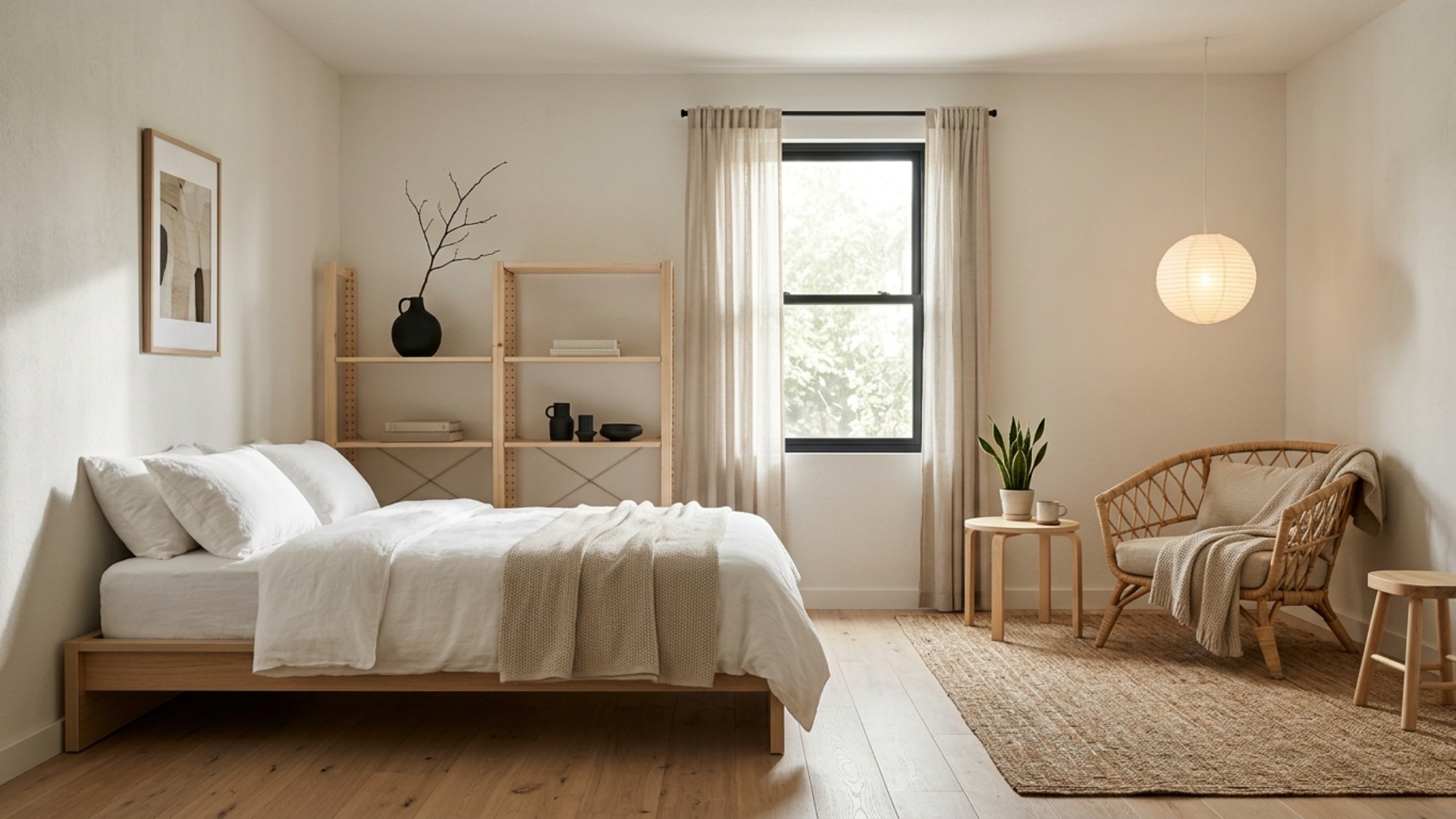
A japandi studio needs maybe four anchor pieces, not a full collection: a low light-wood bed frame such as the Tarva or Neiden, a slim open shelf like Ivar or a birch Billy, one round table, and a single soft lounge chair. Buy those well and leave the walls bare around them. Skip the matching nightstands, the extra cabinet, and anything sold as a set.
-
03
Warm the flat-pack with texture and craft
Raw IKEA reads cold because it is all smooth and machine-made, and japandi lives on the tension between clean lines and handmade texture. Add a chunky wool or jute rug, a linen duvet in oatmeal rather than bright white, a paper Regolit or Vate lantern, and two or three pieces of real stoneware. One handmade object on an otherwise plain shelf does more than ten styling props.
-
04
Zone the studio so one room reads as several
Use a low shelf or the back of the sofa as a quiet divider between sleeping and living, and keep sightlines open above waist height so the room still breathes. A rug under the bed and another under the living area tells the eye where one zone ends and the next begins. Push the tallest pieces against one wall so the floor stays visible, which is what makes a small space feel calm.
-
05
See the layout in Framehouse before you commit
IKEA finishes are almost impossible to judge from a website thumbnail, and a studio gives you no room for a wrong call. Photograph your empty space and use Framehouse to test the oak against your floor, the rug against the wall color, and the furniture arrangement, before you spend a Saturday building it. It is far cheaper to move a bed in a render than to carry a flat-pack across the room twice.
Built for ikea only design
Moves that pay off
Working from one catalog is a real constraint, so spend the budget where it shows and hack the rest.
- Buy the anchor pieces first: bed, one shelf, one table, one chair. Everything else can wait a paycheck.
- Upgrade the parts you touch. Swap IKEA knobs for matte black or leather pulls, and add real wood legs where you can.
- Choose the pale wood finish every time, and avoid the dark brown and gloss white versions of the same item.
- Skip the matching series. One coordinated collection in a studio reads as a showroom, not a home.
- Layer in non-IKEA texture cheaply: a thrifted stoneware bowl, a linen runner, one ceramic lamp.
- Hold back on storage until you know what you own, then buy the smallest amount that hides it.
japandi cues
What to keep, what to skip
Japandi is Scandinavian warmth meeting Japanese restraint, and it holds together on a few precise rules.
- Palette: warm white, light oak, oatmeal, and matte black in small, deliberate amounts.
- Materials: pale wood, linen, paper, wool, and handmade ceramic, with very little metal.
- Lines: low, horizontal furniture and a clear floor, so the eye rests instead of scanning.
- Signature move: one shelf or ledge styled with three objects and a lot of empty space around them.
- Light: soft and diffused, filtered through linen rather than bouncing off a glossy surface.
- What to skip: clutter, ornament, bright color, and heavy dark wood, which pull the room toward generic rustic.
Use it for
What people plan with Framehouse
- Test IKEA oak against your actual floor before building a whole bed
- Try two studio layouts side by side to see which keeps the floor open
- Show a roommate or partner what the finished corner will feel like
- Check a rug and wall color together before ordering either one
- Plan the four anchor pieces so you buy them in the right order
Quick answers
Common questions
Make a plan you can act on
Skip the spiral of mood boards. Three minutes in the Aura Quiz turns your taste into a direction.
Take the Aura Quiz