IKEA-Only Kitchen Ideas in Modern Farmhouse Style
An IKEA kitchen is a very good cabinet system wearing a very recognizable set of doors. Modern farmhouse is one of the few styles that fits it almost perfectly, as long as you know which three parts to change.
The real problem
Why this is harder than it looks
The thing nobody tells you about an IKEA kitchen is that the part people criticize is the part that is actually good. The cabinet boxes are square, adjustable, and rated for decades of use, and the planner will hand you a workable layout in an afternoon. What gives an IKEA kitchen away is never the box. It is the door, the handle, the counter, and the toe kick, in roughly that order.
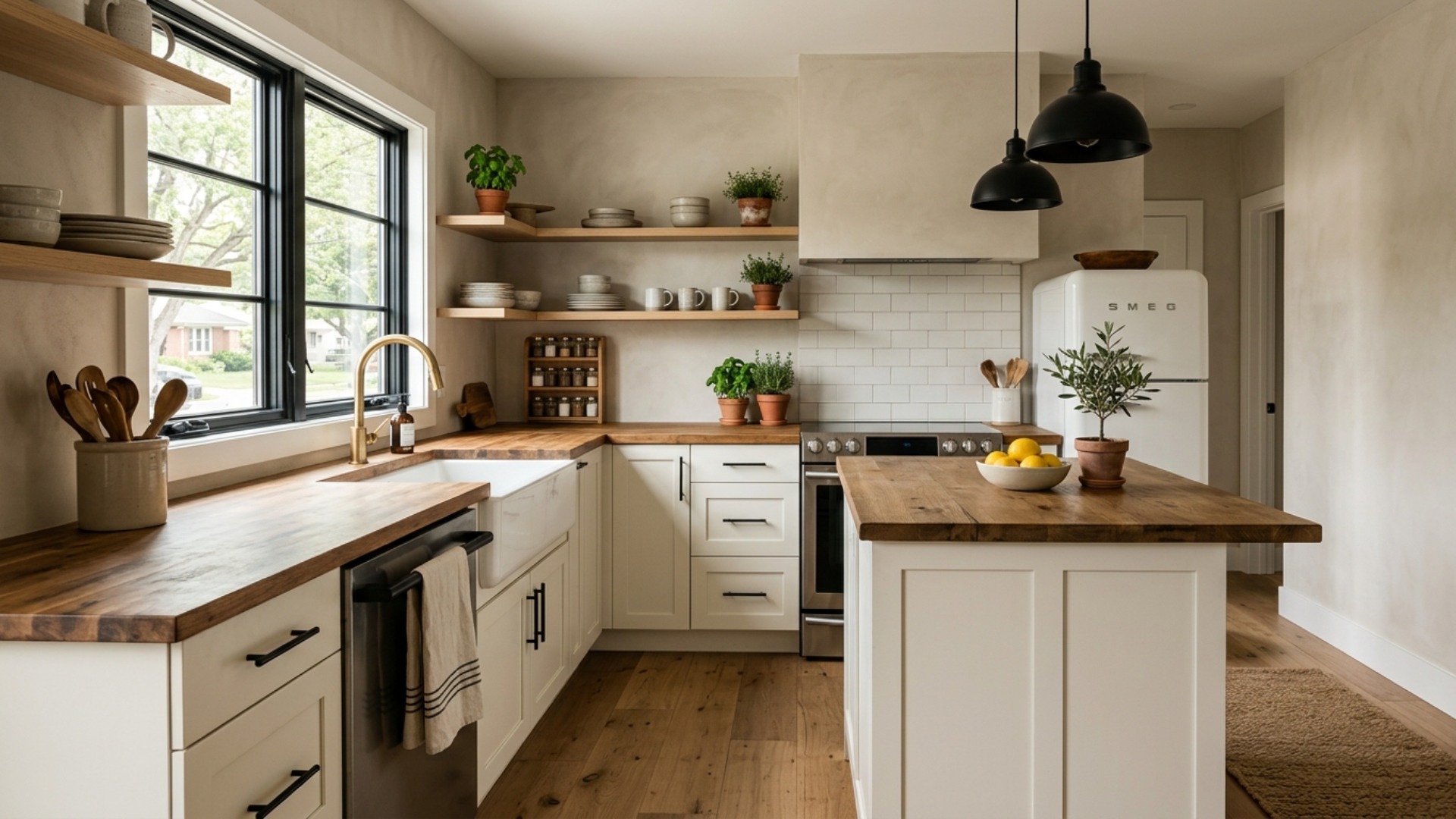
That matters here because modern farmhouse wants exactly four things: a shaker door, a warm counter, black hardware, and some visible wood. IKEA gets you within reach of all four and then stops just short of each one. The doors are close to right, the standard handles are not, the laminate counters read thin next to a farmhouse sink, and the plastic toe kick is the detail that quietly tells everyone what they are looking at.
The expensive mistake is deciding to go IKEA-only and then buying the entire kitchen from one page of the catalog: their doors, their handles, their counter, their sink, their lighting. Each piece is fine. Together they read as a showroom rather than a room, because everything shares one design language and nothing interrupts it.
So the approach that works is not really IKEA-only, it is IKEA-structural. Keep the boxes and the layout, spend the saved money on the four visible surfaces, and let one element in the room come from somewhere else entirely. That single outside piece, usually the sink or the pendants, is what makes the whole kitchen stop reading as a kit.
A clear path
How to plan it
-
01
Plan the boxes before you think about the doors
Measure the room twice, including the ceiling height and every obstruction, then build the layout in the IKEA planner. The cabinet system is the part you are really buying, so get the runs, the drawer stacks, and the filler panels right first. Doors can change later. A cabinet in the wrong place cannot.
-
02
Choose a true shaker door and stop looking at anything else
Roughly eighty percent of what people read as the IKEA look lives in the door front. A flat five-piece shaker in warm white or a soft greige is exactly what modern farmhouse wants, whether you take it from IKEA or from one of the third-party front makers that build to their sizes. Avoid high-gloss and avoid anything with an integrated finger pull.
-
03
Upgrade the counter, the handles, and the toe kick
These three are where IKEA is weakest and where the money saved on boxes should go. Butcher block or a warm-toned solid surface instead of thin laminate, slim matte black bar pulls in place of the standard hardware, and a solid oak toe kick rather than the plastic strip. The toe kick sounds trivial and is the detail that most often gives the kitchen away.
-
04
Break the run with open shelving and one outside piece
An unbroken wall of matching doors is what makes a kitchen read as a kit. Swap two upper cabinets for open oak shelves, and bring in exactly one element from outside the system: a fireclay apron sink, a pair of black dome pendants, or a real brass faucet. One outside piece is enough. Three starts to look unplanned.
-
05
See it in your own kitchen before you place the order
IKEA kitchen orders are large, delivered all at once, and painful to change after the fact. Render your actual room with the door color, the counter, and the hardware you are considering, and check the door against your floor rather than against a showroom floor. Warm white doors over a cool gray tile is the single most common regret in this style.
Built for ikea only design
Moves that pay off
Working within one system is a constraint worth using deliberately rather than fighting. What pays off:
- Order the boxes and the fronts as separate decisions. Treating them as one purchase is what pushes people into the standard look by default.
- Order more cover panels and filler strips than the planner suggests. They are cheap, and the finished ends are what separate a built-in look from a row of boxes.
- Watch for the kitchen promotions that run a few times a year. On a full kitchen the difference is meaningful enough to be worth waiting a month for.
- Budget for assembly honestly. A full kitchen is many hours of flat-pack, and paying someone is often the difference between finishing in a week and finishing in two months.
- Keep the appliance panels consistent. Mixing a paneled dishwasher with an exposed stainless fridge is the kind of half-decision that reads as unfinished.
- Do not buy the accessories and the styling from the same catalog. Bowls, boards, and textiles from anywhere else are what make the room look lived in rather than shopped.
modern farmhouse cues
What to keep, what to skip
Modern farmhouse is a warm style that goes wrong when it gets literal. The cues that hold up in a kitchen built from a cabinet system:
- A five-piece shaker door in warm white or soft greige. Not bright white, which turns cold against wood, and nothing with a routed profile.
- Wood you can see: butcher block counter, open oak shelves, or an oak toe kick. At least one of the three, ideally two.
- Matte black in exactly two places, usually the hardware and the pendants. Black on everything tips the room toward industrial.
- A deep apron sink. It is the single most recognizable modern farmhouse element and it does more work than any other upgrade.
- Texture through material rather than pattern: fireclay, unlacquered brass, linen, stoneware.
- What to skip: shiplap on every wall, script signs, galvanized buckets used as decor, and barn doors in rooms that never had one. The style reads best when the references are structural rather than decorative.
Use it for
What people plan with Framehouse
- Test warm white doors against the floor you already have
- Compare butcher block and a solid surface counter side by side
- See whether open shelving works over your actual sink run
- Decide on the apron sink before the cabinet order is placed
- Show a partner the finished kitchen before a five figure order
Quick answers
Common questions
Make a plan you can act on
Skip the spiral of mood boards. Three minutes in the Aura Quiz turns your taste into a direction.
Take the Aura Quiz