Industrial Kitchen Ideas for a First Apartment
Industrial is the rare style that gets better when the kitchen is a little rough around the edges. Here is how to build it in a rental galley, against landlord white cabinets, on what is left of your budget after the deposit.
The real problem
Why this is harder than it looks
Industrial gets misread as a shopping category. People decide they want it and start buying black metal objects: a black dish rack, a black soap pump, a pipe shelf bought as a kit. The room fills up with signals and still reads like a rental with accessories in it.
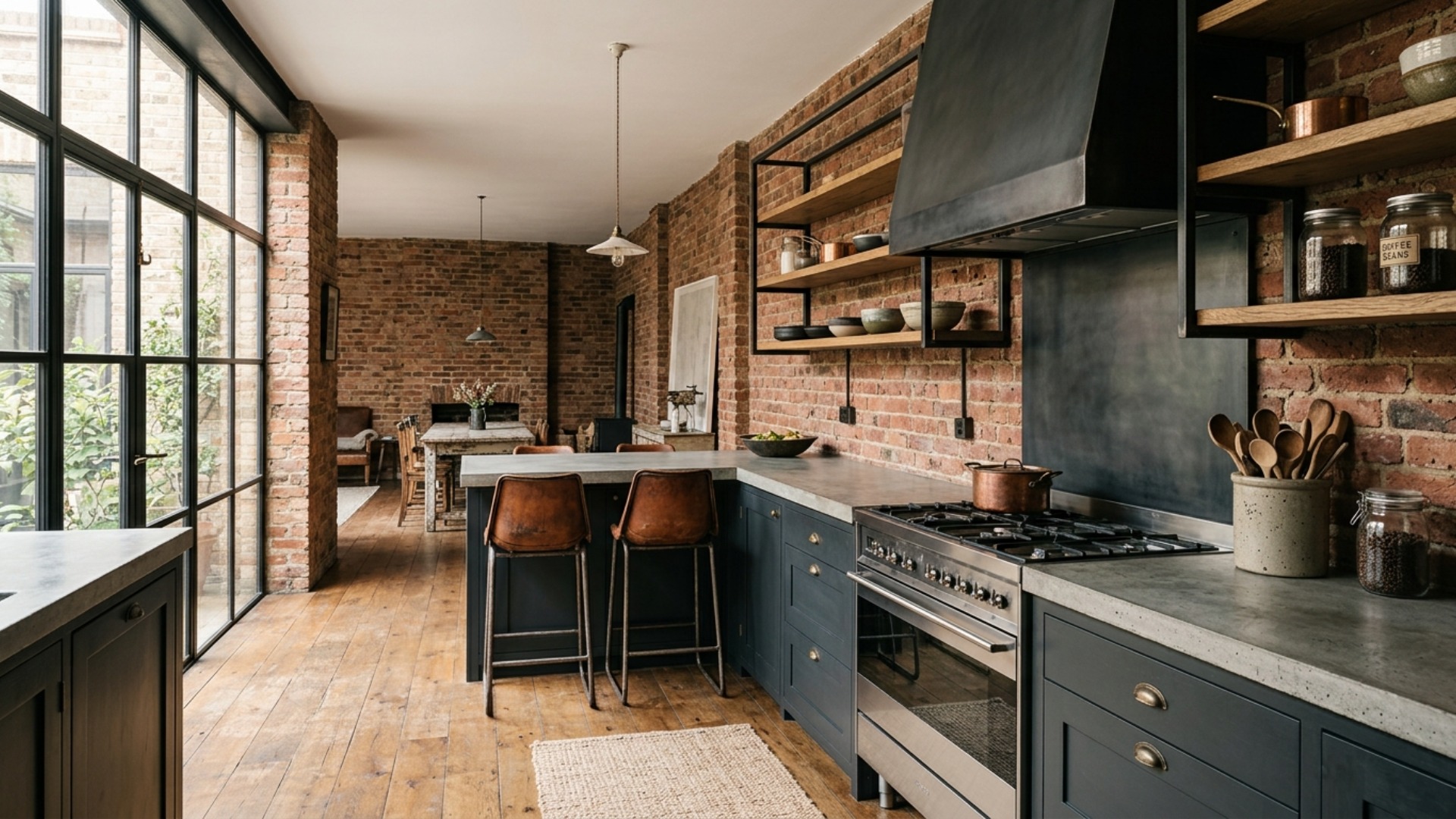
What the style actually runs on is contrast and visible utility. Matte black against warm wood, a bulb you can see, storage that shows what it holds, and one material that has earned its wear. None of that requires a building with exposed brick. It requires deciding that the working parts of the kitchen are the decoration, which is a very different instinct from hiding them.
The first apartment version of this starts from a specific kitchen: a narrow galley, white thermofoil cabinet doors, a beige laminate counter, one dome light in the ceiling, and a lease that forbids most of what you would like to do. That is less of an obstacle than it sounds. Almost every real industrial gesture is removable, and the ones that are not are the ones you should skip anyway.
The failure pattern is spending the whole budget on small black objects and none of it on light. A kitchen lit by a cool white ceiling dome will look institutional no matter what you put on the counter. Light first, then open storage, then one warm material to keep the black from going cold. Everything else is optional.
A clear path
How to plan it
-
01
Change the light before you change anything else
The builder dome and its 4000K bulb are doing more damage than the cabinets. Swap the bulbs for 2700K, and if the fixture cannot be touched, add a plug-in pendant with a fabric cord or two matte black clamp lamps aimed at the counter. Keep the original fixture in a labeled box for move-out.
-
02
Get the things you use daily out of the cabinets
Industrial kitchens look worked in, and that comes from open storage rather than styling. A wall rail with S-hooks, a magnetic knife strip, and a hanging rail for two or three pans runs under $60 and does more for the room than any object you could buy. Hang the pans you actually cook with, not a display set.
-
03
Cover the counter instead of fighting the cabinets
A butcher block slab or a 24 inch walnut board left permanently on the counter warms the whole galley and gives you the material contrast the style needs. Skip peel-and-stick cabinet film. It photographs badly, it rarely survives a year of steam, and the cabinets are not the problem.
-
04
Add one worn material and one steel piece you actually use
A leather-seated stool, a cast iron pan hung where you can see it, a steel shelf holding jars. The rule that keeps this from turning into a theme: buy things whose function justifies the finish. Patina you earn in a year of cooking always reads better than patina that came pre-applied.
-
05
Visualize the real kitchen before you spend
A rental kitchen has more constraints than budget, and black metal against white thermofoil either works in your light or looks severe in it. Render your actual galley in industrial, test a pendant and a wood counter surface together, and buy once. Most people get this wrong on the first pendant and eat the return shipping.
Built for first apartment
Moves that pay off
A first apartment kitchen limits what you can change more than what you can spend. Almost everything worth doing here is reversible and comes with you.
- Assume nothing that needs a drill unless the lease says otherwise. Adhesive rails rated over five pounds, tension rods, and freestanding shelving carry most of this style.
- Keep every original fixture, bulb, and cabinet pull in a labeled box. A swap is only reversible if you can undo it in an afternoon.
- Spend the first $150 on light and open storage. That pair changes the room more than the next $500 will.
- Buy pieces sized to you, not to this kitchen. Stools, lamps, shelving, and pans move with you. A shelf cut to fit this wall does not.
- Wait a month before buying a runner. Galley traffic patterns are not obvious from the doorway, and the wrong runner is in the way every day.
- Do not paint the cabinets in a first rental. It rarely comes back at the deposit, and the cabinet color is not what is holding the room back.
industrial cues
What to keep, what to skip
Industrial is a materials style, and it only works when the cold materials are outnumbered by something warm. The cues that hold up in a small kitchen:
- Matte black and blackened steel used structurally, on light, hardware, rails, and shelving, rather than scattered across objects.
- One warm counterweight in every sightline: walnut, worn oak, or aged leather. Without it the room reads like an office kitchenette.
- Visible utility. Exposed bulbs, open shelves, hanging pans, a rail of tools. Storage that shows what it holds.
- Patina that was earned. Cast iron, unlacquered brass, and leather all get better with a year of cooking.
- Concrete, zinc, or slate as an accent surface, even at cutting-board scale when the counters are not yours.
- What to skip: pipe-fitting shelf kits, applied distressing, Edison bulbs in every socket, and anything using a gear or a rivet as decoration.
Use it for
What people plan with Framehouse
- Test a black pendant against landlord white cabinets before ordering
- See whether open shelving works in a galley this narrow
- Compare walnut and blackened steel in your own kitchen light
- Plan a $200 first pass instead of guessing at the whole kitchen
- Show a roommate the plan before anyone buys a shelf
Quick answers
Common questions
Make a plan you can act on
Skip the spiral of mood boards. Three minutes in the Aura Quiz turns your taste into a direction.
Take the Aura Quiz