Scandinavian Home Office Ideas for a First Apartment
Scandinavian design was solving the small, badly lit workspace a century before remote work made it your problem. This page shows how to carve a calm, working office out of a first apartment without buying furniture you will regret at the next lease.
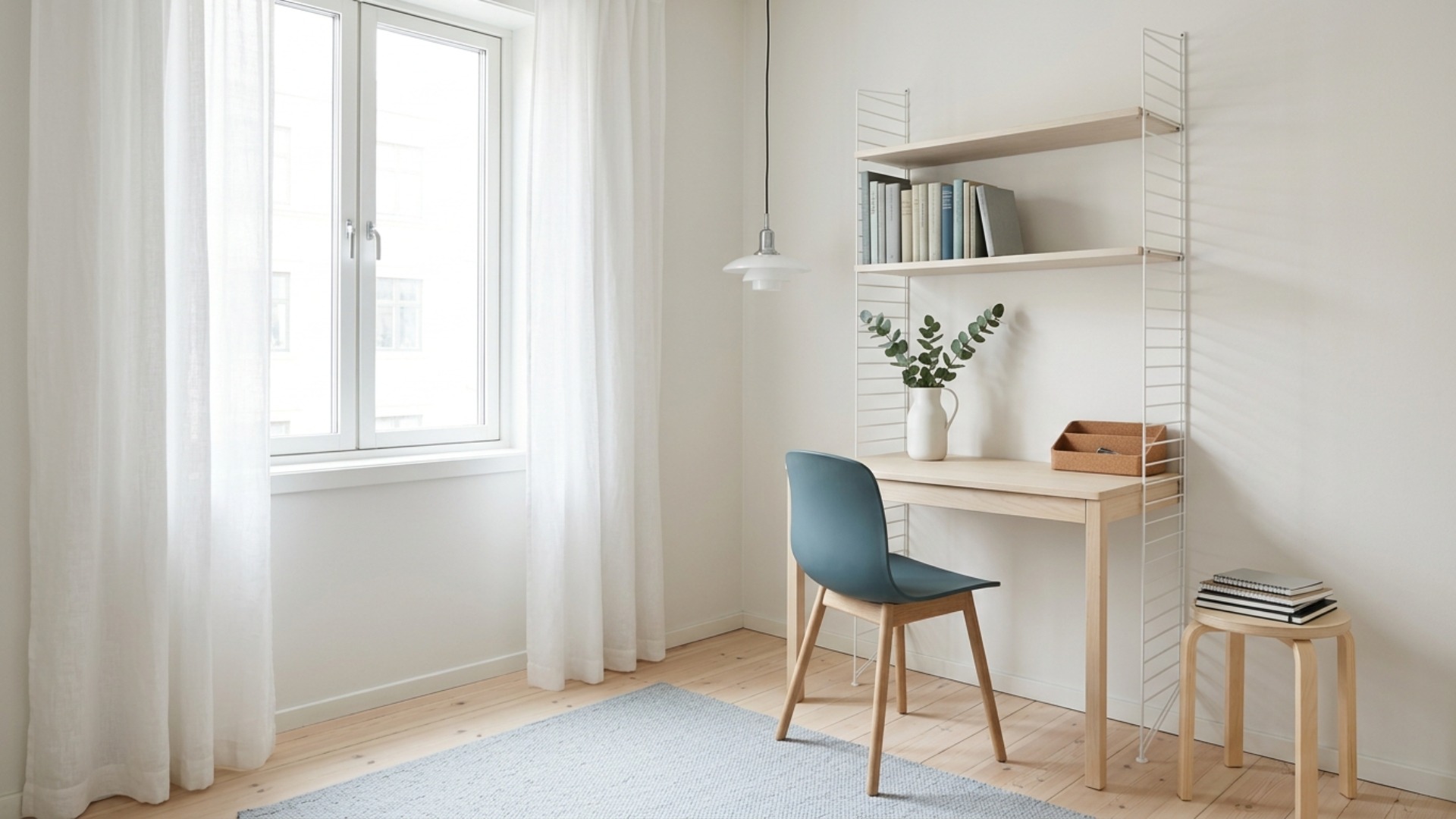
The real problem
Why this is harder than it looks
The usual first-apartment office is a desk bought in a hurry, pushed against whatever wall was empty, under the room's one overhead bulb. It works for a week. Then the surface silts up with cables and mail, the chair starts hurting by two in the afternoon, and the corner becomes the place in the apartment you least want to look at. People blame the small space. The space is not the problem.
What is actually going on is that a workspace fails on three specifics: light, storage, and the chair. Scandinavian design is strict about all three, which is why it suits a first office better than almost any other style. It was developed for small northern apartments with long dark winters, so it treats daylight as the most valuable object in the room and storage as something that climbs walls instead of eating floor.
Your starting point is probably a corner of a bedroom or living room, a rented wall you cannot paint, and a budget that has already survived a deposit and a couch. That is fine. The Scandinavian version of an office is deliberately small: one honest desk, one good chair, wall-mounted shelving, and daylight managed with sheer curtains rather than blocked with heavy ones.
The failure pattern to avoid is buying the whole office as a matched set from one showroom trip, in dark wood, with a bulky executive chair. Dark furniture shrinks a small room, and an oversized chair turns a work corner into a furniture problem. Keep it pale, keep it legged, and put the money in the chair, not the desk.
A clear path
How to plan it
-
01
Claim the daylight before you place anything
Put the desk perpendicular to the window, not facing it and not with your back to it. Sitting side-on kills screen glare and keeps the light on your work through the day. Swap heavy curtains for sheer white linen if the lease allows, since a Scandinavian office runs on every lumen the window gives.
-
02
Buy the chair first and the desk second
The chair is the piece you feel for eight hours, so it gets the biggest slice of the budget. A used Herman Miller or Steelcase task chair at 200 to 400 dollars beats any new chair at the same price, and a simple pale birch or white desk, IKEA Lagkapten or a secondhand find at 50 to 150 dollars, carries the style fine.
-
03
Send storage up the wall in one system
Floor cabinets eat the little space a first apartment has, so mount one coherent shelving run above or beside the desk: a String Pocket, IKEA Boaxel, or simple birch brackets and shelves. One system in one finish reads calm; three mismatched units read like a dorm. Renters can use freestanding ladder shelving to the same effect.
-
04
Keep the palette to white, one pale wood, and one quiet color
Scandinavian discipline is what separates a calm office from a beige one: white or chalk walls, birch or pale oak surfaces, and a single muted accent such as grey-blue or sage carried by the chair, the rug, or a wool throw. Warm the evenings with a 2700K desk lamp instead of the overhead bulb, which flattens everything it touches.
-
05
Preview the corner in Framehouse before spending
A first apartment rarely has a spare foot, so a desk that is two inches too deep genuinely matters. Photograph the corner and test the setup in Framehouse first: check the desk depth against the walkway, see the shelving on your actual wall, and compare birch against white before anything is ordered or assembled.
Built for first apartment
Moves that pay off
A first apartment office is a sequencing problem: rent, deposit, and couch came first, so the office has to earn its footprint piece by piece.
- Measure the corner before the desk, including the swing of the nearest door and the walkway you cross to reach the bed or kitchen.
- Spend on the chair, save on the desk. The reverse is the most common and most regretted split.
- Choose wall-mounted or freestanding storage you can take to the next apartment, since the first lease is rarely the last.
- Defer the printer, the second monitor arm, and the pinboard until you have worked in the corner for a month and know what you actually reach for.
- Skip anything in dark wood or glossy black in a small rented room; it swallows light you cannot spare.
- Keep every cable off the floor from day one with a mounted tray, because cable mess is the thing that makes a small office feel like a temporary one.
scandinavian cues
What to keep, what to skip
The Scandinavian kit is small and precise, which is exactly what a first office needs.
- Palette: white or chalk walls, birch or pale oak, and one muted accent such as grey-blue, sage, or clay, nothing louder.
- Materials: matte pale wood, wool, paper, cotton, and steel in white or grey; save leather and brass for later rooms.
- Light: sheer curtains on the window, a warm task lamp on the desk, and the overhead bulb left off while you work.
- Line: slim legs, thin surfaces, and open air under the desk so the floor reads continuous in a small room.
- Craft: one visibly well-made object, a turned-wood stool or a good ceramic mug, does more than a shelf of decor.
- Skip: matched furniture sets, dark executive chairs, glass desks, and the grey-on-grey palette that turns Scandinavian into an office cubicle.
Use it for
What people plan with Framehouse
- Check a 47-inch desk against your actual corner before ordering it.
- Compare birch against white for the desk on a photo of your real wall.
- See whether ladder shelving or wall rails suit the room better before buying either.
- Test where the desk sits relative to the window to kill screen glare.
- Show a roommate the plan for the shared corner before furniture arrives.
Quick answers
Common questions
Make a plan you can act on
Skip the spiral of mood boards. Three minutes in the Aura Quiz turns your taste into a direction.
Take the Aura Quiz