Coastal Home Office Ideas for Your First Apartment
Coastal is a renter's style: it lives in light, linen, and a little natural wood, none of which need a landlord's permission. This page shows how to turn a beige corner into a calm place to work, on a first-apartment budget.
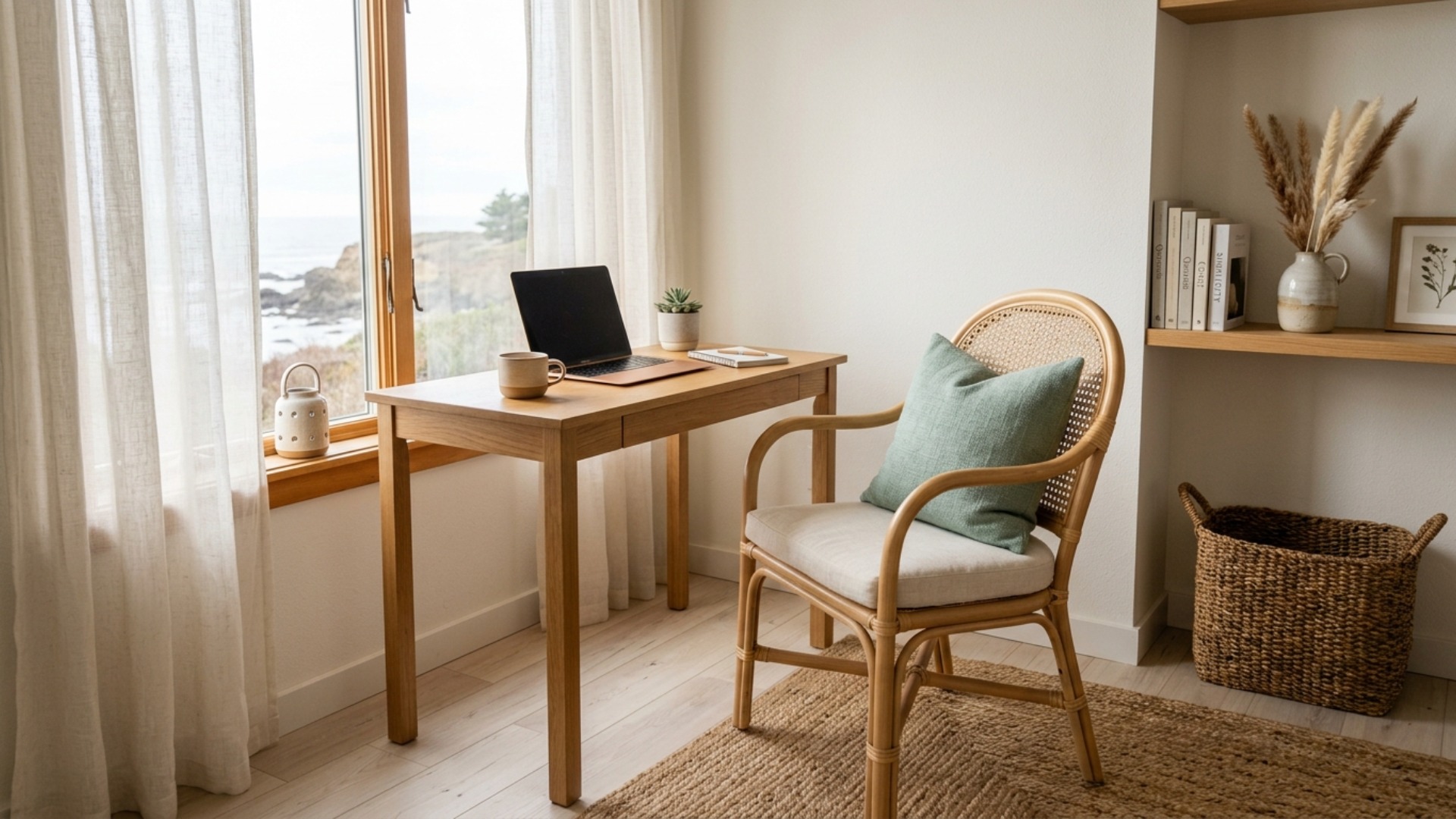
The real problem
Why this is harder than it looks
Coastal usually gets read as a literal beach theme: seashells, an anchor, navy-and-white stripes, maybe a ship wheel on the wall. In a first apartment people buy a few nautical props and a blue accent they cannot even paint, and the corner ends up looking like a gift shop rather than the calm airy space they pinned.
What coastal actually is is light, air, and natural texture: off-white, sand, weathered wood, linen, and woven fibers. It is the feeling of a bright room near water, not a pile of ocean objects. For a home office that distinction matters, because the whole point is a calm place to focus, and theme clutter is the fastest way to lose it.
Your real starting point is a rental: builder-beige or white walls you cannot change, a tight budget, and a home office that is really a corner of the bedroom or the living room. You cannot renovate, you can only add and arrange. The good news is that coastal is a renter's style, because it lives in textiles and a few natural materials rather than in construction.
The failure pattern is spending the whole small budget on themed decor and a trendy desk, then ending up with a corner that photographs well and works badly. The other version is going all-white and cold. A coastal office works when the light is maximized, the texture is layered, and the desk actually functions.
A clear path
How to plan it
-
01
Put the desk where the light is, facing or beside the window
Coastal is about light, and a home office needs it more than any other zone. Position the desk beside a window so daylight rakes across the surface rather than glaring behind your screen, and keep the sightline from the chair open. If the only spot is dark, add a warm 2700K task lamp and a mirror to bounce what light there is.
-
02
Start with warm white and sand, then one quiet blue
Skip the navy and the nautical stripes. Use the off-white or beige walls you already have as the base, layer in sand, oatmeal, and natural wood, then add one soft muted blue or sea-glass green through a cushion, a tray, or a piece of art. As a renter you can do all of this with removable pieces and no paint at all.
-
03
Bring in linen, jute, and rattan, not seashells
Coastal reads through texture: a jute or sisal rug under the chair, a linen curtain, a rattan or cane desk chair, a woven basket for cables and files. These do the work that a bowl of shells cannot, and most come cheap from IKEA, HAY, or a thrift store. One piece of driftwood-toned wood is all the literal beach you need.
-
04
Choose a real desk and hide the cables
A coastal office is calm because it is uncluttered, so function comes first. Pick a simple light-wood or white desk with one drawer, add a cable tray underneath, and give yourself a single woven tray for the things that pile up. A clear surface with good light reads more coastal than any accessory you could buy.
-
05
See the setup in Framehouse before spending your deposit budget
In a first apartment the budget is small and returns are a hassle, so the wrong desk or rug is expensive. Framehouse renders your actual corner in coastal so you can test whether a light oak or a white desk suits the room, and how a jute rug and a linen curtain change the feel, before you spend money you would rather keep.
Built for first apartment
Moves that pay off
A first apartment means renting, a tight budget, and walls you cannot change. Coastal suits it because the style lives in textiles and a few natural pieces, all of which move with you.
- Choose renter-safe updates: lean art instead of drilling, and add nothing you cannot take down.
- Buy pieces that move with you. A desk, a chair, a rug, and a lamp are an office in any future apartment too.
- Spend on the chair and the light first. Comfort and daylight matter more than decor when you actually work there.
- Skip themed decor. One woven basket and a linen curtain do more than a whole shelf of coastal props.
- Use what the landlord gave you. Beige or white walls are already a coastal base, so you do not need to paint.
- Keep a small budget back for cable management and storage, the two things that make a shared-room office usable.
coastal cues
What to keep, what to skip
Coastal is light, air, and natural texture in a soft, sun-bleached palette. Get the texture and light right and it never tips into beach-theme kitsch.
- Palette: off-white, sand, oatmeal, weathered wood, and one soft blue or sea-glass green. No navy-and-rope cliches.
- Materials: linen, cotton, jute or sisal, rattan and cane, and pale or driftwood-toned wood.
- Light is central: sheer or linen window treatments, and nothing heavy blocking the daylight.
- One structural signature: a woven or rattan piece, such as a cane chair or a jute rug, anchors the whole look.
- Texture over pattern: layered natural weaves carry more than any printed motif.
- What to skip: seashells, anchors, ship wheels, and navy stripes. One piece of natural wood is enough ocean.
Use it for
What people plan with Framehouse
- Test whether a light oak or a white desk suits your actual corner before buying
- See how a jute rug and a linen curtain change a rented beige room
- Compare a soft blue against a sea-glass green accent in your real light
- Show a roommate how the office corner will fit without taking over the room
- Plan a renter-safe setup that packs up and moves to the next apartment
Quick answers
Common questions
Make a plan you can act on
Skip the spiral of mood boards. Three minutes in the Aura Quiz turns your taste into a direction.
Take the Aura Quiz