Japandi Bedroom Ideas for a First Apartment
Japandi is the rare style that gets better the less money you have, because its whole argument is that a few honest things beat a room full of adequate ones. This page covers what to buy first in a first apartment, what the landlord white walls are actually doing to the look, and where the cheap version goes wrong.
The real problem
Why this is harder than it looks
Japandi is usually explained as Scandinavian plus Japanese, which is true and not very useful. The part that matters for a first apartment is that both traditions came out of small rooms and limited means, so the style is built around subtraction rather than accumulation. That makes it one of the few looks you can actually finish on a first salary, as long as you understand that finishing means owning less, not owning cheaper versions of more.
What is really going on underneath is a contrast between warmth and discipline. The Scandinavian half brings light wood, soft textiles, and comfort. The Japanese half brings low furniture, clean horizontal lines, negative space, and a refusal to display things. Take away either half and it stops working: all warmth and no discipline is just Scandinavian, all discipline and no warmth is a waiting room.
A first apartment starts you in a specific and slightly hostile position. You have builder-grade white walls with a cool blue undertone, a ceiling light you cannot change, engineered floors you did not choose, and a lease that says no drilling. None of that stops a Japandi bedroom, but it does change the order of work, because the things you would normally fix with paint have to be fixed with textiles and lamps instead.
The failure pattern is treating Japandi as a shopping aesthetic: a rattan headboard, a bouclé pouffe, a wavy mirror, three pampas stems in a jug. That is a Pinterest board, not a style. Japandi in a rental is carried by four decisions, the bed height, the light temperature, one wood tone, and how much you are willing to leave off the surfaces. Everything else is optional and most of it is a distraction.
A clear path
How to plan it
-
01
Get the bed low and get the bedding right
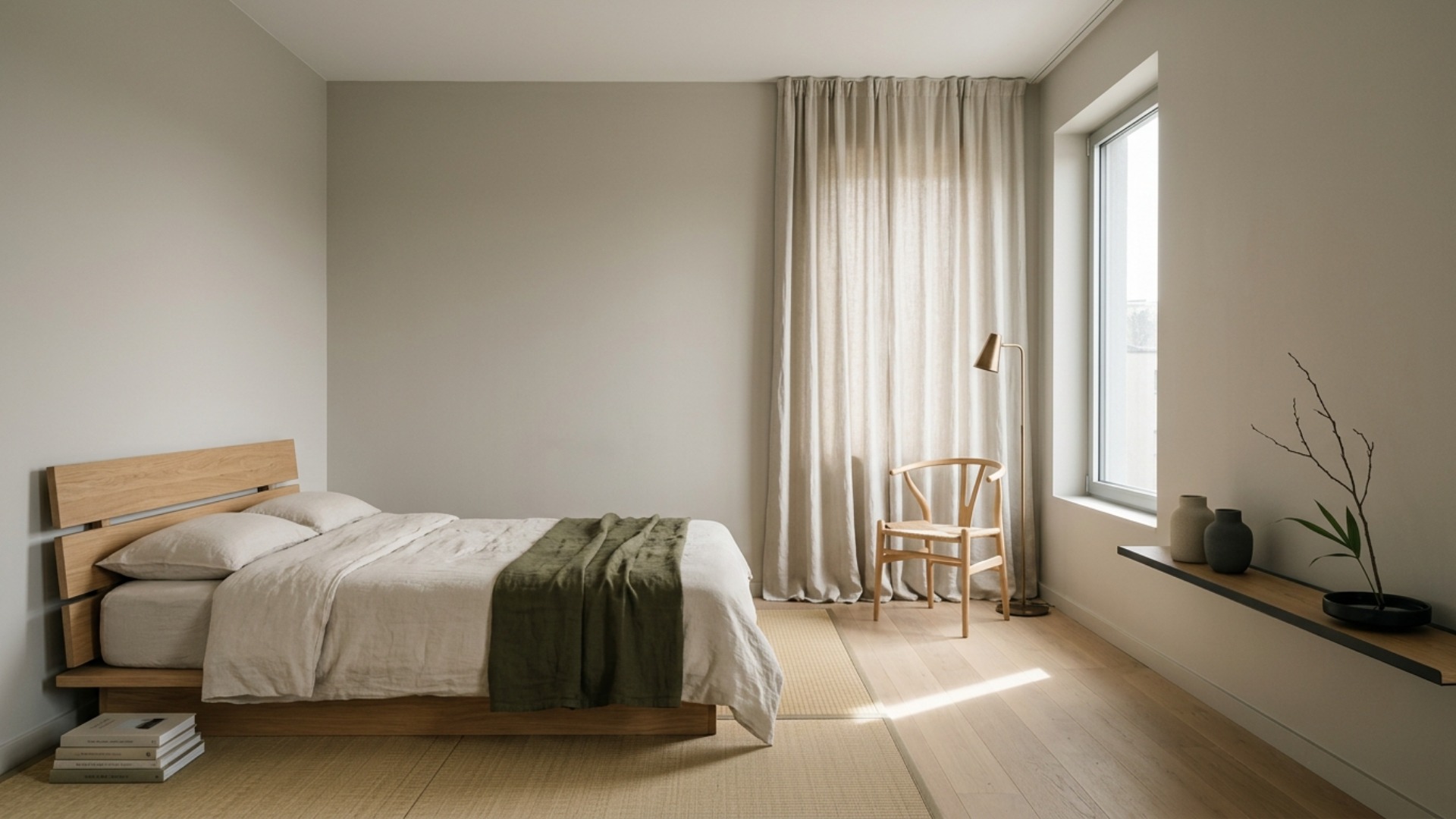
Height is the single most Japandi thing in a bedroom and it costs nothing extra. A low platform frame, ideally under 30 centimetres to the top of the mattress, immediately makes a small rental ceiling read as taller. Then put the money into bedding, because it is the largest surface in the room and the one you touch: washed linen or heavy cotton in oatmeal, greige, or soft white, and no headboard rather than a bad one.
-
02
Fix the light before you fix anything else
Rental lighting is almost always a single cool ceiling fitting, and it will flatten every material in the room no matter what you buy. Swap to 2700K bulbs, which costs about $20, and add two low light sources, a floor lamp in a corner and something small at bed height. If the ceiling shade is bad and you cannot replace the fitting, a plain paper or opal shade clips or screws on in five minutes and comes down again when you move.
-
03
Commit to one wood tone and hold the line
Japandi tolerates almost no wood mixing, which is helpful when you are buying secondhand and tempted by whatever is cheap. Pick light oak or ash and refuse everything darker or redder, including the pine that dominates cheap furniture and the orange-toned mid century pieces that keep turning up on marketplace listings. One tone across the bed, any shelf, and the nightstand does more for the room than any single purchase.
-
04
Solve the walls without paint
Most first apartments will not let you paint, and rental white is cool and unforgiving. Work around it: hang one large piece of unframed natural linen or a plain textile panel on the main wall using removable strips, add a floor-standing mirror rather than a hung one, and let a floor lamp wash the wall with warm light. That combination softens a cold white far more effectively than trying to cover it with framed prints.
-
05
See it before you spend the deposit money
A first apartment budget has no slack in it, and a bed frame or a rug bought at the wrong scale is money you will not get back. Photograph the room and use Framehouse to test the bed height, the wood tone, and the rug size against your actual walls and floor before ordering. It is particularly worth checking against rental white, since a warm oak that looks right in a showroom can read orange against a cool builder white.
Built for first apartment
Moves that pay off
A first apartment is a temporary room with a permanent budget problem. Buy for the next three rooms, not just this one.
- Buy the mattress and the bedding new, and everything else secondhand if you can. Those are the two things that do not move well between homes and the two you use every night.
- Choose pieces that survive a move. Solid low frames, a light floor lamp, and one shelf will fit almost any future room. A fitted wardrobe unit will not.
- Do not buy a headboard yet. It is the most style-specific purchase in a bedroom and the easiest one to get wrong before you know what the room needs.
- Use removable command strips and tension rods rather than drilling. Losing a deposit is more expensive than every decorative decision on this page combined.
- Spend on the floor lamp. It is the piece that carries the light in every rental and the one you will still own in ten years.
- Leave the surfaces almost empty for the first month. In a small rental, storage pressure shows up fast, and you want to see where it lands before you fill the room.
japandi cues
What to keep, what to skip
Japandi is restraint with warmth. The two halves have to stay in balance.
- Palette: warm off-white and greige, light oak or ash, one matte black, and one muted natural accent such as olive, clay, or charcoal.
- Materials: soaped or oiled light wood, washed linen, undyed cotton, paper cord, rush or jute, hand-thrown matte ceramic. Nothing shiny and nothing synthetic looking.
- Structural signature: everything low and horizontal. A low bed, a low shelf, a long line of sight across the room with nothing tall interrupting it.
- Negative space is a material in its own right. One bare wall and one empty surface are doing as much work as any object you could put there.
- Craft should be visible: a joint you can see, a hand-thrown rim that is not perfectly round, a linen that creases. Machine perfection reads as contemporary, not Japandi.
- What to skip: pampas grass, wavy mirrors, faux rattan, macrame, warm brass everywhere, and any object whose only job is to look Japandi.
Use it for
What people plan with Framehouse
- Check a low bed frame against your ceiling height before buying
- Test a warm oak tone against builder-grade rental white
- See whether a linen wall panel warms the room more than framed art
- Compare a 160 by 230 rug against a 200 by 300 in the actual room
- Show a flatmate or partner the plan before anything gets ordered
Quick answers
Common questions
Make a plan you can act on
Skip the spiral of mood boards. Three minutes in the Aura Quiz turns your taste into a direction.
Take the Aura Quiz