Coastal Bedroom Ideas for Your First Apartment
Coastal is the easiest style to buy and the hardest to earn, because almost everything sold as coastal is a souvenir rather than a material. This page covers how to build the light, the linen, and the sand tones in a rental bedroom on a first apartment budget, and which beachy objects to leave in the store.
The real problem
Why this is harder than it looks
Coastal is the most heavily merchandised style in the home aisle, which is why it is the one people get wrong the fastest. Search it and you will be shown rope, oars, driftwood letters, and a cushion with a whale on it. None of those things appear in the rooms that actually look coastal. What appears instead is a set of surfaces that all happen to be pale, matte, and slightly imperfect, photographed on a bright day.
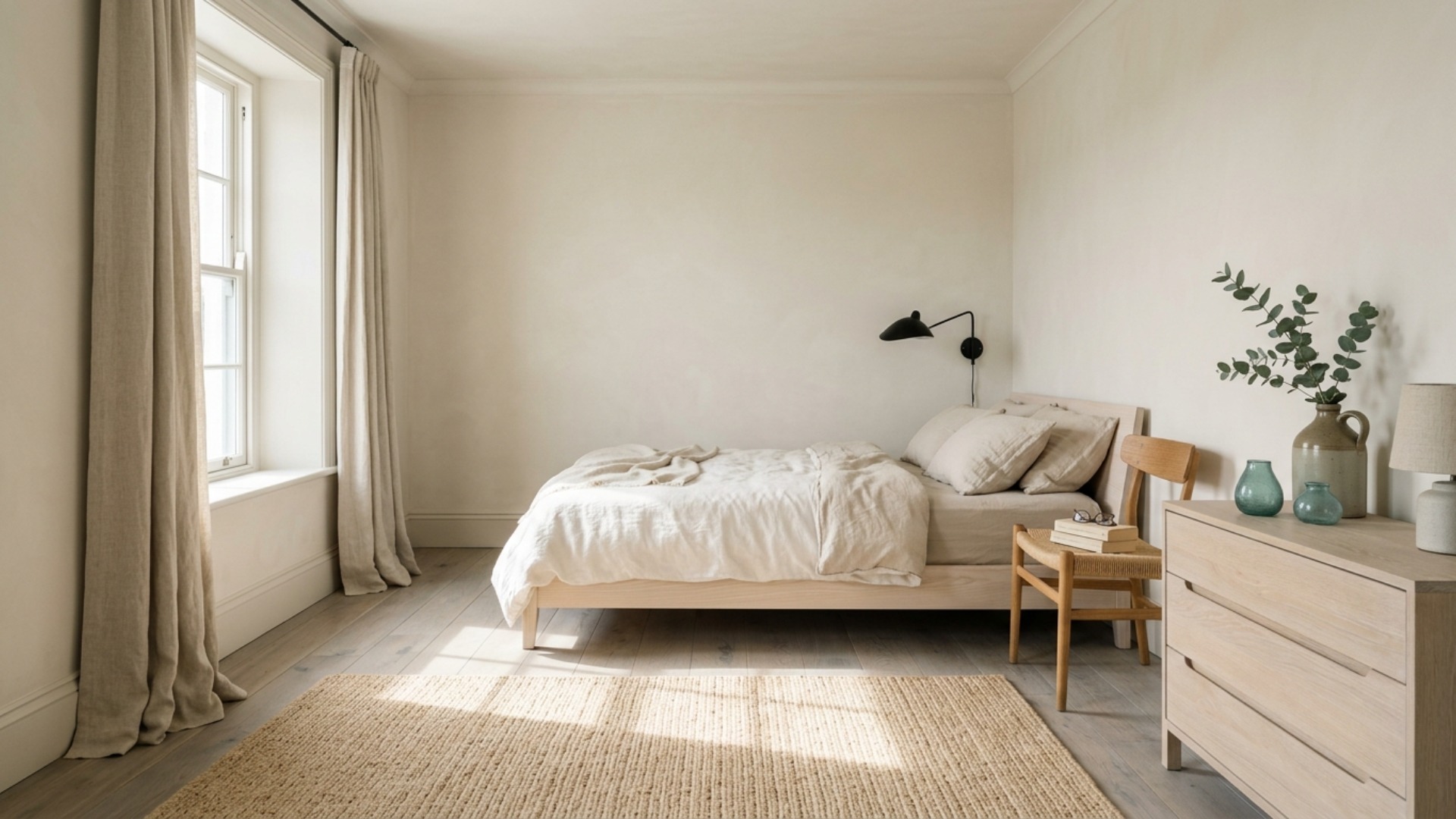
That is the real mechanism. Coastal is not a color story, it is a light story. Off-white limewash, sand, weathered oak, jute, and washed linen all share one property: they are rough enough to scatter light instead of bouncing it. Put four of those textures in a room and it reads as coastal with no blue in it at all. Put one glossy white lacquer dresser in the same room and the effect collapses, because the light suddenly has somewhere hard to land.
A first apartment starts you somewhere specific and slightly against you. The walls are builder white with a cool blue-grey undertone, there is one overhead fixture running a 4000K bulb, the floor is a mid-brown engineered plank you did not choose, and the lease says no paint and no drilling. That is a room that already leans cold and flat, which is exactly the opposite of the condition coastal needs.
So the failure pattern is predictable and it goes one of two ways. Either the room drifts grey, because someone trusted a paint chip labelled coastal that had a blue undertone in it, and now everything reads like a waiting room. Or it drifts nautical, because the objects were asked to do the job the surfaces should have done. The fix in both cases is the same: get the temperature and the texture right first, and buy almost nothing that references the sea.
A clear path
How to plan it
-
01
Warm the whites before you buy anything blue
The single biggest lever in a rental coastal bedroom is color temperature, and it costs about twenty dollars. Swap every bulb in the room to 2700K, and if the ceiling fitting is a bare cool-white dome, add a paper or opal shade over it. Builder white plus a 4000K bulb makes sand, linen, and oak all read grey, and no amount of shopping recovers from that.
-
02
Put the money in bedding, and buy texture rather than print
The bed is the largest surface in the room, so it settles the style before anything else does. Choose washed linen or heavy stonewashed cotton in oatmeal, chalk, or a warm soft white, and refuse anything with a stripe, a print, or a satin sheen. A full set runs roughly $150 to $250 and it is the one purchase on this page worth buying new.
-
03
Add one rough natural texture at floor level
Coastal rooms feel grounded because something underfoot has a visible weave. A jute or seagrass rug is the cheapest way to get it, and it needs to be big enough to run past both sides of the bed, usually 8 by 10 for a queen rather than the 5 by 7 that feels safer in the cart. If jute is too scratchy first thing in the morning, lay a small washable cotton runner on top on the side you get out of.
-
04
Solve the window and the blank wall without a drill
Vertical blinds are the most rental thing in any rental and also the easiest fix. Hang unlined oatmeal linen curtains on a tension rod inside the frame or a spring rod above it, mount them as high as the ceiling allows, and let the hem just touch the floor. On the main wall, one large unframed panel of natural linen or a leaning floor mirror warms a cool white far more than a gallery of small frames.
-
05
See it in your own room before the money leaves
A first apartment budget has no slack, and a rug at the wrong size or an oak tone that turns orange against builder white is money you do not get back. Photograph the bedroom and use Framehouse to test the wall temperature, the rug scale, and the wood tone against your actual floor and light. Sand and off-white are unusually hard to judge from a swatch, since both change character completely depending on the white behind them.
Built for first apartment
Moves that pay off
A first apartment is a temporary room with a permanent budget. Buy for the next three apartments, not only this one.
- Buy the mattress, the bedding, and the pillows new. Everything else can be secondhand, and coastal genuinely improves with wear.
- Spend your largest single amount on lighting rather than furniture. A good floor lamp moves with you and fixes every rental you will ever live in.
- Do not buy a headboard in the first month. It is the most style-specific purchase in a bedroom and the easiest one to regret.
- Skip the accent wall idea entirely. If you cannot paint, textiles and lamps will take you further than any removable wallpaper.
- Buy the rug before the art. Floor texture carries coastal. Wall art does not.
- Live with empty surfaces for a few weeks. In a small bedroom you need to see where the clutter actually lands before buying storage for it.
coastal cues
What to keep, what to skip
Coastal is a texture and temperature style. Get those two right and you can leave out every blue thing in the room.
- Palette: warm off-white and chalk, sand, weathered oak, and one muted accent such as sea glass green, soft clay, or a faded denim blue. Never more than one accent.
- Materials: washed linen, undyed cotton, jute and seagrass, limed or weathered oak, rattan, unglazed matte ceramic. Everything matte, nothing lacquered.
- Structural signature: light that moves through the room rather than sitting in one place. Curtains hung high, a low bed, nothing tall blocking the window.
- Warm your neutrals against the wall you actually have. A sand that looks perfect on a chip can go green or pink against builder white.
- One woven object at eye level is enough: a rattan pendant shade, a large basket, or a mirror in a cane frame. One, not four.
- What to skip: navy and white stripes, rope and oars, driftwood signage, shells in glass jars, anything with a starfish on it, and glossy white lacquer furniture.
Use it for
What people plan with Framehouse
- Test a warm sand tone against your builder white before buying paint or textiles
- Check an 8 by 10 jute rug against your bed size and door swing
- Compare weathered oak and bleached ash under your actual window light
- See whether ceiling-height linen curtains fix the room without new furniture
- Show a roommate or a partner the plan before anything gets ordered
Quick answers
Common questions
Make a plan you can act on
Skip the spiral of mood boards. Three minutes in the Aura Quiz turns your taste into a direction.
Take the Aura Quiz