Industrial Living Room Ideas for a Family Home Refresh
Industrial has a reputation for being a hard style to live in with children, and most of that reputation comes from people copying a photography studio instead of a home. This page shows how to keep the steel and the brick while making the room genuinely comfortable for a family.
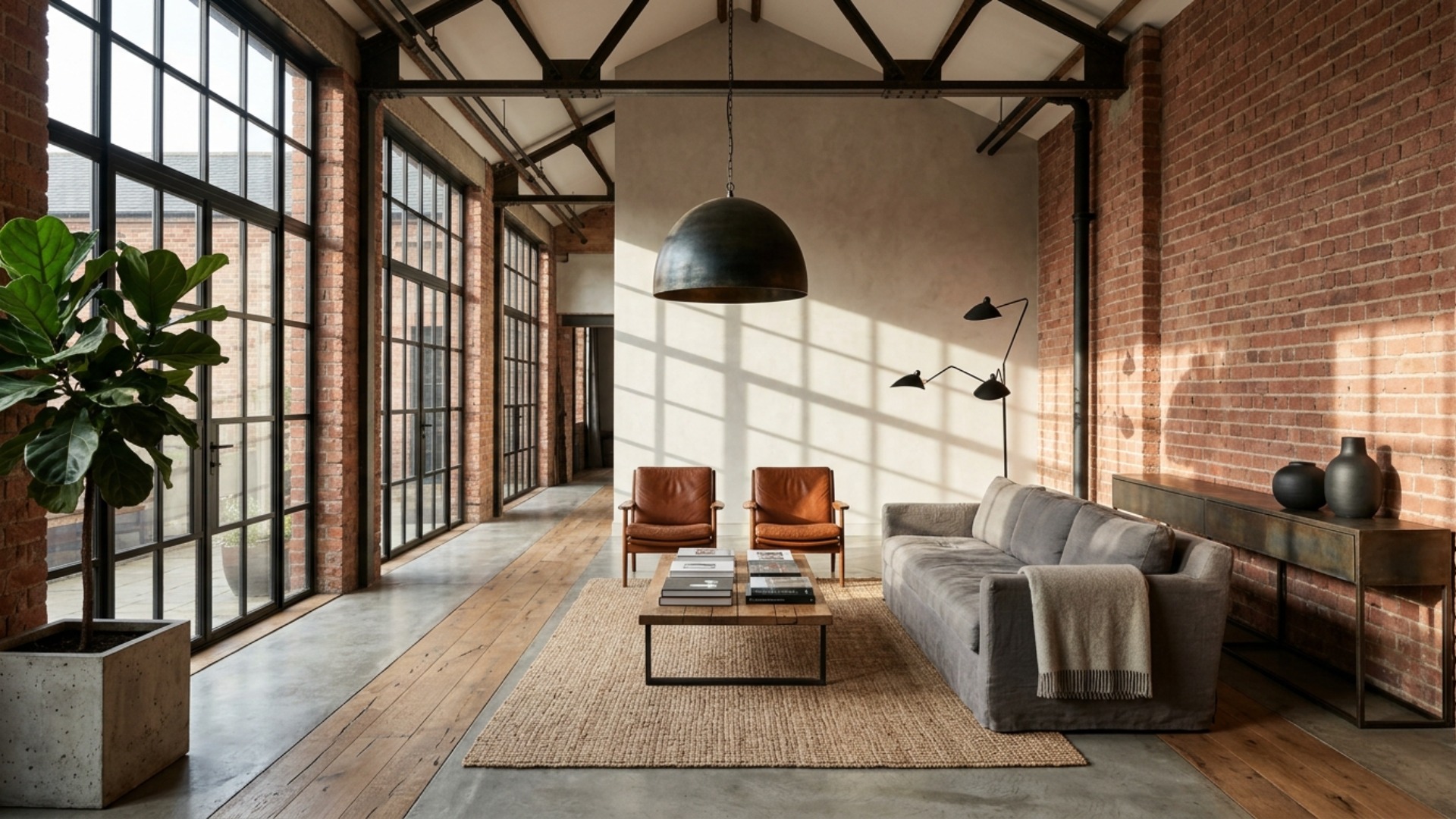
The real problem
Why this is harder than it looks
The industrial rooms people save to a board are almost always commercial spaces. Bare concrete, one leather chair, a single filament bulb hanging on a cord, and nothing soft anywhere. Copied literally into a family living room, that becomes a space with terrible acoustics, no seating, and a coffee table with a corner at toddler head height. The style gets blamed for being cold when what actually happened is that a photograph of an empty loft got treated as a floor plan.
The interesting thing about industrial is that it was never a decorating style to begin with. It is what happened when people moved into buildings designed for machines and softened them enough to live in. The tension between hard shell and soft contents is the whole point. A brick wall reads warm when there is a wool rug in front of it. On its own it reads like a parking garage.
A family refresh usually arrives with the room already full. There is a sofa that has survived a decade, a television that has to stay, a rug with a stain, and a corner where the toys live whether you planned for it or not. This is not an empty room you get to stage. It is a working room you are trying to make coherent, and pretending otherwise is why refreshes stall halfway.
The failure pattern is buying hardness. People add a metal shelving unit, a concrete side table, and a black metal floor lamp, and the room gets louder, colder, and less usable, so nobody sits in it. Industrial in a family home works in the opposite direction: keep or expose two or three genuinely hard elements, then spend everything else on warmth, softness, and things that survive a spilled drink.
A clear path
How to plan it
-
01
Find the hard element you already have and expose it
Almost every house has one: a brick chimney breast under plaster, a steel lintel over a wide opening, original floorboards under carpet, or a concrete slab under vinyl. Uncovering one is usually cheaper than buying an industrial-looking object and it will always look more convincing, because it is actually structural. If nothing is hidden, the honest substitute is a single wall in a limewash like Bauwerk Colour Slate, not a panel of fake brick veneer.
-
02
Warm the palette before you add any more metal
Industrial goes wrong on temperature, not on color. Bring the walls to a warm grey rather than a blue grey: Farrow and Ball Mole's Breath or Benjamin Moore Kendall Charcoal in a matte finish, both of which sit against brick without turning it pink. Then bring in cognac leather, natural jute, and undyed wool. Aim for roughly two thirds warm materials to one third hard ones, and the room will read industrial without reading like a workshop.
-
03
Buy the seating for actual family use, then make it look right
A performance fabric sofa in a stonewashed grey, deep enough for an adult to lie down on, does more for this room than any decorative purchase. Crypton and Sunbrella weaves handle juice and dogs and no longer look like outdoor furniture. Skip the vintage leather chesterfield as the main seat if you have young children, since real aniline leather scratches immediately, and keep the aged leather for a single armchair where the patina is a feature rather than a worry.
-
04
Fix the acoustics, which is the part nobody photographs
Hard floors, brick, and high ceilings turn a family room into an echo chamber, and that is the real reason people find industrial spaces uncomfortable. A wool rug with a felt underlay, unlined heavy curtains on a black steel rod, and a full bookcase along one wall will take the ring out of a room faster than any acoustic panel. This is the single most underrated move in the whole style.
-
05
Layer the lighting so the room works after dark
One caged pendant on a dimmer is a look. It is not lighting. Add a floor lamp behind the seating, a table lamp with a linen shade on the console, and warm 2700K bulbs everywhere, then put as much of it as possible on dimmers. Industrial fixtures throw hard light, so the fix is more sources at lower output rather than one bright fitting overhead.
Built for family home refresh
Moves that pay off
A family refresh is a sequencing problem more than a shopping problem, because the room has to keep working while you change it.
- Start with the two things that are hardest to change later: the wall color and the floor. Everything else can be swapped in stages without redoing the room.
- Deal with the television honestly. Mount it low over a long steel and oak console rather than above the fireplace, where it is both a neck ache and the loudest object in the room.
- Give the toys a permanent home in the room rather than a temporary one in the hallway. Two large woven baskets under the console are the least visually noisy solution.
- Replace soft furnishings before furniture. New cushions, a wool throw, and a rug in the right scale will change the room more than a new armchair, and cost a fifth as much.
- Defer the light fittings. They are the most satisfying purchase and the least urgent, and prices on good industrial pendants do not move much.
- Keep one piece with real history in it, even if it does not match: an old workbench, a grandparent's chair, a scratched trunk. Industrial rooms need evidence of use, and a family home already has some.
industrial cues
What to keep, what to skip
Industrial reads best when the hard materials are original and the soft ones are generous. Getting that ratio right matters more than any single purchase.
- Palette: warm grey and soft red brick as the base, blackened steel for line work, and cognac leather as the one warm accent. Keep blue undertones out of the greys.
- Materials: brick, concrete, blackened or oxidised steel, aged leather, reclaimed oak with saw marks, heavy jute, and raw linen. Everything should look like it could take a knock.
- Structural signature: exposed structure. A visible steel beam, a bare brick chimney breast, or unpainted lintels do more work than any furniture in the room.
- Scale: industrial rooms want fewer, larger objects. One oversized pendant, one wide low console, one big rug. Small items scattered around read as clutter against a hard shell.
- Softness: at least one wall-height textile and one thick rug, always. This is the difference between a warm loft and a cold garage.
- Skip: fake distressing, Edison bulbs in every socket, corrugated metal accent panels, and signage with the word Factory on it.
Use it for
What people plan with Framehouse
- Test a warm grey against your brick before committing to two coats
- See whether an exposed chimney breast is worth uncovering
- Check that a wide sectional still leaves a walkway for children
- Compare a cognac leather chair against the floor you already have
- Show a partner the room with the television mounted lower
Quick answers
Common questions
Make a plan you can act on
Skip the spiral of mood boards. Three minutes in the Aura Quiz turns your taste into a direction.
Take the Aura Quiz