Japandi Kitchen Ideas for a Family Home Refresh
Japandi is usually photographed in homes where nobody spills anything, which makes families assume it is not for them. The opposite is true: a kitchen that hides clutter by design is the most family-proof style there is, if you build it in the right order.
The real problem
Why this is harder than it looks
The standard objection to japandi in a family kitchen is that it cannot survive children: the empty counters, the pale wood, the three considered objects. That objection mistakes the photograph for the system. The photograph is what the kitchen looks like after the system works, not a discipline the family has to perform every hour.
What japandi actually is, in a working kitchen, is a storage philosophy with a warm finish. Everything has a home that is easier to use than the counter, the palette is tight enough that the room looks composed even when it is half tidy, and the materials are chosen to wear rather than to stay perfect. Scandinavian homes run this way with kids in snowsuits; the style was never fragile.
Your starting point is a kitchen that already works structurally, which is what makes a refresh different from a renovation. The cabinets are fine, the layout is fine, and the family cannot lose the room for six weeks. The style has to arrive through paint, hardware, lighting, open surfaces, and storage behavior, not through demolition.
The failure pattern is starting with the aesthetics and skipping the storage. A family kitchen painted warm white with bare counters and no new storage plan reverts in nine days, and the style gets blamed. Solve where the backpacks, mail, chargers, and snack bowls actually go first, and the calm surfaces become the default state instead of a performance.
A clear path
How to plan it
-
01
Solve the drop zone before touching the style
Every family kitchen has an entropy point where bags, mail, and chargers land. Give that job to one cabinet or a bench with baskets by the door, and empty the counter it used to occupy. This is the least photogenic step and it decides whether every other step survives the first school week.
-
02
Tighten the palette to warm white, oak, and one black
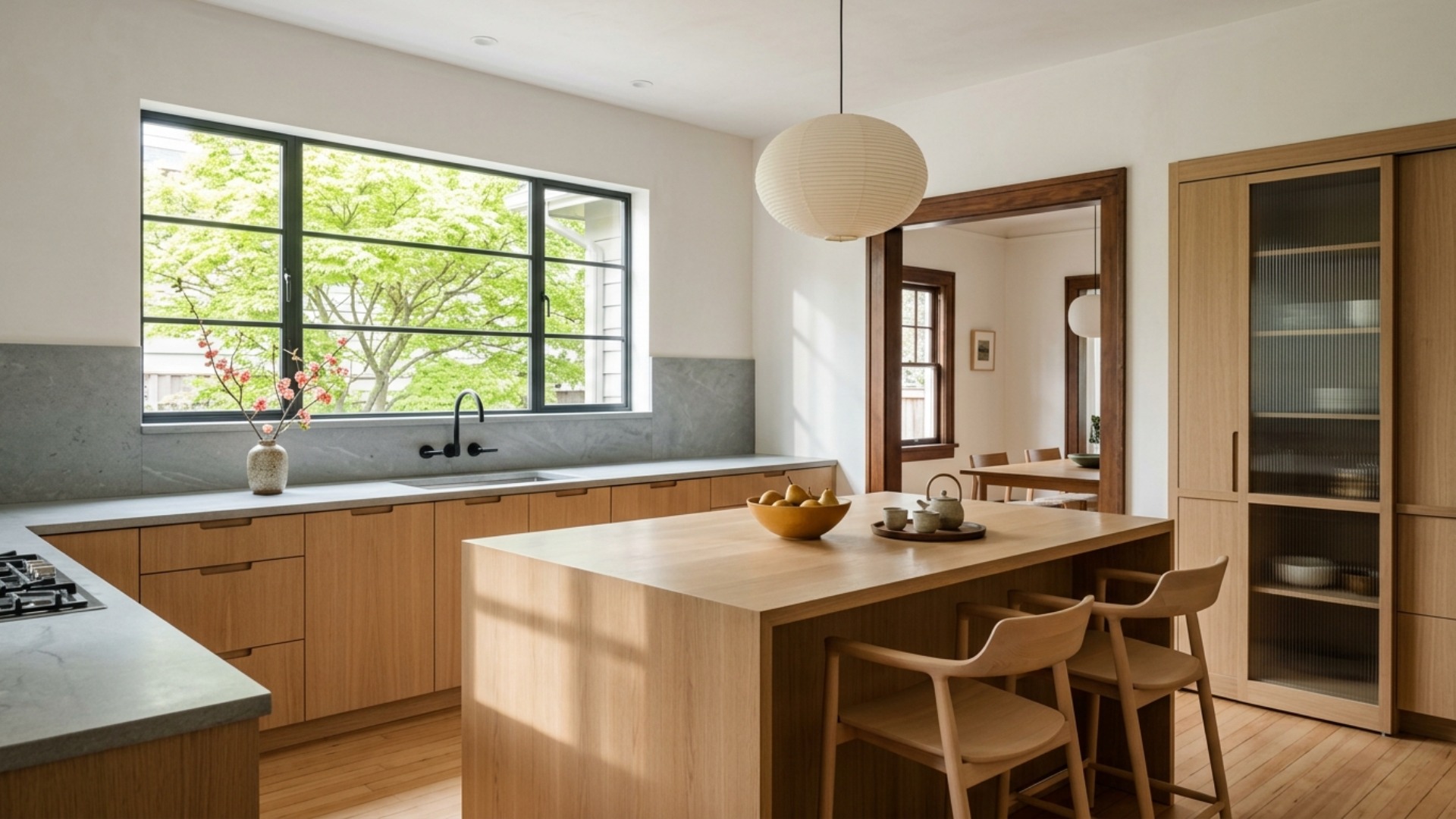
Repaint walls and any dated upper cabinets in a warm white like Benjamin Moore White Dove, keep or introduce oak tones in open shelving or stools, and hold black to hardware and one light fixture. A three-note palette makes a lived-in kitchen read intentional even mid-homework.
-
03
Swap hardware and lighting in one weekend
Matte black or oak pulls, a plain black faucet if yours is builder chrome, and one paper or linen pendant over the table or island, with bulbs at 2700K. This is the highest visible return per dollar in the whole refresh, usually under $350 all in.
-
04
Clear the counters by giving everything a cheaper home
The japandi rule is that a surface is not storage. Move small appliances into a pantry cabinet or an appliance garage, corral daily oils and salt on one oak tray, and let the coffee machine be the single appliance that lives out. A tray is what makes five daily objects read as one considered one.
-
05
Preview the palette on your actual kitchen before painting
Warm whites shift badly against existing floors and counters, and cabinet paint is a two-weekend commitment you do not want to repeat. Photograph the kitchen and test the wall color, hardware, and pendant in Framehouse first, so the one weekend you spend is the right one.
Built for family home refresh
Moves that pay off
A refresh with a family in the house has to be sequenced around real life, which means cheap, reversible, and one weekend at a time.
- Order the work by disruption, not by excitement: drop zone, then paint, then hardware, then lighting, then styling.
- Keep the appliances you have; japandi hides them better than it replaces them, and a panel-ready fridge can wait for the real renovation.
- Put $80 into drawer organizers before any decor purchase. Interior order is what keeps exterior order from being a chore.
- Choose matte and washable finishes: eggshell walls, matte cabinet paint, and unlacquered or powder-coated pulls that hide fingerprints.
- Let kid zones stay kid zones: one low drawer for their cups and snacks keeps the rest of the kitchen calm and them independent.
- Skip anything that needs daily resetting to look right, including open shelf displays deeper than one row.
japandi cues
What to keep, what to skip
Japandi in a kitchen is a narrow palette, honest materials, and a preference for emptiness over display. Keep these lines and the room reads calm even in use.
- Palette: warm white, pale oak, and matte black once or twice, with one muted accent like ochre or clay if the room needs it.
- Materials: wood with visible grain, stone or butcher block, linen, paper, and unglazed ceramic. Nothing glossy, nothing chrome.
- One structural signature: a single run of oak open shelving or a paper pendant at scale, not both.
- Counters hold three things or fewer per run: a tray of daily oils, the coffee machine, one living thing.
- Texture does the decorating: a grainy cutting board, a stoneware bowl, a linen towel on the rail.
- What to skip: word signs, matching canister sets on display, brass overload, and anything that exists only to be looked at.
Use it for
What people plan with Framehouse
- Test a warm white against your existing counters before committing a weekend to it
- See whether black hardware suits your cabinet fronts before ordering forty pulls
- Check that an oak shelf warms the wall without crowding the window
- Compare pendant options over your actual table instead of guessing at scale
- Show the family what the finished kitchen will feel like before the boxes arrive
Quick answers
Common questions
Make a plan you can act on
Skip the spiral of mood boards. Three minutes in the Aura Quiz turns your taste into a direction.
Take the Aura Quiz