Modern Farmhouse Home Office Ideas for a Family Home Refresh
In most family homes the office is where furniture goes to be forgotten, which makes it the highest-return room in a refresh. Here is how to turn it modern farmhouse without a renovation, a barn door, or a single script sign.
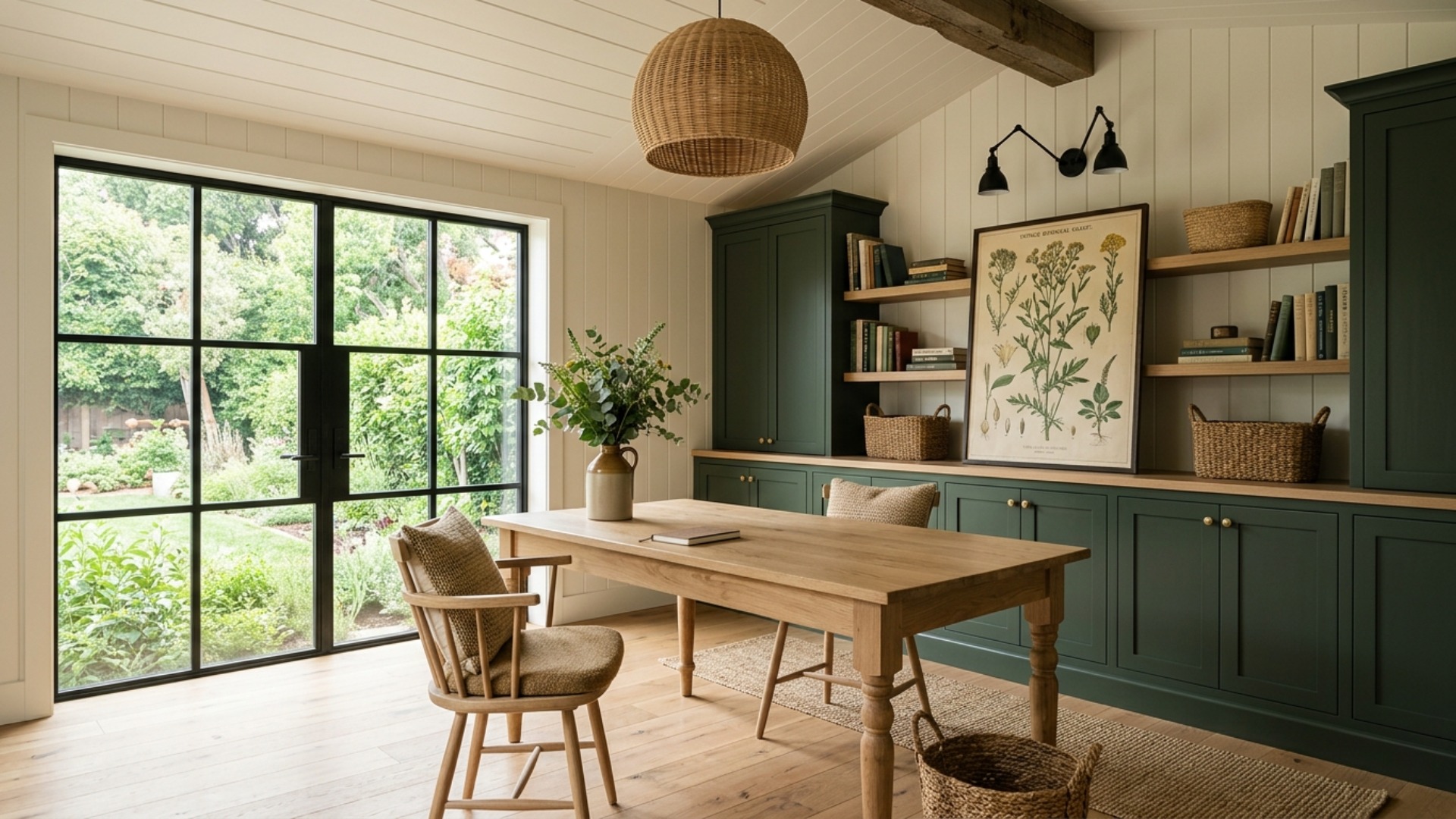
The real problem
Why this is harder than it looks
The home office in an established family home is rarely designed. It accretes: the old dining chairs, the filing cabinet from two jobs ago, the exercise bike, the wrapping paper. Refreshing it is less a decorating problem than an archaeology project, and most inspiration photos skip that part entirely.
The style carries its own trap. Farmhouse is the most merchandised look in America, and the office versions fill up fast with script signs, faux-distressed desks, and a sliding barn door that eats a wall of usable space. That is theme decorating, and it dates in about three years. Modern farmhouse is quieter: warm white walls, one honest wood, black metal in small doses, and one painted accent color doing the personality work.
There is also a purpose problem. In a family home the office is never only an office. It is where homework happens, bills get sorted, and the printer lives. A refresh that designs for one adult on video calls will be overrun within a month, because the room's real job was never in the plan.
The honest starting point is subtraction and daylight. Empty the room completely, see what the window and floor actually give you, and only then decide what earns its way back in. Most office refreshes fail because the junk never fully left.
A clear path
How to plan it
-
01
Empty the room and start from zero
Take everything out, not just the obvious clutter. An empty room shows you the light, the outlets, and the true wall lengths, and it breaks the gravitational pull of furniture that was only there by habit. Sell or donate anything that has not been touched in a year.
-
02
Paint first, and keep it to two moves
Walls in a warm white such as Benjamin Moore White Dove or Sherwin-Williams Alabaster, and one deep accent on cabinetry or a single built-in wall, such as Benjamin Moore Backwoods or Sherwin-Williams Pewter Green. Two colors is the whole farmhouse palette; a third starts the theme-room slide.
-
03
Choose a table, not a desk
A 60 by 28 inch farmhouse table in character-grade oak or pine works harder than any office desk: two people fit for homework hour, the proportions suit the style, and it will move to another room in a future life. Pair it with one comfortable chair in wood or wool, not black mesh.
-
04
Give the family overflow a closed home
One wall of shaker-front cabinets, or a single painted armoire if built-ins are not in budget, absorbs the printer, the paper, and the craft supplies. Add two or three seagrass baskets on open shelves for the kid clutter that arrives daily. Farmhouse forgives many things but not visible plastic.
-
05
Visualize the room before you commit the spend
Photograph the emptied room and test the paint, table, and cabinet color in Framehouse first. Deep greens in particular shift hard between a paint chip and a wall, and seeing the whole room in context is the difference between confident and hopeful.
Built for family home refresh
Moves that pay off
A refresh in a lived-in family home has different rules from a blank-slate build:
- Work in two rounds: paint, lighting, and the table first; storage and styling a month later, once the room's real traffic shows itself.
- Keep one work surface clear for homework and projects. The office earns its place by serving the whole house.
- Favor closed storage over open shelving at roughly two to one. Family paper multiplies in the dark.
- Keep the existing floor. A flat-weave wool rug in oat or stripe warms it for a tenth of the cost of replacement.
- Choose finishes that survive juice and glue sticks: matte paint that wipes, a waxed or oiled table top, no glass.
- Defer built-ins until the layout has survived a season. Cabinetry is the most expensive thing to guess wrong.
modern farmhouse cues
What to keep, what to skip
Modern farmhouse in an office is restraint plus warmth, and the difference from theme farmhouse is what you leave out:
- Palette of warm white, one natural wood tone, matte black hardware, and a single deep accent such as forest green or charcoal.
- Shiplap only if the house already speaks that language, and painted the wall color, never installed as an accent gimmick.
- Black metal in small doses: a library sconce, window hardware, a task lamp. It is punctuation, not a theme.
- Texture from rattan, seagrass, and wool rather than pattern. One woven pendant does more than any gallery wall.
- One vintage or vintage-looking piece, a chair or chest, to keep the room from reading as a catalog page.
- Skip script signs, barn doors, and factory distressing. They are the fastest way to date the whole refresh.
Use it for
What people plan with Framehouse
- Test a deep green cabinet color against your actual room
- See a farmhouse table in the space before selling the old desk
- Compare two storage walls before pricing built-ins
- Check a woven pendant's scale against your ceiling height
- Show a partner the finished room before the first can of paint
Quick answers
Common questions
Make a plan you can act on
Skip the spiral of mood boards. Three minutes in the Aura Quiz turns your taste into a direction.
Take the Aura Quiz