Modern Farmhouse Studio Apartment Ideas for an Empty Room
An empty studio is the one moment you get to build modern farmhouse warmth in the right order, before a rushed furniture run locks the layout in. This page covers where to start, what to buy first, and how to keep a single open room from reading like a showroom floor.
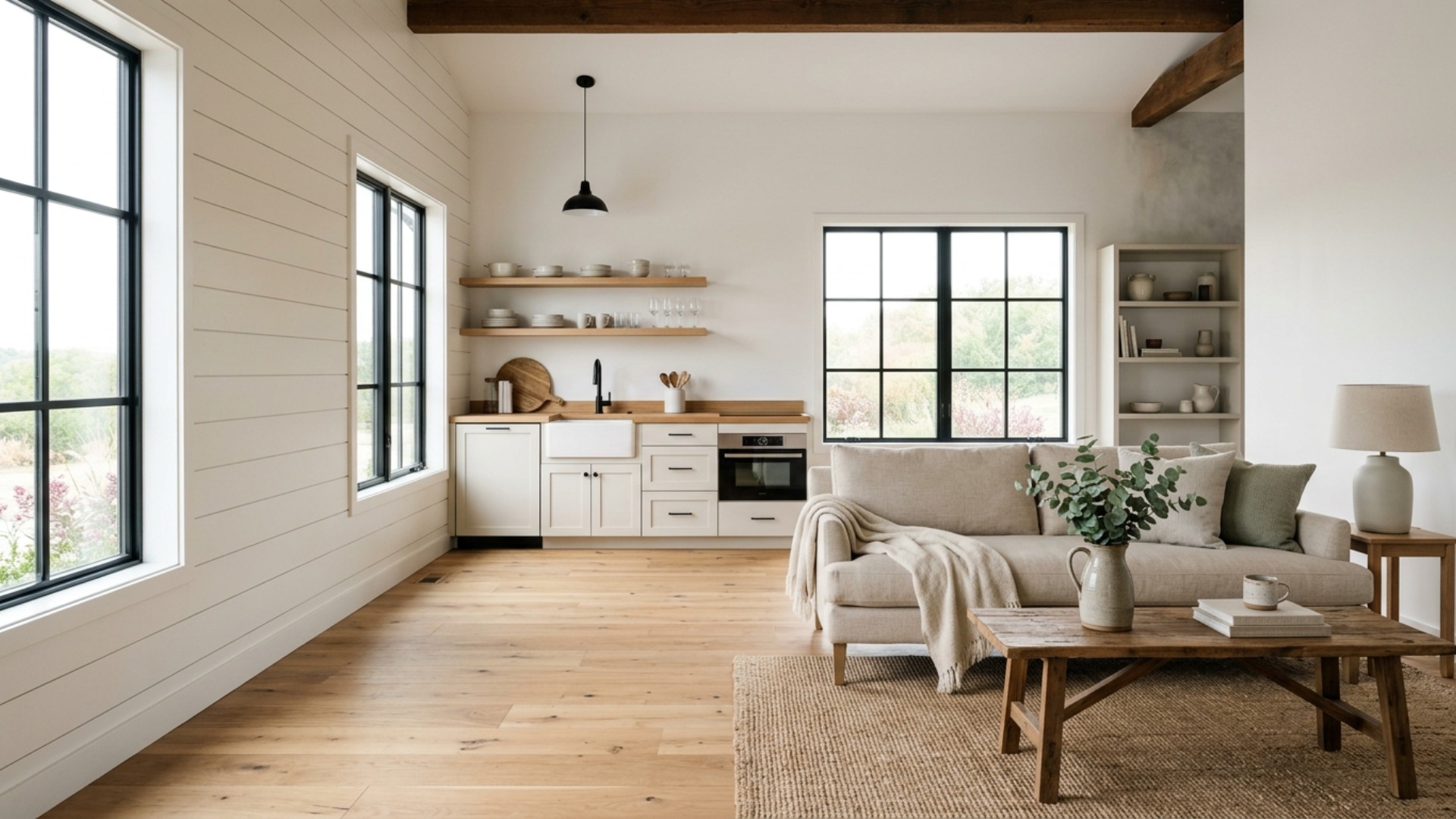
The real problem
Why this is harder than it looks
Modern farmhouse gets misread as a shopping list: shiplap, a black-framed mirror, a chunky wood table, done. In a house with real walls that can work, because the architecture carries some of the weight. In an empty studio it collapses, because you are asking one 400 square foot room to be a living room, a bedroom, a kitchen, and an entry at once, and a pile of farmhouse props with no plan just reads as clutter that happens to be beige.
What is actually going on is that modern farmhouse depends on contrast and restraint, not on quantity. The look comes from a few honest materials, warm white walls, natural wood, matte black, set against a lot of calm empty space. A studio has very little empty space to give, so every piece has to earn its footprint twice, once for how it looks and once for the job it does.
The specific trap for someone standing in an empty studio is buying for the room they wish they had. A seven foot dining table, an oversized sectional, a four poster bed: each is beautiful and each will swallow a studio whole. The starting point is not furniture at all. It is deciding where the invisible walls go, which zones the room needs, and how light moves through it, and only then choosing pieces that hold those zones without blocking the light.
The failure pattern is the slow accumulation of farmhouse touches that never add up to a room. A sign here, a galvanized bucket there, three throw pillows with different words on them. Skip all of it. A studio done in this style wins on the big decisions, the wall color, the wood tone, one anchoring textile, and stays almost aggressively plain everywhere else.
A clear path
How to plan it
-
01
Set the zones before you buy anything
Walk the empty room and mark, even with painter's tape on the floor, where sleeping, sitting, and eating will live. In a studio the rug defines a zone, not a wall, so plan for one or two rugs to draw the lines. Getting this right on an empty floor costs nothing and saves you from a sofa that ends up floating in the middle of the room.
-
02
Commit to the wall color first
Paint is the cheapest way to get eighty percent of the modern farmhouse feeling, and an empty room is the only time you will ever have to roll it easily. Benjamin Moore White Dove or Simply White gives you the warm, slightly creamy white the style needs, and it reads as intentional before a single piece of furniture arrives. Avoid a stark blue-white, which tips the room toward cold and contemporary.
-
03
Buy the bed and sofa as the two anchors
In a studio these two pieces set the whole budget and the whole scale, so buy them before anything decorative. A low-profile bed in natural oak or a simple upholstered frame in oatmeal linen, plus a sofa in a warm neutral rather than gray, will do more than any accessory. Keep both lower than you think, since low furniture makes a small ceiling feel taller and the room feel calmer.
-
04
Add warmth through wood and texture, not signage
The farmhouse warmth comes from material, so layer natural oak, jute, linen, and matte black hardware, then stop. One reclaimed-wood console, a woven basket for storage, linen curtains hung high and wide. Resist every printed sign and every script pillow; the style reads as expensive precisely when it stays quiet.
-
05
See the room in Framehouse before you commit the spend
Paint chips and tiny fabric swatches lie about how a color fills a whole room, and in a studio a wrong call is expensive because there is nowhere to hide it. Photograph the empty space and use Framehouse to test White Dove against your floor, or an oak bed against a linen sofa, before you buy. It is far cheaper to reject a combination on screen than after it is carried up three flights of stairs.
Built for empty room design
Moves that pay off
An empty room is a gift and a trap at once. The order you buy in matters more than any single piece, so use the blank floor to plan rather than to fill.
- Buy the anchors first, bed and seating, and live with them for two weeks before adding anything else.
- Define zones with rugs and lighting, not with bulky dividers that eat square footage.
- Measure the doorway and stairwell before ordering, since a studio move-in is where oversized furniture gets stuck.
- Defer the dining table. A small round table or a drop-leaf against the wall serves a studio far better than a statement piece.
- Hold back a third of your budget for after the big pieces land, since the room will tell you what it actually needs.
- Resist filling every wall on day one. Empty wall is part of the style, not a problem to solve.
modern farmhouse cues
What to keep, what to skip
Modern farmhouse is warm white plus honest material plus restraint. Hit these notes and skip the rest.
- Palette: warm whites like White Dove, natural oak, oatmeal and greige textiles, one hit of matte black.
- Materials: real or convincing wood, linen, jute, and cotton, nothing high-gloss or overly slick.
- Signature: black-framed windows or interior black hardware against pale walls, the single strongest farmhouse cue.
- Lighting: a matte black or aged-brass pendant, plus warm bulbs at 2700K, never cool white.
- Texture over pattern: let weave and grain do the work and keep prints almost absent.
- What to skip: script wall signs, galvanized barn decor, and shabby-chic distressing, which date fast and cheapen the look.
Use it for
What people plan with Framehouse
- Test White Dove against your actual floor and light before buying a gallon.
- Lay out sleeping, sitting, and eating zones on the empty floor before ordering furniture.
- Compare an oak bed frame against an upholstered one in the real room.
- Show a partner or roommate what the finished studio will feel like before you commit.
- Decide where the one matte-black accent should land so it reads as intentional.
Quick answers
Common questions
Make a plan you can act on
Skip the spiral of mood boards. Three minutes in the Aura Quiz turns your taste into a direction.
Take the Aura Quiz