Mid Century Modern Living Room Ideas for an Empty Room
An empty living room is the only time you get to place the furniture before the furniture places you. Here is how to build a mid century modern room from bare floor to finished, in the order that keeps you from overbuying.
The real problem
Why this is harder than it looks
An empty room reads as freedom, and mid century modern is the style people reach for when they finally have one. The trouble is that the style is built on negative space, and negative space is the one thing an empty room already has for free. So the instinct is to fill it, and filling it is exactly what kills it.
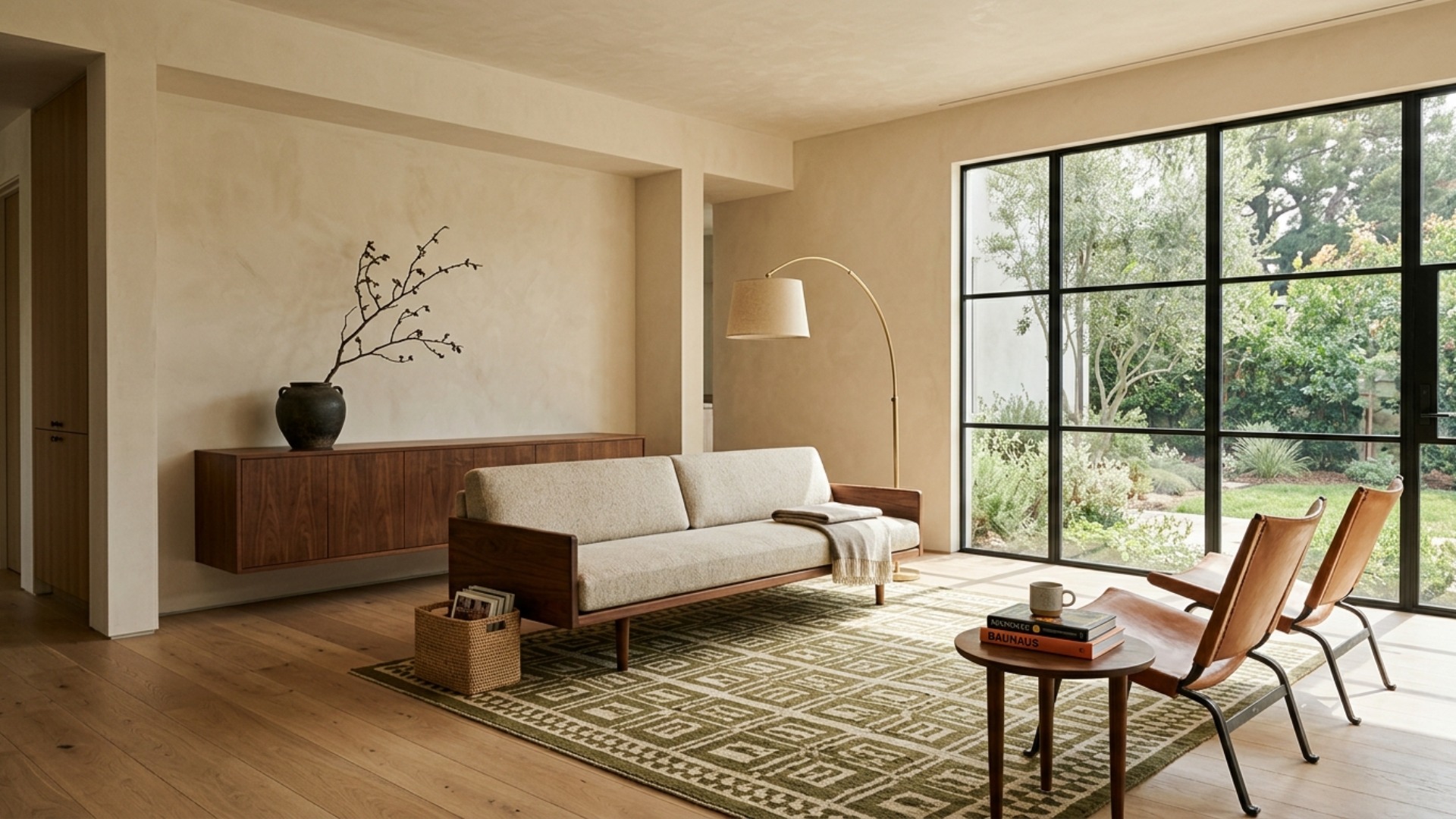
Mid century modern works because the furniture sits low and the legs are visible. Light passes under everything, the floor stays readable end to end, and the room looks larger than its footprint. Add a skirted sofa, a deep sectional, or a coffee table with a solid base and the floor disappears. After that the room reads heavy no matter how much walnut you bought.
Starting from empty is a real advantage and also the most expensive moment in the process. You are buying everything at once, and every decision gets made without anything to react against. Nothing in the room tells you the sofa is too big. You find that out when it is stuck in the stairwell.
The failure pattern is buying the sofa first, in the largest size the room can technically hold, and then arranging the next twelve months around that mistake. Reverse it. Rug first, seating scaled to the rug, then storage, then light. Get the footprint right and a mid century room forgives almost everything else.
A clear path
How to plan it
-
01
Tape out the footprint before you buy anything
Mark the rug and the sofa on the bare floor with painter's tape and live with it for three or four days. An 84 inch sofa and an 8x10 rug feel completely different taped out at full scale than they look on a product page, and this is the only free mistake you get.
-
02
Buy the rug first and let it set the plan
In an empty room the rug is the floor plan, so it goes first. Choose 8x10 for most rooms and 9x12 for anything wider than about fourteen feet, sized so the front legs of every seat land on it. Low-pile wool in cream, olive, or a muted geometric wears far better than anything shaggy.
-
03
Choose one low sofa with visible legs, then stop
Look for a seat depth around 32 inches, an arm that sits low, and tapered legs you can see the floor under. Skip the sectional entirely: it solves a seating problem you do not have yet and removes the openness you are paying for. A pair of chairs can come later, once you know where people actually sit.
-
04
Fix the vertical problem with one tall piece and one warm light
Empty rooms have everything at knee height, which is why they still feel unfinished after the furniture arrives. A walnut credenza plus something in the 60 to 70 inch range, an arc lamp or art hung high, resolves it. Put the room on two or three warm lamps and stop using the ceiling fixture.
-
05
Visualize the actual room before you commit the budget
Sofa scale and wood tone are close to impossible to judge from a listing photo, and in an empty room you have nothing to compare against. Render your real room in mid century modern, test two rug sizes and two walnut tones against your floor, and buy once. It is the difference between one delivery and one delivery plus one return.
Built for empty room design
Moves that pay off
An empty room is a budget problem before it is a design problem. Everything comes due at once, so the sequence matters more than the shopping list.
- Buy in three waves. Rug, sofa, and one lamp in the first. Storage and a second chair in the second. Art and objects in the third, once you know where you actually sit.
- Measure the doorway, the stair turn, and the elevator before ordering anything over six feet. A sofa that will not make the corner costs more to solve than most people budget for the sofa.
- Put the money in the sofa and the rug. Side tables, lamps, and shelving in this style are widely reproduced and the affordable versions are genuinely good.
- Use a cheap placeholder in the right size rather than an expensive piece in the wrong one. Scale teaches you more in a month than research does.
- Leave one corner deliberately unsolved for the first month. It usually turns out to want a reading chair, and you would not have known that on day one.
- Do not buy art until the walls are painted and the seating is placed. Art bought to fill a wall rarely survives the second arrangement.
mid century modern cues
What to keep, what to skip
Mid century modern is a proportion style before it is a wood-tone style. The cues that carry it in a living room:
- Legs on everything, tapered or splayed or hairpin, and visible from across the room. If the floor disappears under a piece, it is the wrong piece.
- Walnut as the primary wood, used in two or three places rather than everywhere. Teak and oak both work, but pick one and commit.
- A low horizon. Seat heights around 16 to 18 inches, a credenza at 30, and nothing bulky above eye level.
- One saturated accent from the period palette: olive, mustard, rust, or a deep teal. One of them, not four.
- A small material vocabulary repeated: wool, leather, walnut, brass, and a little glass or ceramic.
- What to skip: starburst clocks, boomerang prints, kidney shapes, and matching furniture sets. One period-correct piece reads as confidence. Six reads as a showroom.
Use it for
What people plan with Framehouse
- Test an 8x10 against a 9x12 before the floor is covered
- Decide between one sofa and a pair of chairs on your actual wall
- See how walnut reads against the floor color you already have
- Sequence a first-year budget across three waves instead of one weekend
- Show a partner the finished room before either of you commits to a sofa
Quick answers
Common questions
Make a plan you can act on
Skip the spiral of mood boards. Three minutes in the Aura Quiz turns your taste into a direction.
Take the Aura Quiz