Coastal Living Room Ideas for an Empty Room
An empty living room is the rare chance to build coastal from the floor up, before a single mismatched piece locks in the palette. This page is a plan for filling it in the right order, so the room reads calm and collected rather than like a furniture showroom.
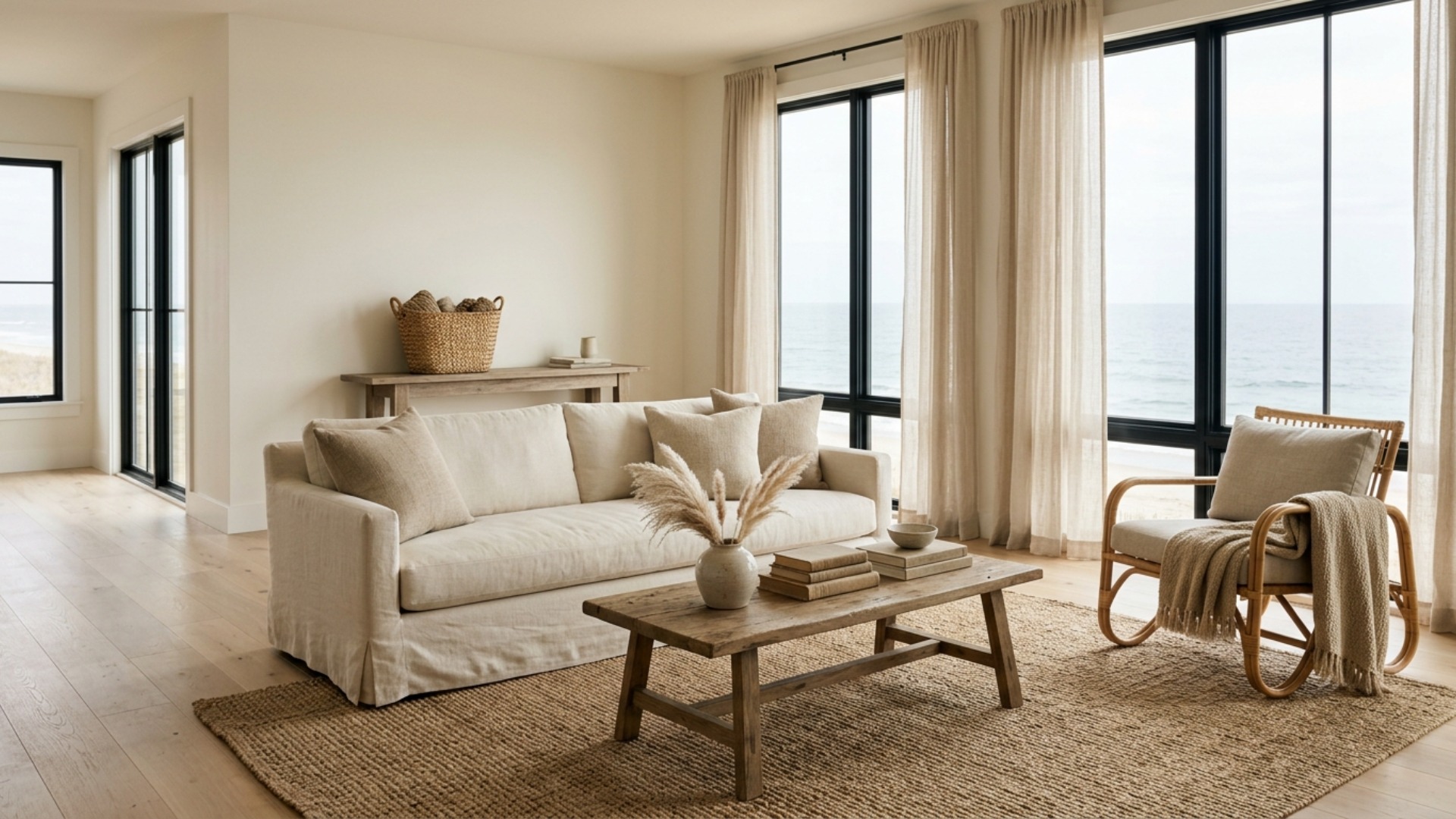
The real problem
Why this is harder than it looks
An empty room feels like freedom and paralyzes people for the same reason. There is nothing to react to, so most first attempts at coastal happen at the furniture store: a matching sofa-and-loveseat set, a coffee table, two lamps, all chosen in an afternoon and delivered at once. The room fills up but never comes together, because it was bought as a package instead of built as a space.
Coastal is easy to get wrong precisely because it looks effortless. What reads as breezy and undesigned is usually a tight, disciplined palette of off-whites, sand, and weathered wood, layered with a lot of natural texture. Skip the discipline and you get one of two failures: a beige box with no life, or a theme room of anchors, rope, and navy stripes that announces the word coastal instead of feeling like the coast.
Starting from empty, your real constraint is sequencing and scale. A living room needs a rug large enough to sit under the front legs of the furniture, a sofa sized to the wall rather than the sale, and a light plan, and those are the decisions hardest to reverse once the boxes are open. Getting the big, permanent things right matters far more than the throw pillows everyone starts with.
The failure pattern is buying small and matchy before committing to the big and quiet. People buy the coffee table and the accent chair first because they are fun, then discover the rug is too small and the sofa is the wrong white. Build the shell first: floor, seating, light, and window treatments in a warm neutral palette, then let the character come from texture and a few collected pieces.
A clear path
How to plan it
-
01
Set the palette and the rug before anything else
In an empty room the floor is your foundation, so start there. Lay down a large natural-fiber rug, jute, wool, or a flatweave in sand or oatmeal, sized so the front legs of every seat will sit on it, and settle your whites now: a warm off-white like Benjamin Moore White Sand or Swiss Coffee reads coastal where a cool white reads clinical. Everything else gets chosen against these two decisions.
-
02
Buy the sofa for the wall, not the sale
The sofa is the anchor and the piece people most often get wrong by buying a set. Measure your longest wall and choose one sofa scaled to it, ideally a low-profile linen or performance-weave slipcover in warm white or greige, which is both the coastal look and the practical choice for a room that will see sandy feet. A slipcover you can wash outlasts a fixed upholstery you cannot.
-
03
Layer texture instead of color
Coastal gets its life from material, not hue, so vary the textures before you reach for accent colors. Combine a rattan or cane chair, a weathered oak or driftwood-toned coffee table, unlined linen curtains, and a woven basket or two, keeping everything within the off-white-to-oak range. The near-neutral palette is what lets a mix of textures feel calm rather than busy.
-
04
Add character in threes, not themes
Resist the anchors and the navy. Bring in personality through a few natural, collected objects: a large ceramic vessel with pampas or olive branches, a stack of weathered books, one piece of unframed art in soft washed tones. Odd numbers and restraint read as coastal; a matching nautical set reads as a gift shop.
-
05
See the whole room before you fill it
Furnishing an empty room from scratch is the easiest place to make an expensive scale mistake, since nothing is there to correct against. Photograph the empty space and use Framehouse to place the rug, the sofa, and the window treatments at real size before you buy, so you catch a too-small rug or a too-cool white while it is still free to fix.
Built for empty room design
Moves that pay off
Furnishing from empty rewards order of operations. Buy the permanent, hard-to-return things first and let the finishing touches wait.
- Start with the rug and wall color, the two decisions everything else is chosen against.
- Buy the sofa second, scaled to the wall, before any accent seating.
- Add window treatments early; bare windows keep a coastal room feeling unfinished no matter how it is furnished.
- Hold off on the coffee table and accent chair until the sofa and rug are in and living with them.
- Skip the throw-pillow and decor haul on day one; those are the cheapest and last things to add.
- Leave one corner unfilled for a month and let the room tell you what it actually needs.
coastal cues
What to keep, what to skip
Coastal is a warm neutral palette carried by natural texture and light, not a set of seaside props. Hold these and it will feel like the coast without saying so.
- Palette: off-white, sand, oatmeal, and soft greige, warmed by weathered oak and driftwood tones.
- Materials: linen, jute, rattan, cane, weathered wood, and unglazed ceramic. Keep everything matte.
- One structural signature: abundant soft daylight and airy, unlined window treatments that move.
- Favor slipcovered and washable seating; coastal is meant to be lived in, not roped off.
- Layer three or four textures within one narrow color range rather than adding bold color.
- What to skip: navy-and-white stripes, rope, anchors, and any literal nautical motif.
Use it for
What people plan with Framehouse
- Test a warm off-white against your floor and daylight before painting an empty room
- Check that a rug is large enough to sit under your planned furniture
- Size a sofa to your actual wall before ordering from a showroom
- See how linen curtains change the light before choosing window treatments
- Show a partner the finished room before committing to a full furniture order
Quick answers
Common questions
Make a plan you can act on
Skip the spiral of mood boards. Three minutes in the Aura Quiz turns your taste into a direction.
Take the Aura Quiz