Minimalist Kitchen Ideas for an Empty Room
An empty kitchen is the only moment minimalism is genuinely cheap, because the discipline happens in the layout rather than in the things you buy later to hide the mess. This page covers the order to make the decisions in, where the money should go, and the point at which most minimalist kitchens quietly fall apart.
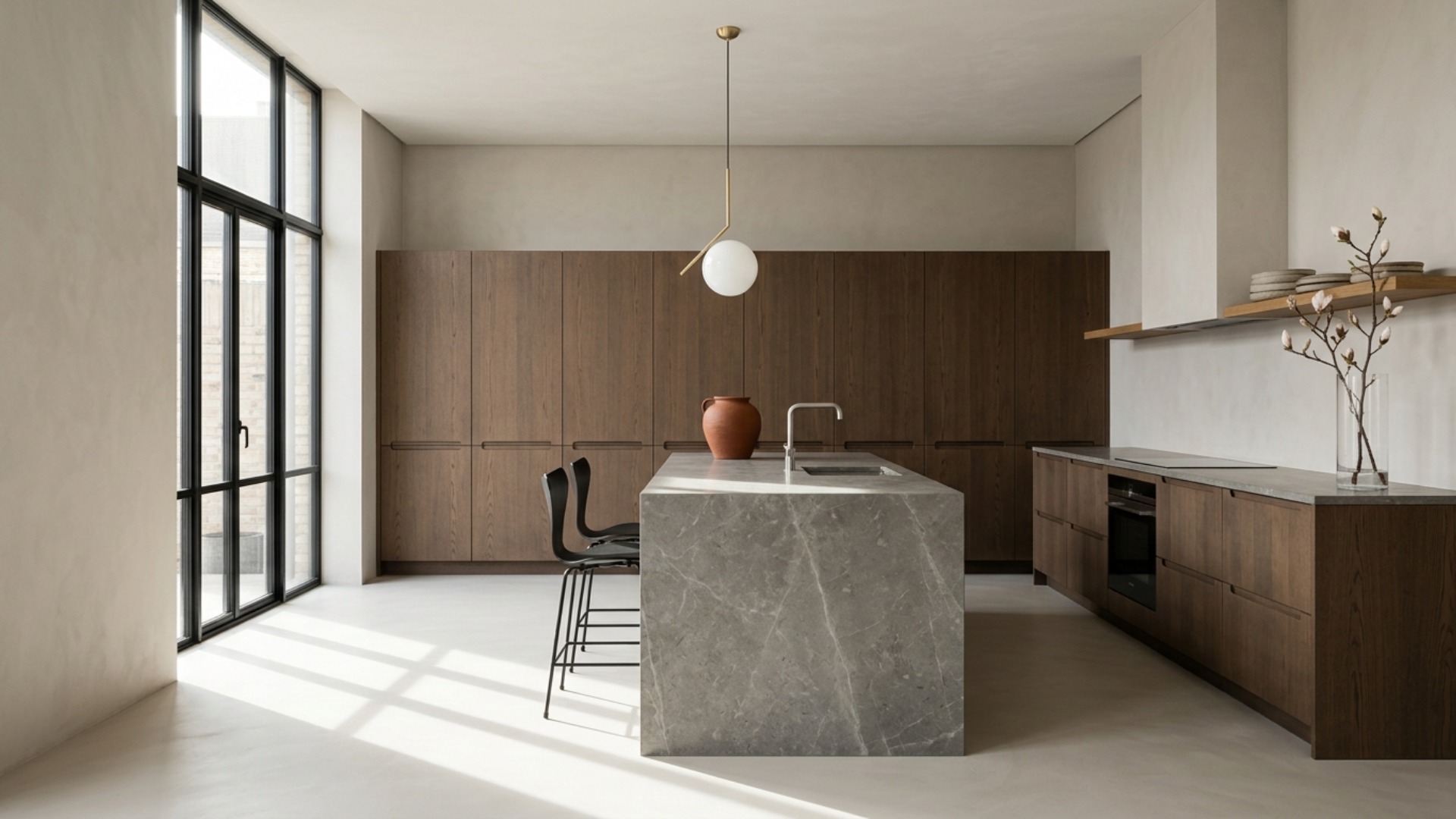
The real problem
Why this is harder than it looks
Minimalism gets read as an aesthetic of absence: white boxes, no handles, nothing on the counter. That reading is exactly why so many minimalist kitchens fail. The bare counter is the result, not the method. What produces it is a storage plan generous enough that nothing has to live out in the open, and in an empty room that plan is the only thing you are really designing.
A kitchen is the most object-dense room in a house. Even a modest one holds several hundred items, and every one of them has to go somewhere. Minimalism does not reduce that number, it moves the objects behind a door. So the honest measure of a minimalist kitchen is not how clean it looks on the day the photographer leaves. It is linear metres of closed storage per person, and whether the things used daily sit within one reach of where they are used.
Standing in an empty room is the best position you will ever be in, because the two decisions that matter most, where the sink goes and how much full-height storage you can steal from the walls, are both free right now and nearly impossible to change later. Most people skip past both and go straight to cabinet fronts, which is the cheapest part of the decision to reverse and the least important to how the room actually works.
The failure pattern is minimalism bought rather than planned. Handleless fronts, integrated appliances, one unbroken run of pale cabinetry, and then six months later a kettle, a knife block, a fruit bowl, and a charging cable have colonised the worktop because there was never anywhere else for them to go. Design the hidden half first. If you cannot say where the kettle lives with the door shut, the kitchen is not finished yet.
A clear path
How to plan it
-
01
Settle the sink and the working run before you look at a single door front
Plumbing is the one thing in an empty room that is still cheap to move and ruinous to move later, so fix it first. Put the sink under the window if there is one, keep the total walking distance between sink, hob, and fridge under about 7 metres, and leave a full metre of clear floor in front of anything that opens. Everything else on this page can be changed later. This cannot.
-
02
Buy storage volume before you buy finishes
In a minimalist kitchen the cabinet interior does all the work and the cabinet front takes the credit. Spend on full-height units, deep drawers instead of base cupboards, and one dedicated appliance garage with a door on it, then take the cheapest front you can honestly live with. A $9,000 kitchen with the right storage will read calmer than a $25,000 one without it, every time.
-
03
Choose one focal material and let everything else recede
Minimalism without a focal point is just a corridor. Pick a single surface to carry the room, usually the worktop and splashback in one honed stone, and keep every other surface matte and unremarkable. Honed Pietra Grey, Belgian bluestone, or a good quartz run as one continuous slab reads as deliberate. Three competing materials in a small kitchen reads as a showroom that could not decide.
-
04
Solve the worktop before you move in, not after
Write the real list of what you use daily, kettle, toaster, grinder, knives, oils, and give each one a home behind a door within reach of where it gets used. It is a fifteen minute exercise and it decides whether the kitchen stays minimalist for longer than a fortnight. If the list does not fit, you need one more cabinet, not more willpower.
-
05
See the empty room dressed before you order anything
Cabinet fronts and stone are the least forgiving things to judge from a sample, because a 10 centimetre chip tells you nothing about how an entire wall of it reads at four in the afternoon. Photograph the empty room and use Framehouse to test the cabinet tone, the stone, and the wall colour together at full scale. A kitchen is the most expensive room to get wrong and almost nothing in one can be returned.
Built for empty room design
Moves that pay off
An empty room gives you an unusual amount of freedom and an unusual amount of rope. Sequence matters more here than in any other project.
- Do the services first: sockets, waste, water, and extraction. They cost a fraction now and involve a wall coming down later.
- Tape the full footprint on the floor, including door swings and the fridge with its door open. Kitchens fail on clearance far more often than on style.
- Order the appliances before the cabinetry is cut. Integrated appliance dimensions vary by centimetres and the joinery has to follow them, not the other way round.
- Resist filling the room in one pass. An empty kitchen with good bones and no bar stools looks better than a complete one assembled in a hurry.
- Live with the lighting on a temporary fitting for a week before fixing the final positions. Where you actually stand and chop is rarely where the plan assumed.
- Hold back roughly ten percent of the budget for the things you only discover once you are cooking in the room.
modern minimalist cues
What to keep, what to skip
Minimalism is a set of decisions about what stays visible, not a colour scheme.
- Palette: two neutrals and nothing else. A warm off-white or pale grey across walls and cabinetry, one deeper tone carried by the stone or the floor.
- Materials: matte throughout. Micro-cement, honed stone, oiled or smoked oak, brushed rather than polished metal. Gloss doubles every reflection and every fingerprint.
- Structural signature: one continuous line. A single unbroken worktop height, cabinet fronts that align across the run, and no wall cupboards interrupting it if you can avoid them.
- Hardware is either absent or deliberate. Handleless with a routed finger pull, or one honest solid handle used everywhere. A mixture of the two is the giveaway.
- Open shelving is allowed exactly once, and it holds one category of object rather than a selection.
- What to skip: three metals, glass-fronted cabinets, decorative splashback tile, hanging rail systems, and anything sold as a storage solution that lives on the counter.
Use it for
What people plan with Framehouse
- Test a smoked oak front against your floor before ordering the kitchen
- See whether a wall of full-height units closes the room in
- Compare a single stone worktop against a two material scheme
- Show a partner the finished kitchen before the joinery is signed off
- Decide whether the island sits square to the run or turned across it
Quick answers
Common questions
Make a plan you can act on
Skip the spiral of mood boards. Three minutes in the Aura Quiz turns your taste into a direction.
Take the Aura Quiz