Coastal Home Office Ideas for an Empty Room
An empty room is the rare design problem where nothing has gone wrong yet. Here is how to build a coastal home office in the right order, so the light and the layout do the work before the furniture does.
The real problem
Why this is harder than it looks
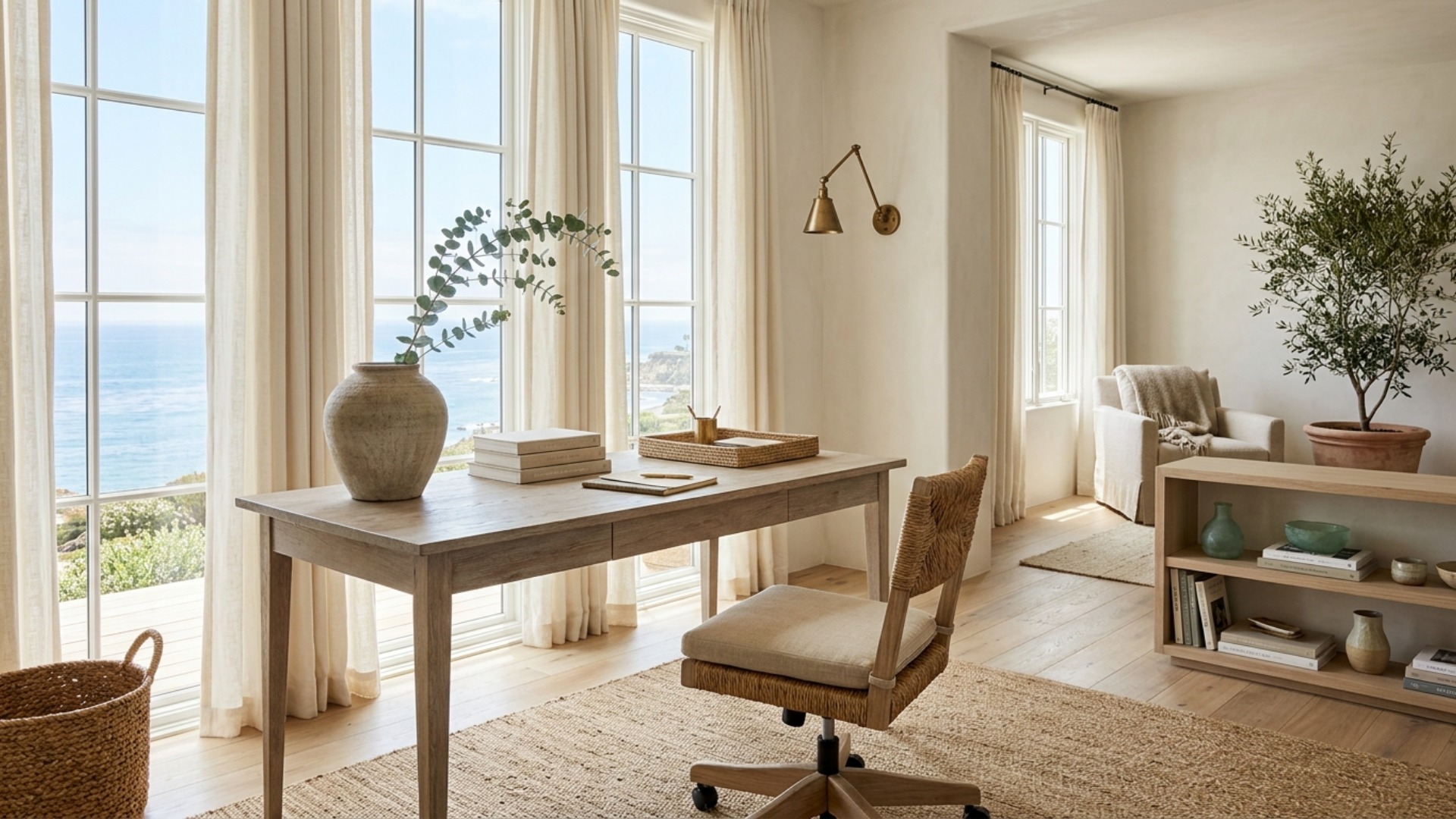
Most people read coastal as a color story. Off white walls, a bit of blue, some rope and a shell or two, and the room is done. That reading is why so many coastal offices end up looking like a rental listing. Coastal is not a palette. It is a light and texture problem. The rooms that work are the ones where the light is soft and diffuse, and where five or six natural materials sit next to each other at slightly different temperatures: bleached oak, jute, unbleached linen, plaster, rattan, aged brass.
Underneath the look is a simple idea. Coastal interiors are built to make a room feel unhurried, which is a strange goal for a room where you work. That tension is the real design problem here, and it is solvable. You are not making a beach house. You are borrowing the calm surfaces and the light handling, and keeping the ergonomics and storage that a working room needs.
An empty room makes this both easier and harder. Easier because nothing has to be worked around. Harder because there is no anchor, so most people default to the one decision that feels safe: buy a desk, push it against the longest wall, and start filling in from there. That single move quietly decides your sightlines, your video call background, and whether you spend eight hours a day facing drywall.
The failure pattern is buying in the wrong order. Desk first, then chair, then a rug that does not fit, then a lamp to fix the light problem the desk placement created. By the time the room is furnished it costs more than it should and still feels thin, because the shell was never addressed. Paint, floor, and window treatment are the cheapest decisions in the room and they set everything else.
A clear path
How to plan it
-
01
Live in the empty room for a week
Before anything is ordered, spend a few working days in the room with a folding table and a laptop. Note where the light lands at 9am, 1pm, and 4pm, where the glare is, and which wall you actually want to look at. A week of this saves a return shipping fee and a wrong desk.
-
02
Place the desk before you choose the desk
Put the desk perpendicular to the window rather than facing it or backed to it. Facing a window means all day glare on the screen, backing it means you are silhouetted on every call. Perpendicular gives you soft side light on your face and no reflection on the monitor, and it is usually the reason a coastal office photographs well.
-
03
Paint the shell one warm off white and stop there
Coastal collapses the moment the walls go cool or gray. Benjamin Moore White Dove or Farrow and Ball Pointing both hold warmth without going yellow, and either one costs under $100 for the room. Skip the accent wall. In this style the texture does the contrast work, not the color.
-
04
Handle the windows with unlined linen, not blinds
Unlined or lightly lined linen or cotton in ivory or oatmeal is the single most coastal thing you can do to a room, because it turns hard daylight into the diffuse light the style depends on. Hang the rod near the ceiling and let the panels break slightly on the floor. Expect $80 to $200 a window.
-
05
Visualize the room before you commit the budget
Paint chips and product photos lie about how a warm off white reads against a specific floor and a specific quality of light. Upload a photo of the empty room to Framehouse, try the palette and the layout in place, and check the perpendicular desk position against the window before anything ships. It costs nothing to be wrong here and several hundred dollars to be wrong after delivery.
Built for empty room design
Moves that pay off
An empty room is a sequencing problem more than a taste problem. Spend on the shell and the layout first, because those are the decisions that are expensive to reverse, and let the furniture arrive in groups rather than one parcel a week.
- Buy in three purchases, not thirty: desk and chair, then rug and storage, then lighting and objects. The drip of small orders never resolves into a room.
- Do the shell before the furniture. Paint, curtains, and a rug run about $400 to $700 and change the room more than any single piece of furniture will.
- Budget the chair properly. It is the one item you touch for eight hours, and a woven or rush seat with a real cushion beats a $90 mesh task chair on both comfort and looks.
- Leave one wall almost empty on purpose. In a room with no history, restraint reads as confidence, and you will want somewhere to put a shelf in a year.
- Defer the art. Wait until the room is furnished and you know what the light does to that wall in the afternoon.
- Do not buy a second small side table to fill the gap. Empty floor is part of the style, and the gap usually wants a plant or nothing.
coastal cues
What to keep, what to skip
Coastal is carried by texture and light temperature, not by color. Get five natural materials into the room at slightly different tones and the style arrives on its own.
- Palette: warm off white walls, sand, oatmeal, bleached oak, and one quiet sea glass green or faded denim as the only real color.
- Materials: unbleached linen, jute or seagrass, rattan or rush, lime wash or plaster, and aged brass rather than chrome or polished nickel.
- Wood: keep it pale and matte. Weathered white oak and bleached ash read coastal. Dark walnut and glossy finishes do not.
- Structural signature: full length unlined linen curtains hung near the ceiling. This one move does more for the style than any piece of decor.
- Light: warm bulbs at 2700K, and at least three sources in the room. Overhead light alone kills the softness the whole style depends on.
- Skip: rope detailing, anchors, driftwood signage, navy and white stripes, and anything with a shell on it. The style survives on materials, and the motifs date it in a year.
Use it for
What people plan with Framehouse
- Test warm off white against your actual floor before buying paint
- Try the desk perpendicular to the window before the desk arrives
- See whether a jute rug or a flatweave suits the room at full size
- Show a partner what the empty room will feel like once furnished
- Check that a light coastal palette still reads warm in north facing light
Quick answers
Common questions
Make a plan you can act on
Skip the spiral of mood boards. Three minutes in the Aura Quiz turns your taste into a direction.
Take the Aura Quiz