Organic Modern Bedroom Ideas for an Empty Room
An empty bedroom is the rare design problem with no compromises built into it, and that freedom is exactly what makes people freeze. Here is the order to fill it in, so the finished room reads calm and layered instead of like four catalog purchases that arrived on the same day.
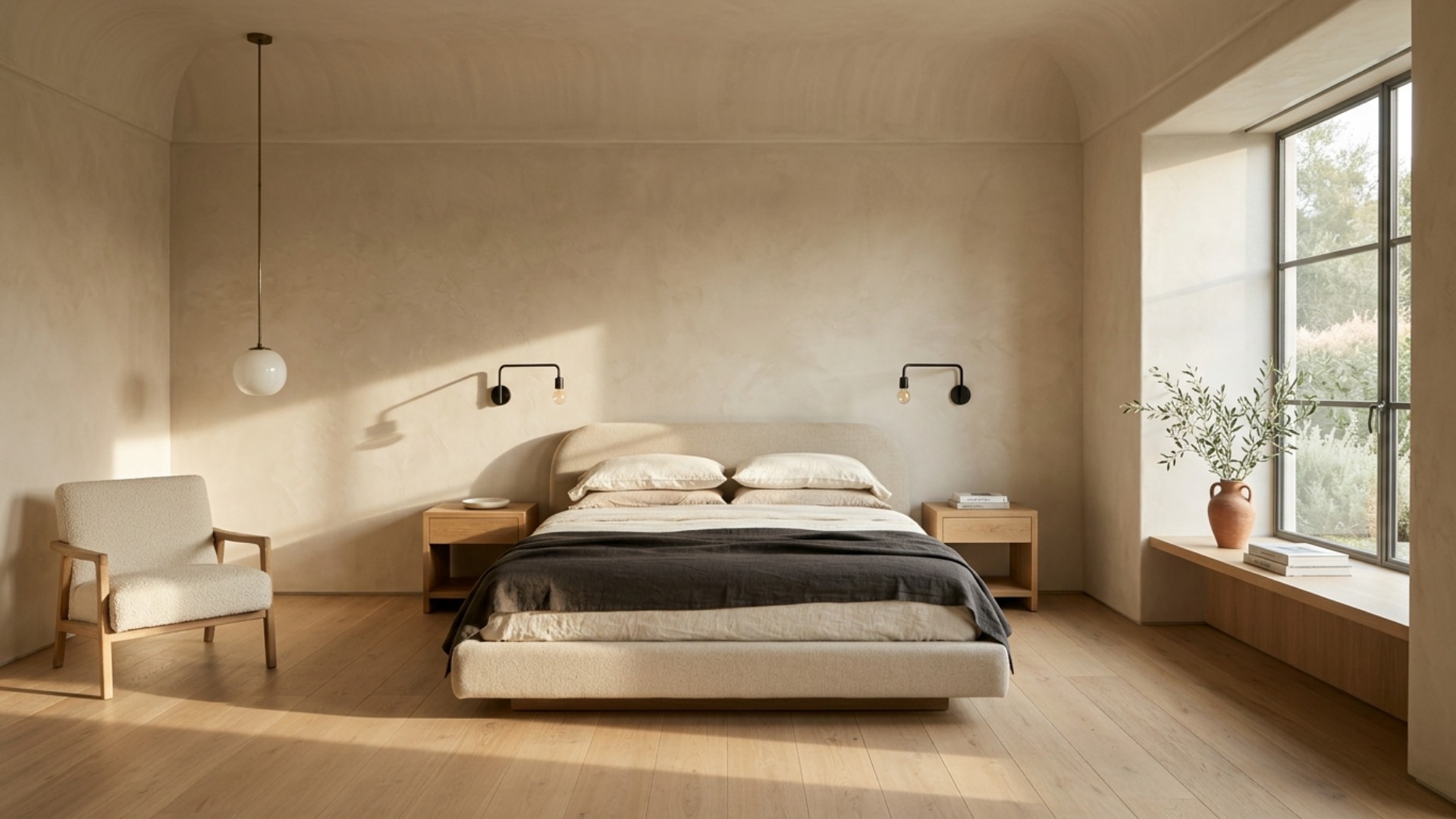
The real problem
Why this is harder than it looks
An empty bedroom lies about its size. With nothing in it the floor reads huge and the walls read tall, so almost everyone buys furniture one size too small and then the room still looks empty after four thousand dollars of delivery. Organic modern makes this worse before it makes it better, because the style leans on negative space, and a room that is genuinely under furnished looks identical to one that is deliberately restrained.
Organic modern is not a set of objects. It is a rule about surfaces. Every plane in the room should be a natural material sitting in its own colour, and the interest comes from how those surfaces catch light rather than from pattern or contrast. That is exactly why it fails in an empty room. You cannot judge plaster, oak, wool and stone against each other from a chip, a swatch and three browser tabs. They only resolve in relation to each other and to the light your particular window gives you at four in the afternoon.
Empty is genuinely the best case, though, and it is worth saying so. You are not working around an inherited bed frame, a carpet you cannot replace or a wall colour someone else chose. Everything is available, including the structural decisions that get skipped in every other scenario: where the bed actually wants to sit, whether the window wall can carry a headboard, how much clearance you need on the side you get out of.
The failure pattern is buying the bed first. It is the biggest decision and the biggest line item, which is why everyone reaches for it on day one, and it means the whole room gets planned around a piece chosen before anyone knew what the room does with light. Start with the surfaces that are cheap and reversible, live with them for a fortnight, and let the bed be the fourth decision rather than the first.
A clear path
How to plan it
-
01
Tape the bed footprint onto the floor
Before anything ships, mark the bed out on the floor in painters tape, then add 30 inches of clearance on the side you get out of and 24 inches at the foot. A queen at 60 by 80 inches and a king at 76 by 80 read completely differently once the walking room is drawn in, and in a bedroom under 12 feet wide the king almost always loses. This is a free hour that saves a restocking fee.
-
02
Paint warm, and test it on the darkest wall
Organic modern dies on a cool undertone, so stay in the cream and greige family: Benjamin Moore White Dove OC-17, Farrow and Ball Slipper Satin, or Sherwin Williams Alabaster. Paint a two foot square on the wall the window does not reach rather than the bright one, because that is where a white with any blue in it turns grey. Two coats and a weekend of watching it at different hours costs about $80.
-
03
Do the floor and the window before the furniture
A wool or jute rug and unlined linen curtains change how the empty room feels more than any single piece of furniture, and they are the two things people postpone. Hang the rod within four inches of the ceiling and run it eight to twelve inches past the frame on each side, and the window will look twice the size. The rug should extend at least 24 inches past the bed on three sides, which for a queen means a 9 by 12.
-
04
Buy the bed, then deliberately stop for a month
With paint, rug and curtains in place the bed becomes a decision you can actually make: a low platform in white oak, or a soft headboard in oatmeal wool or boucle. Nothing tufted, nothing with a footboard. Then wait. Nightstands, lighting and the one sculptural chair are meant to arrive slowly, and an empty corner for six weeks is not a failure state in this style.
-
05
See the room finished before you commit the money
Paint, wood tone and textile colour are the three things nobody can judge from a chip, and in an empty room you have no existing pieces to calibrate against. Photograph the bare room and run it through Framehouse to see White Dove against a white oak bed and an oatmeal rug in your actual light, so the first thing you buy is the right thing rather than the thing you learn from.
Built for empty room design
Moves that pay off
An empty room is a sequencing problem, not a shopping problem. What follows is the order that stops you buying twice.
- Work in four waves: paint, then floor and window, then the bed, then everything else. Each wave should be livable on its own.
- Budget in the same order. Roughly 10 percent paint, 20 percent rug and curtains, 45 percent bed and mattress, 25 percent everything after.
- Tape the furniture footprint on the floor before ordering anything. Empty rooms read a full size larger than they measure.
- Buy the mattress before the frame. Height varies by four inches across brands and it changes how the whole bed sits in the room.
- Leave one corner unresolved on purpose for the first two months. That is where the good piece goes when you finally find it.
- Do not buy art yet. Wall decisions made in an empty room are the ones people replace first.
organic modern cues
What to keep, what to skip
Organic modern is a discipline about surfaces. Six things it actually asks for.
- Palette: cream, oatmeal, greige, and one clay or bronze note. Every white leans warm. No cool grey anywhere in the room.
- Materials: limewash or plaster walls, white oak, honed limestone or travertine, undyed wool, raw linen, unglazed stoneware.
- Structural signature: one soft edge somewhere that matters. An arched reveal, a rounded plaster cove, a curved headboard, a bullnose shelf.
- Lighting: warm, low and layered. Two swing arm sconces beside the bed beat one overhead fixture every single time.
- Texture instead of pattern. If you want interest, change the weave rather than adding a print.
- Skip: high gloss finishes, three different metals in one room, the arched mirror bought because an algorithm suggested it, and anything sold as greige with a cool cast.
Use it for
What people plan with Framehouse
- Test a warm white against your bare walls before buying two gallons of paint
- See whether a queen or a king actually fits the empty floor plan
- Compare a white oak platform bed against an upholstered headboard in the same room
- Show a partner what the finished bedroom will feel like before anything ships
- Decide rug size and colour without ordering three and returning two
Quick answers
Common questions
Make a plan you can act on
Skip the spiral of mood boards. Three minutes in the Aura Quiz turns your taste into a direction.
Take the Aura Quiz