Mid Century Modern Living Room Ideas for a Couple's First Home
Mid century modern is the most forgiving style for a first shared home, because it was designed to mix rather than to match. The hard part is not choosing the look, it is deciding whose furniture survives the merge.
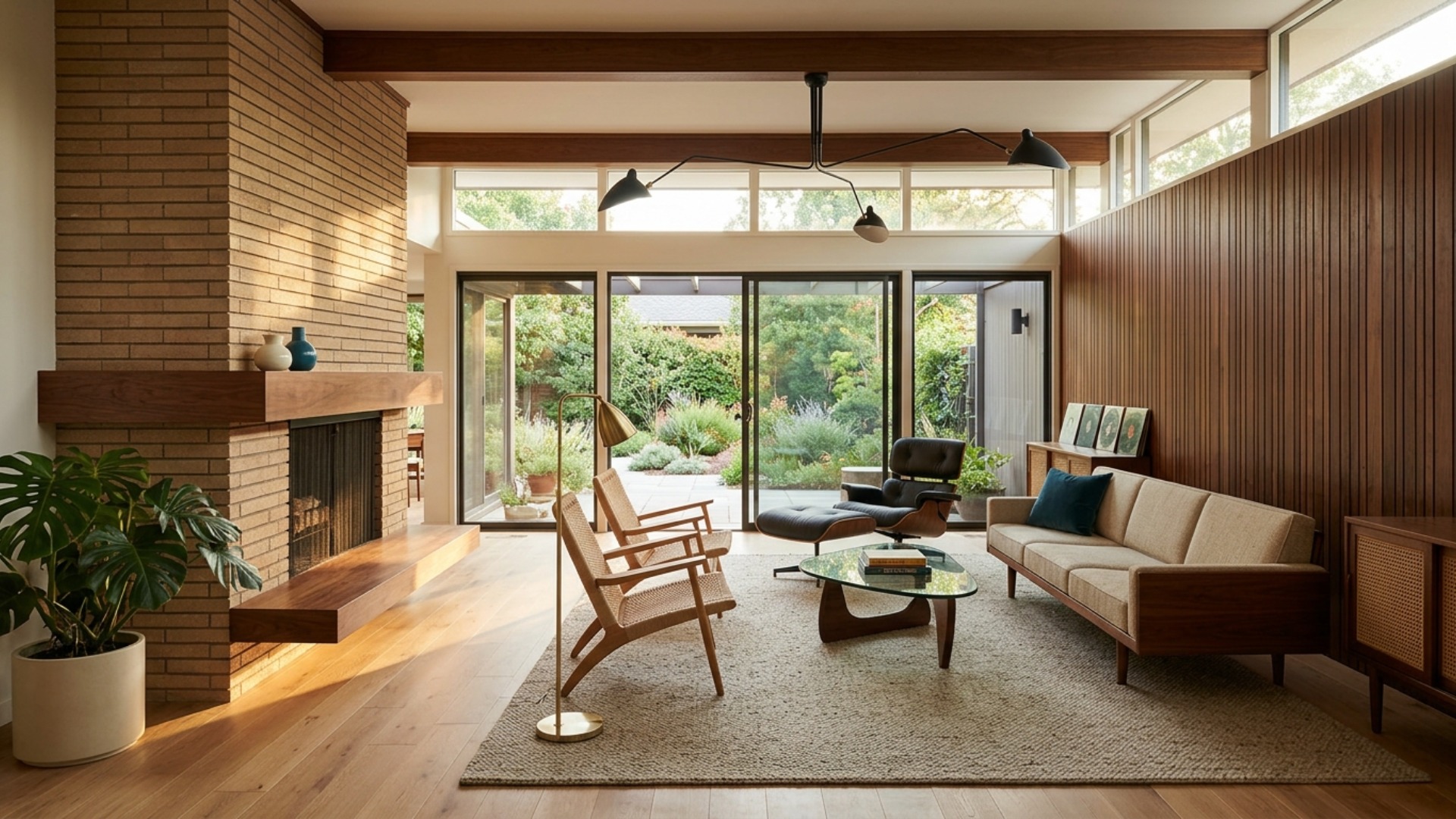
The real problem
Why this is harder than it looks
The most common mid century living room is a period costume. Reproduction sofa, reproduction credenza, sunburst clock, boomerang coffee table, a print of an Eames poster, all bought within about six weeks of each other. It photographs well and it feels like a set. Nothing in it has any history, which is a strange outcome for a style whose entire appeal is that it has aged well.
What the original designers were actually solving was small postwar houses and modest budgets. Furniture got low so ceilings felt higher, backs opened up so a piece could sit in the middle of a room, legs got slim so floors stayed visible, and a single honest material was allowed to carry a whole piece. It was a functional argument that happened to produce a beautiful result. Buy the result without the argument and you get a theme room.
A first home together has its own starting point, which is two households arriving in one room. One walnut sideboard inherited from a grandparent, one grey sectional that made sense in a rented flat, two very different opinions about how much colour a living room can take, and a shared reluctance to be the one who says their partner's chair has to go.
The failure pattern is deciding to buy everything new in one style to settle the argument. It is expensive, it produces the showroom problem, and it throws away the single best asset a first home has, which is a few pieces with real provenance. Mid century modern mixes with inherited furniture better than almost any other style, because it was designed to sit alongside what people already owned. Use that rather than starting from zero.
A clear path
How to plan it
-
01
Each agree on two pieces that are not up for discussion
Before anything is bought or thrown out, each of you names two pieces that stay no matter what, and neither of you gets to argue about the other's choices. It sounds like a party game and it does more work than a mood board, because most of the friction in a first shared home is about feeling overruled rather than about taste. Design the room around those four pieces and the remaining decisions get much easier.
-
02
Buy the sofa once, and buy it low
The sofa is the piece you will replace last, so it is worth getting right on the first attempt. Look for a seat height of 40 to 43cm, a depth of 85 to 95cm, exposed legs with at least 15cm of clear floor beneath, and a back no higher than the window sill. Article, Sabai, and secondhand Danish frames all hit this. A bulky high-backed sectional will fight every other decision you make in the room.
-
03
Put walnut in exactly two places, not five
Walnut is the signature of the style and the fastest way to overcook it. One credenza and one smaller piece, a side table or a chair frame, is the right amount for most living rooms. Everything else can be oak, cane, painted, or upholstered. If you inherited a walnut piece, that is one of your two, and it will almost always look better than anything you can buy new at the same price.
-
04
Pick one saturated colour and keep it in the textiles
Mid century palettes read as colourful but are usually 85 percent neutral with one strong note. Choose a single colour the pair of you agree on, petrol blue, mustard, olive, or burnt orange, and confine it to cushions, a throw, and perhaps one chair. Colour that lives in textiles can be changed in an afternoon, which matters in a first home where you are both still finding out what you like.
-
05
Visualize the merged room in Framehouse before you buy the sofa
This is the step that ends the argument without either of you having to be right. Upload a photo of the living room and generate the mid century version with the pieces you are both keeping still in it. Seeing the inherited sideboard next to the new sofa answers the question far better than describing it does, and it is a great deal cheaper than finding out after delivery.
Built for couple first home
Moves that pay off
A first home together is as much a negotiation as a design project. These moves reduce the number of decisions you have to get right on the first pass.
- Buy in order of how long you will keep it: sofa first, then lighting, then the credenza, then everything else.
- Do not buy a matching set. Two people who bought a suite together tend to feel differently about it within a year.
- Keep at least one inherited piece visible in the main room. It is the difference between a home and a first apartment with a bigger budget.
- Agree a per-item threshold, perhaps 400 dollars, above which you both have to say yes. It prevents the slow accumulation nobody chose.
- Defer the art for six months. You will both know much more about the room, and about each other, by then.
- Rent or borrow a rug before committing. Rug size is the most common expensive mistake in a first living room.
mid century modern cues
What to keep, what to skip
Mid century modern is easy to admire and easy to overdo. The line between the two is mostly about proportion and restraint.
- Palette: warm cream or soft white walls, walnut, oatmeal, and one saturated accent. Petrol blue, mustard, olive, and burnt orange are the period-correct choices.
- Wood: walnut and teak for the statement pieces, oak or beech for everything else. Keep the finish satin rather than glossy.
- Legs and light beneath. Furniture raised on tapered legs with visible floor underneath is the structural signature, and it is what makes a small living room breathe.
- Materials: wool tweed, cane, papercord, leather that will patina, glass, and one matte black metal element such as a lamp arm.
- Mix eras deliberately. One contemporary piece and one older inherited piece keep the room from reading as a reproduction.
- Skip: the full themed set, sunburst clocks, kidney shaped everything, and reproduction chairs bought four at a time.
Use it for
What people plan with Framehouse
- See whether an inherited sideboard works with a new sofa
- Settle a disagreement about wall colour without painting
- Test a sofa size and position before it is delivered
- Compare walnut against the flooring you already have
- Decide which pieces to keep from two households
Quick answers
Common questions
Make a plan you can act on
Skip the spiral of mood boards. Three minutes in the Aura Quiz turns your taste into a direction.
Take the Aura Quiz