Minimalist Kitchen Ideas for a Couple's First Home
A minimalist kitchen is the best gift two people can give a shared home, because it settles the daily argument about stuff before it starts. This page shows how to get the calm without the coldness, in a kitchen you both actually cook in.
The real problem
Why this is harder than it looks
The standard objection to a minimalist kitchen is that nobody actually lives that way, and looking at most examples, the objection is fair. Photographed minimalist kitchens are empty because nobody cooks in them. A couple's first kitchen has two coffee routines, two knife opinions, a wedding-gift stand mixer, and a drawer of things neither person will admit to owning. Emptiness is not an available option.
What minimalism actually offers a shared kitchen is a decision system, not a look. The style's real rule is one honest home for everything and nothing living on the counter that does not earn it daily. That rule is worth more to two people than to one, because a shared kitchen fails socially before it fails visually: the clutter argument is never about the clutter.
Your starting point is two households merging into one set of cabinets, usually in a kitchen neither of you chose. The temptation is to fit everything in and call it done. The minimalist move is the opposite: merge, cut the duplicates, and only then decide what the kitchen needs, because most first kitchens are missing one good thing and carrying nine mediocre ones.
The failure pattern to avoid is confusing minimalism with renovation. Ripping out cabinets is not step one. Cold minimalism, all white gloss and bare counters, is the other trap; it photographs well and lives badly, and within a year it curdles into resentment of the style itself. Warm materials and ruthless storage get you the calm without the chill.
A clear path
How to plan it
-
01
Merge and cut before you buy anything
Empty both moving boxes into one place and keep the better of every duplicate: one kettle, one colander, the sharper chef's knife. Aim to give away a third of the merged total. This costs nothing, takes a weekend, and does more for the kitchen than any purchase you will make this year.
-
02
Give every category one home and make it reachable
Assign each category a single cabinet or drawer and load it by frequency: daily things between hip and eye level, weekly below, seasonal on top. A couple needs this more than a single person does, because the kitchen only stays minimal if both people can put things back without thinking.
-
03
Clear the counter to five working objects
Pick the five things that earn daily counter space, commonly the kettle or coffee setup, a knife block or magnetic strip, a cutting board, olive oil and salt, and a fruit bowl. Everything else goes into the one-home system. A cleared counter is what makes a rented or dated kitchen read as intentional.
-
04
Warm the palette with one wood and one stone
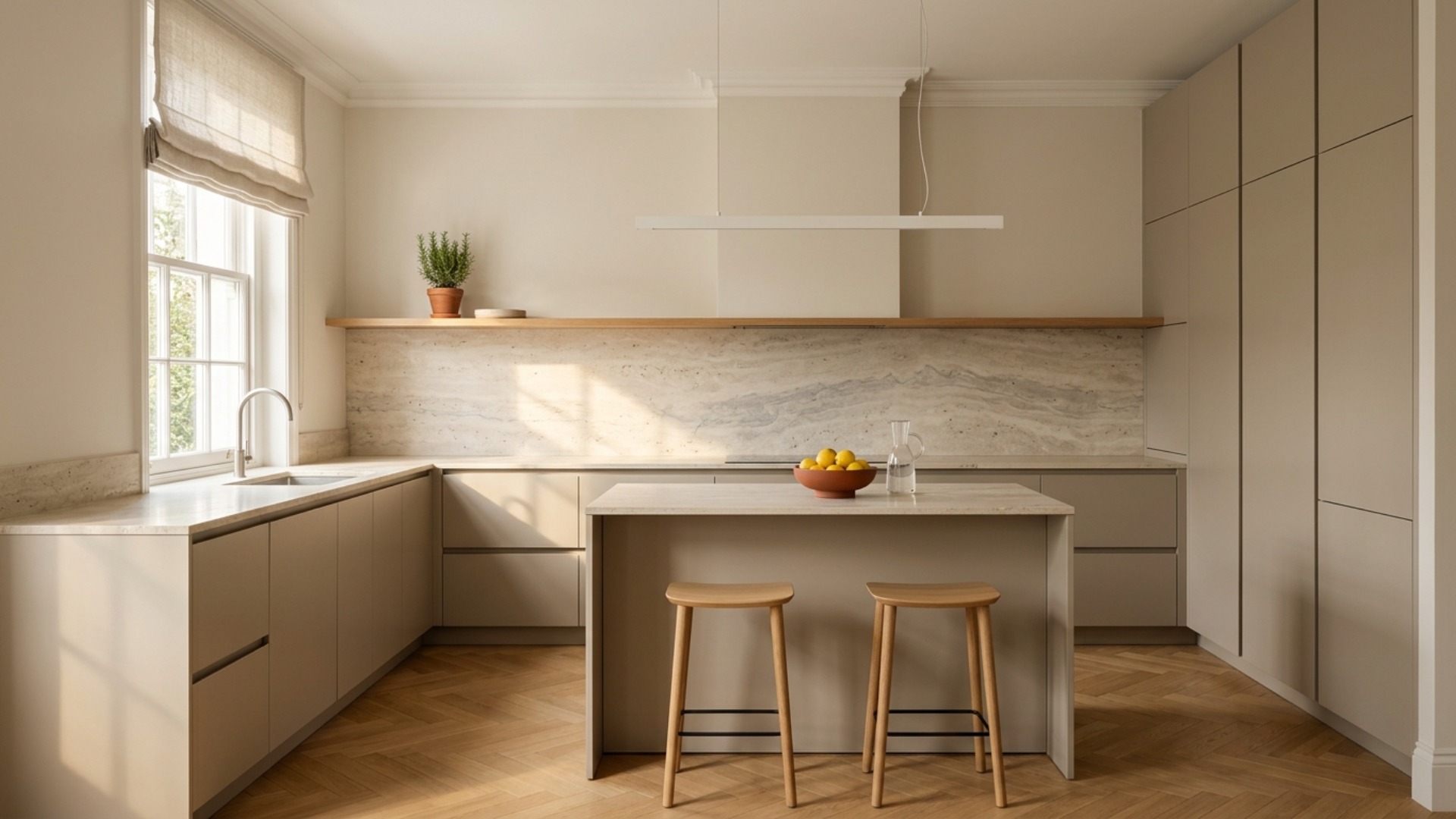
Keep the scheme to a warm neutral on cabinets, one wood tone, and one stone or stone-look surface, for example greige cabinet fronts, an oak shelf, and a travertine-look counter or backsplash. If the cabinets are dated, matte cabinet paint in a shade like Benjamin Moore Pale Oak plus new plain pulls, roughly 200 dollars, moves the kitchen most of the way.
-
05
Preview the changes in Framehouse before you spend
Before you paint cabinets or order stools, photograph the kitchen and test the palette in Framehouse. Cabinet colors and counter tones are notoriously hard to judge from a chip, and seeing the finished room settles the two-person disagreement about greige versus white in ten minutes instead of two weekends.
Built for couple first home
Moves that pay off
A couple's first kitchen is a negotiation, and the sequencing below keeps the negotiation short.
- Do the duplicate cull within the first month, while boxes are still an excuse to handle everything once.
- Agree on the five counter objects together; the list is small enough to negotiate and big enough to matter.
- Spend first on one great shared tool, a real chef's knife or a durable pan, rather than on decor.
- Defer open shelving until you have lived with the kitchen for a season and know what you reach for.
- Skip appliance sprawl: the air fryer, rice cooker, and blender can share one cabinet and rotate to the counter on duty.
- Put the wedding-gift items you cannot return but will not use in one high cabinet, and revisit in a year without guilt.
modern minimalist cues
What to keep, what to skip
Minimalist is a precise style, and the warm version lives on a few strict cues.
- Palette: one warm neutral for cabinets, one wood, one stone, and nothing else asking for attention.
- Materials: matte over gloss everywhere, honed stone or stone-look laminate, oak or birch, ceramic and glass on show.
- Hardware: plain pulls or none, in one finish; mixed metals are where minimalist kitchens quietly fail.
- Light: one linear pendant or a pair of plain pendants, warm bulbs, and never a boob light left in place.
- Surfaces: the counter carries five objects and the fridge door carries zero.
- Skip: gloss white slab everything, open shelving as storage rather than display, and the all-grey scheme that reads like a rental listing.
Use it for
What people plan with Framehouse
- Test a greige cabinet repaint against your actual counters before buying paint.
- See the kitchen with a cleared counter before agreeing to the five-object list.
- Compare two pendant options over the island without ordering either.
- Check whether an oak shelf warms the room enough before drilling into tile.
- Show your partner the finished look so the style debate ends with a picture.
Quick answers
Common questions
Make a plan you can act on
Skip the spiral of mood boards. Three minutes in the Aura Quiz turns your taste into a direction.
Take the Aura Quiz