Coastal Home Office Ideas for a Couple's First Home
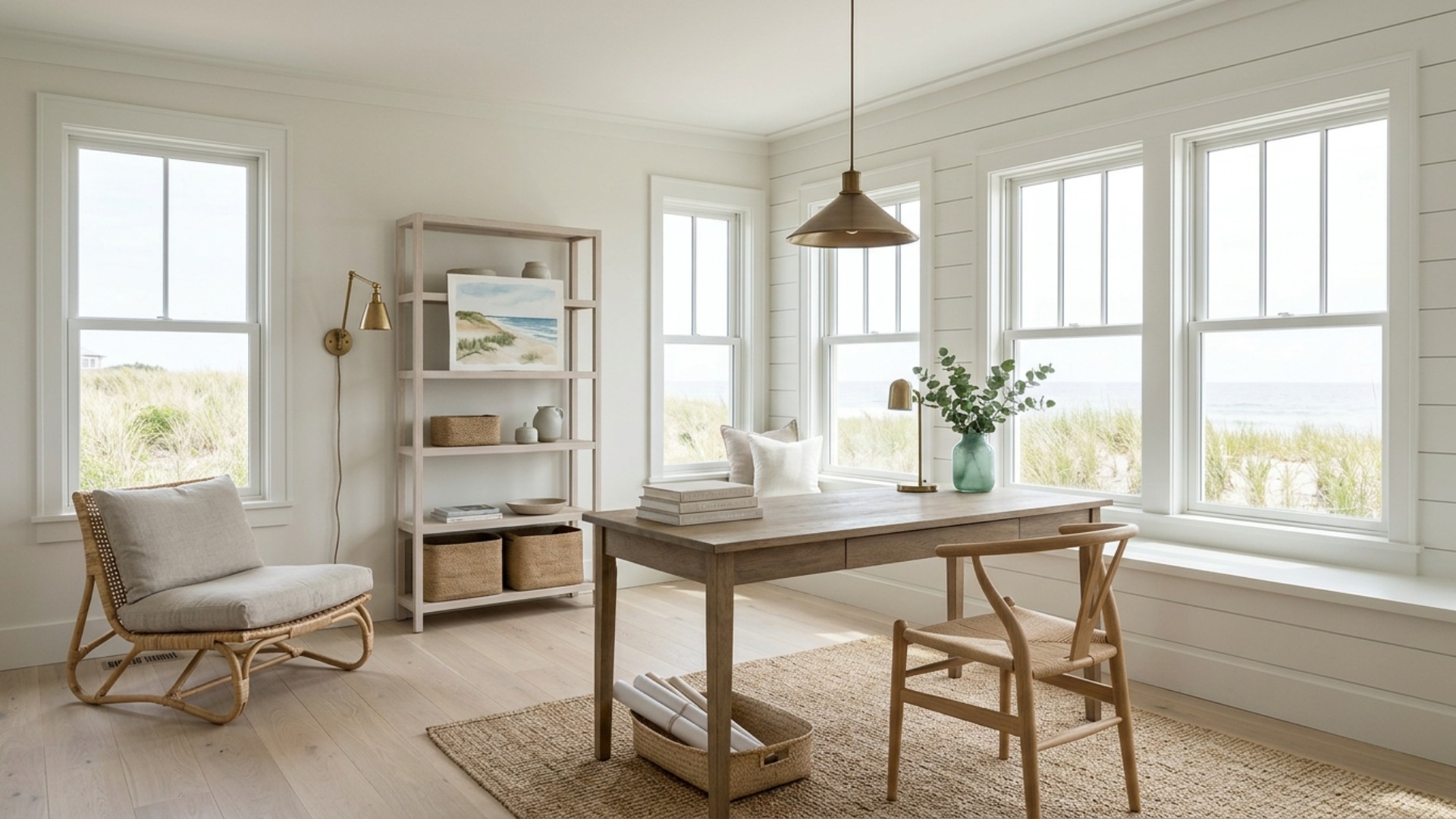
Coastal is a light problem before it is a color problem, which is why the navy and rope version never feels like the real thing. This page shows you how to build a calm, genuinely workable office in the small spare room of a first house, for two people who both need it.
The real problem
Why this is harder than it looks
Most coastal home offices fail because their owners treat coastal as a color scheme. Navy goes on an accent wall, a rope mirror goes above the desk, a jute rug arrives, and the room ends up looking like a gift shop rather than a house near water. The style gets blamed for being kitsch when the execution was the problem.
What actually makes a coastal room work is value contrast and surface. Real coastal interiors sit in a narrow band of pale, warm, slightly chalky tones, so nothing in the room fights for attention and your eye rests. The interest comes from texture instead: raw linen against bleached oak, matte ceramic against woven jute, all of it matte enough to absorb light rather than bounce it back at you. Take the blue out entirely and a good coastal room still reads coastal. Add blue to a room with no texture and it just reads cold.
The specific version of this you are facing is harder than the Pinterest version. A first home office is almost always the smallest bedroom, it faces the wrong way, and it inherits whatever furniture survived the move. It is also shared. Two people, two schedules, and one door that closes.
The failure pattern is predictable. One of you sets up first, the room quietly becomes that person's office, and the second desk gets wedged in later at an angle that works for nobody. Or you order two matching desks, a rug, and a light fixture in a single weekend, and discover that the rug is six inches too wide and the room is now permanently crowded. Almost everything below is sequenced to keep you out of both of those.
A clear path
How to plan it
-
01
Decide whose room this actually is, hour by hour
Before a single purchase, map the week. If one of you takes calls from 9 to 5 and the other works here on weekends, you need one good desk and one flexible perch, not two equal workstations that each get half a room. Write it down, because the version you agree on out loud tends to drift into whoever set up first.
-
02
Paint everything one warm off white, including the trim
Coastal wants a single quiet envelope, so paint the walls, trim, and closet doors the same color in different sheens. Benjamin Moore White Dove OC-17 or Farrow and Ball Pointing are both reliable here. Avoid the popular grey greens like Sherwin Williams Sea Salt in a room with north light, because they go cold and slightly clinical the moment the sun moves.
-
03
Put the desk perpendicular to the window, not under it
A desk pushed flat against the window gives you glare on the screen and a wall of blinds behind your head on video calls. Turn it ninety degrees so the light crosses the desk from the side, which is flattering on camera and keeps the view intact. In a shared room this also opens the wall opposite for the second person.
-
04
Layer three natural textures before you add any color
Pick one woven, one soft, and one hard: a flat jute or wool sisal rug, raw linen curtains hung high and wide, and a piece of matte ceramic or honed stone on the desk. Get those three right and the room reads coastal with a completely neutral palette. Only then decide whether it needs a sea glass green or soft slate accent, and keep it to two objects.
-
05
See the room finished before you spend the money
Paint chips lie in a small room, and a rug you cannot picture is a rug you will end up returning. Upload a photo of the actual room to Framehouse, generate the coastal version, and test both desk placements and two or three off whites against your real light and your real floor. It takes minutes, and it settles the arguments that otherwise cost three weekends and a restocking fee.
Built for couple first home
Moves that pay off
A first home office is rarely a blank room. It is the smallest bedroom, it holds the last owner's curtain rod, and two people have to agree on it. Sequence the work so the reversible decisions come first.
- Live in the room for two weeks before buying furniture. Where you naturally put your laptop tells you more than any layout guide.
- Buy one very good desk rather than two mediocre ones. The second person can work well from a narrow console or a drop leaf table against the opposite wall.
- Give each of you one closed drawer unit for paperwork and cables, and keep the open shelves for things you are happy to look at.
- Defer the rug. It is the single most commonly returned item in a small office, and the room will tell you the right size once the desk is placed.
- Replace the builder grade flush mount light early. It is under $200, it takes an hour, and it changes the room more than any piece of furniture will.
- Do not buy matching chairs. Two people with different backs need different seats, and the mismatch reads as considered rather than careless.
coastal cues
What to keep, what to skip
Coastal is easy to get almost right and easy to overshoot. These are the signals that separate the real thing from the souvenir version.
- Palette: chalk off white, warm sand, bleached oak, and soft slate, with one accent at most. Sea glass green earns its place more often than navy does.
- Materials: raw and washed linen, jute or wool sisal, bleached or limed oak, honed sandstone, unglazed matte ceramic, aged unlacquered brass.
- Finishes stay matte. Coastal light is diffuse, and gloss or high sheen paint breaks the effect faster than a wrong color would.
- The structural signature is generous window treatment: linen panels hung close to the ceiling and wide enough to clear the frame, so the window looks bigger and the light stays soft.
- Wood tones run pale and slightly grey. If your floor is orange toned oak, a jute rug and a pale desk will pull it back without refinishing anything.
- Skip the motifs. No anchors, no rope, no coral, no shiplap accent wall, no lettered signs. If a stranger can name the theme in one second, it has gone too far.
Use it for
What people plan with Framehouse
- Test a warm off white against your real north facing light before buying two gallons
- Settle a desk placement argument by seeing both layouts side by side
- Show a partner what shared means before either of you orders furniture
- Check whether a jute rug fixes an orange toned floor or fights it
- Price out the room in stages so you know what to buy this month and what can wait
Quick answers
Common questions
Make a plan you can act on
Skip the spiral of mood boards. Three minutes in the Aura Quiz turns your taste into a direction.
Take the Aura Quiz