Scandinavian Bedroom Ideas for a Couple's First Home
A first shared bedroom has to hold two people's habits at once, and Scandinavian design earns its name here by making calm feel deliberate rather than empty. This page walks through how to build that room together, from the pieces worth buying once to the ones you can wait on.
The real problem
Why this is harder than it looks
Most couples come to Scandinavian style for the calm, then accidentally build a room that reads as unfinished instead of restful. The look depends on a very short list of materials doing a lot of quiet work, so when a few mismatched pieces creep in, a starter dresser here, a leftover lamp there, the whole room loses the discipline that made the reference photo feel good.
The deeper issue is that Scandinavian rooms are subtractive. They work because of what has been left out, not what has been piled in, and that runs against the instinct of a couple furnishing a first place, which is to fill it. Two people merging their belongings doubles the number of objects competing for one small palette, and the palette is the entire point.
Your real starting point is usually a mattress on a frame one of you already owns and two sets of things that do not match. That is fine. The mistake is trying to fix all of it at once with a single big-box order, which quietly locks in the cheapest version of every decision on the same afternoon.
The failure pattern to avoid is buying for the room you photographed rather than the room you have. Scandinavian design forgives an empty corner and punishes clutter, so the safe sequence is to strip back first, live in the space for a few weeks, and add slowly.
A clear path
How to plan it
-
01
Agree on one palette before buying anything
Sit down together and pick three or four colors you will both hold to: a warm white for walls, one pale wood such as ash or oak, and one soft textile tone like oatmeal or dove grey. Write them down. Every future purchase either fits that list or it does not, which turns a hundred small disagreements into one decision you already made.
-
02
Clear the room down to what earns its place
Before adding a single thing, remove the mismatched lamps, the plastic storage bins, and the spare furniture that drifted in during the move. Scandinavian rooms look expensive because they are edited, and editing costs nothing. A bare corner reads as intentional here in a way it never does in a busier style.
-
03
Spend on the bed and the light first
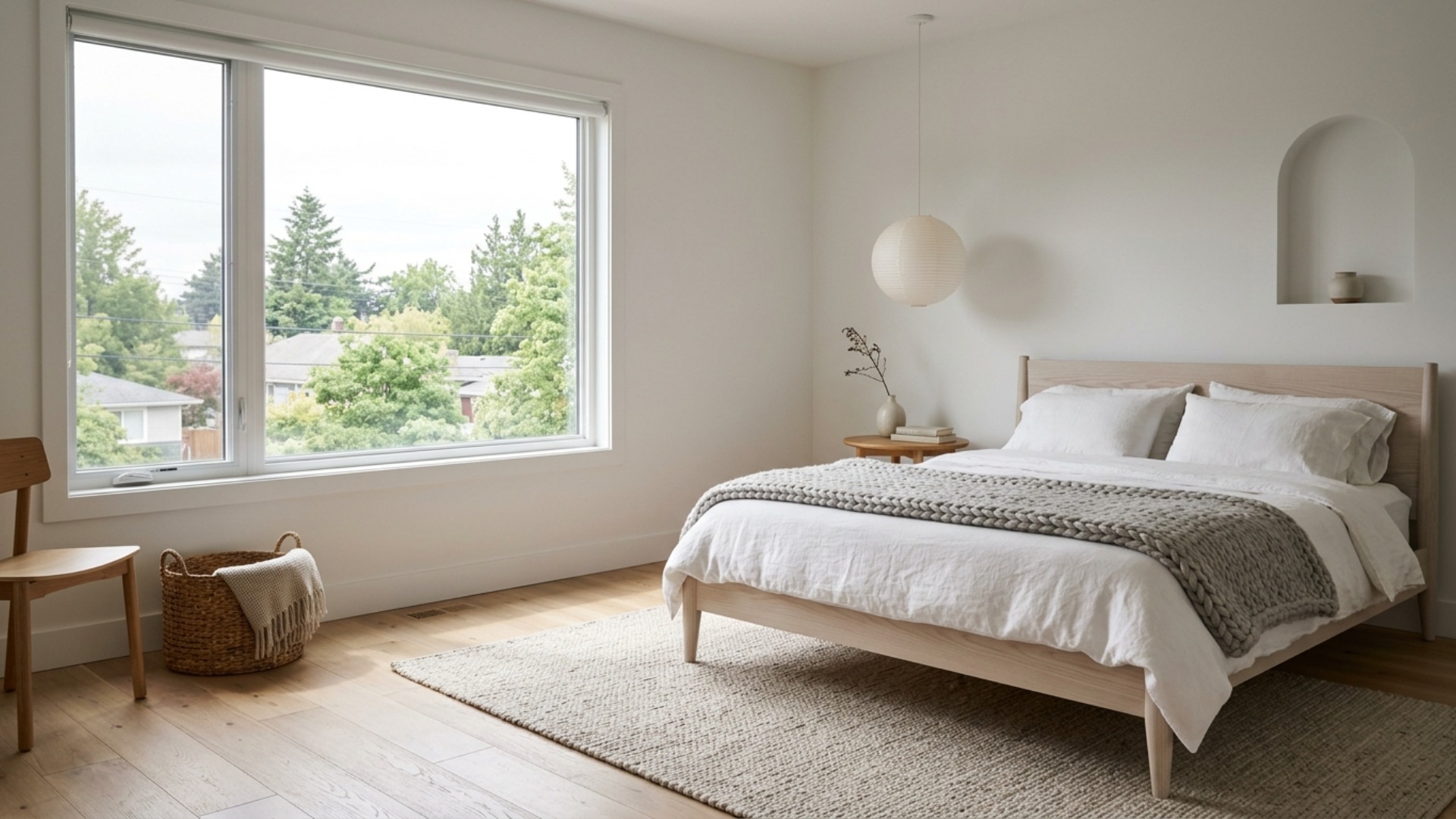
The bed is the largest object and the thing you both touch every day, so buy it once. A simple pale wood or upholstered frame, the IKEA Malm in white-stained oak works, dressed in white linen with one soft grey knit throw, settles most of the room. Swap any cool blue-white bulbs for 2700K warm ones, because Scandinavian calm dies under hardware-store daylight.
-
04
Add texture, not color, so it never feels cold
The usual complaint about Scandinavian rooms is that they feel clinical. The fix is layered texture in the same quiet palette: a chunky wool throw, a flatweave rug in oatmeal, linen curtains that just touch the floor. This is also where you defer. You do not need art on every wall, and one framed piece, or none, is more correct than a gallery wall.
-
05
See it in your real room before you spend
Paint chips and product photos both lie, especially with warm whites that turn yellow or grey depending on your light. Before you commit to a frame color or a wall white, visualize the finished bedroom in Framehouse using a photo of your actual room, so the two of you are agreeing on the same picture instead of two different ones in your heads.
Built for couple first home
Moves that pay off
A first shared bedroom is as much a negotiation as a design project. Sequence it so the money goes to the few things you will keep and waits on the rest.
- Buy the bed frame and mattress once, together, since these outlast the apartment and are the worst things to replace mid-lease.
- Defer the dresser. A pair of matching nightstands and the closet will carry you for a year while you learn how you actually store things.
- Settle the palette before the shopping trip, not in the store, where the lighting and the sales floor will talk you into an outlier.
- Skip buying art in the first month. Blank walls are on brand here, and you will choose better once the room is settled.
- Do not buy two of everything to be fair. One good shared lamp beats his lamp and her lamp fighting across the bed.
- Buy from places with long return windows, because a warm white that looked right in the store often reads wrong at home.
scandinavian cues
What to keep, what to skip
Scandinavian style is a tight set of moves. Hit these and the room reads right even on a small budget.
- Palette: warm white walls, one pale wood such as ash, oak, or birch, and soft textiles in oatmeal, dove grey, and undyed linen.
- Materials: natural wood, wool, and linen, with a little matte black or blackened steel for contrast, never chrome or high gloss.
- Light: maximize it. Undressed or sheer-only windows, warm 2700K bulbs, and a paper globe or simple pendant rather than anything ornate.
- Structure: low, clean-lined furniture with visible legs so the floor stays open, which makes a small first bedroom feel larger.
- One signature: a single sculptural piece, a paper lantern, a woven pendant, or a bentwood chair, does the decorative work for the whole room.
- What to skip: heavy dark wood, ornate headboards, cool gray-blue whites, and any theme. Scandinavian is a background, not a costume.
Use it for
What people plan with Framehouse
- Test a warm white against your existing trim before buying a single can of paint.
- Show your partner what the finished bedroom will feel like so you agree on one picture.
- Compare a pale oak frame against a white-stained one in your own light before ordering.
- Decide whether the room needs curtains or reads better with bare windows.
- Plan the buy-now versus buy-later list so the first month's budget goes to the bed.
Quick answers
Common questions
Make a plan you can act on
Skip the spiral of mood boards. Three minutes in the Aura Quiz turns your taste into a direction.
Take the Aura Quiz