Mid Century Modern Bedroom Ideas for a Couple's First Home
The bedroom is the one room in a first shared home that exists purely for the two of you. Mid century modern gets it right when it stays warm and specific, and goes wrong when it turns into a hotel suite.
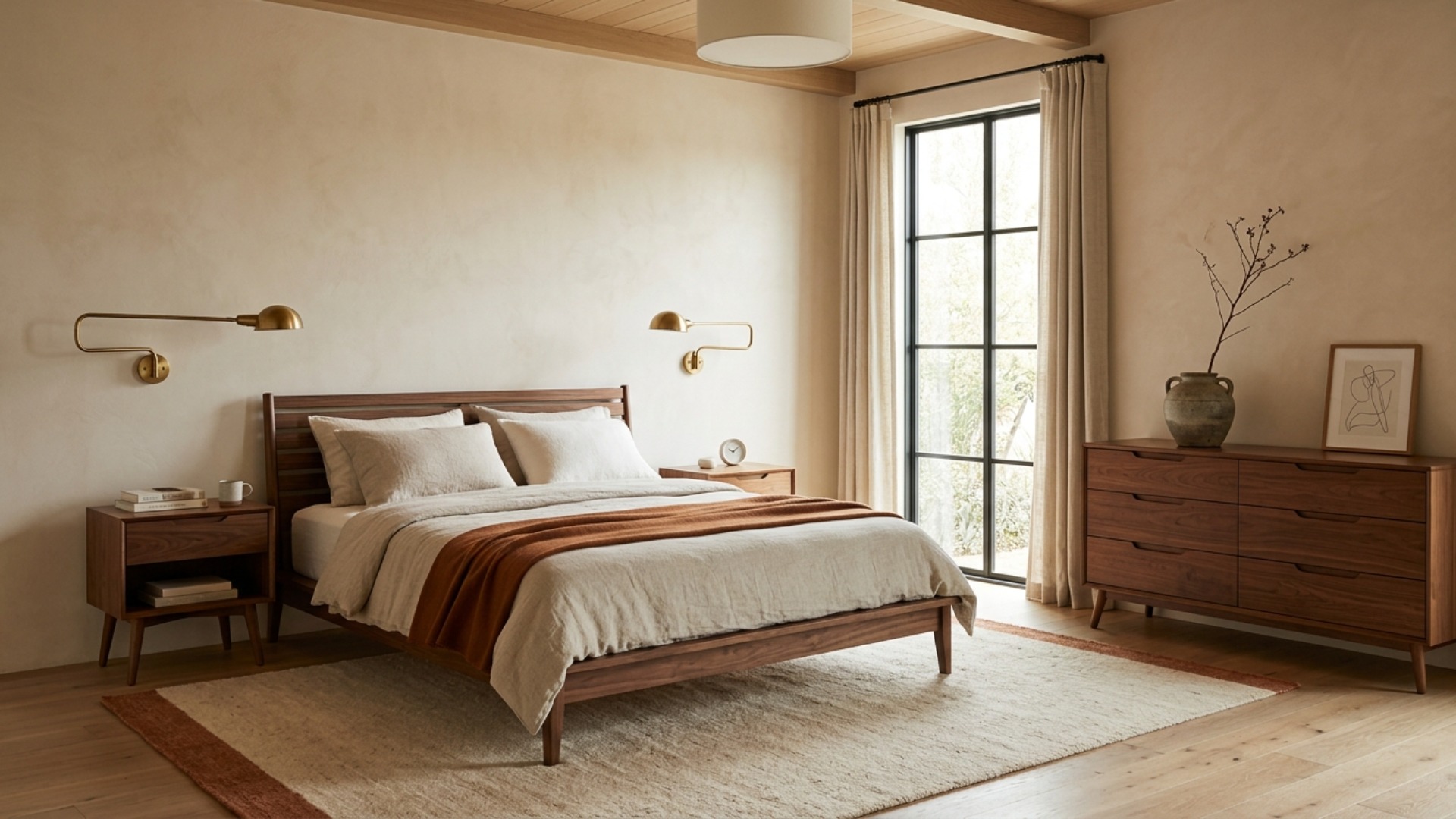
The real problem
Why this is harder than it looks
Mid century modern bedrooms photograph beautifully and are unusually easy to get slightly wrong. The reference images are all the same: low walnut bed, two matched nightstands, two sconces, a rug, nothing else. Copy that literally and you end up with a room that looks correct and feels like a nicely appointed hotel. Nothing in it belongs to either of you.
What is actually going on in the good versions is restraint plus one or two personal objects doing a lot of work. The style leaves so much visual quiet that a single piece of art, a real book stack, or a slightly odd lamp reads as character rather than clutter. That is the opposite of how most people decorate a bedroom, which is by adding many small soft things until it feels finished.
For a couple furnishing a first shared bedroom, there is a second problem underneath the aesthetic one, and it is the one that actually determines whether you like the room. Two people rarely sleep the same way. One reads late, one is up early. One is cold, one is not. One needs a surface for a glass of water and a phone charger, the other needs three drawers. A bedroom that ignores this looks fine and irritates somebody every single night.
So treat symmetry as a functional decision rather than a styling one. Matched nightstands and paired lighting are not just the mid century look, they are how you give two people equivalent control over their own side. Get that right and the room is forgiving about almost everything else.
A clear path
How to plan it
-
01
Set the bed low and give it a slim headboard
A walnut platform frame with visible tapered legs and a slatted or thin upholstered headboard is the whole silhouette. Keep the mattress top around 22 to 25 inches off the floor. Anything taller fights the low horizon the style depends on, and a deep tufted headboard pulls the room toward traditional without you deciding to.
-
02
Buy two of everything that touches sleep
Two nightstands of equal size, two lights, two outlets within reach. This reads as mid century symmetry and functions as basic fairness, which matters more. If the room only allows one nightstand, put a wall shelf on the other side rather than letting one person go without a surface.
-
03
Light each side separately and take the ceiling out of it
Brass or blackened swing arm sconces mounted above each nightstand free the surface and let one person read while the other sleeps. Put them on individual switches or use plug-in versions with inline switches. Then stop using the overhead fixture in the evening entirely: a mid century bedroom lit from the ceiling looks flat and feels like a rental.
-
04
Put the storage in one long low dresser
A six or nine drawer walnut dresser at around 30 inches solves two people's clothes in one piece and gives the room its second horizontal line. Divide the drawers before you move in rather than negotiating them later. Skip the tall chest: vertical bulk is what makes a bedroom feel smaller than it is.
-
05
Test the wood and the wall color together before you buy
Walnut against a warm white wall and walnut against a cool gray wall are two completely different rooms, and a headboard is not something you return casually. Render your actual bedroom, try the wall color against the bed and the floor you already have, and check it in evening light as well as morning. This is the one room you see mostly after dark.
Built for couple first home
Moves that pay off
A first shared bedroom is where two sets of habits meet, and most of what makes it work is decided before anything is styled.
- Decide sides of the bed first, then buy the nightstands. It sounds trivial and it determines outlets, lighting, and who gets the window.
- Split the dresser drawers explicitly. Vague sharing turns into one person using seven drawers within a month.
- Buy the mattress together and in person, and buy separate duvets if you sleep at different temperatures. Two duvets on one bed is the least romantic and most effective fix in this list.
- Put both bedside lights on their own switches. Different reading schedules cause more friction in a first shared bedroom than any decorating disagreement.
- Hang art you both chose after moving in, not the pieces either of you already owned. This is the one room where the split should feel genuinely equal.
- Leave the corner opposite the bed alone for a while. It usually wants a chair, and you will know which chair after a month of living there.
mid century modern cues
What to keep, what to skip
A mid century bedroom runs on a very short list of materials and one strong horizontal line. What holds it together:
- A low horizon set by the bed and repeated by the dresser. Both under about 32 inches, nothing tall on the walls except art.
- Walnut carrying the room, with teak or oak acceptable as long as you commit to one and stay there.
- Symmetry at the bed and nowhere else. Matched nightstands and paired lights, then let the rest of the room be asymmetric so it does not read as a showroom set.
- Brass or blackened steel in exactly one finish, on the sconces and the drawer pulls.
- Wool, linen, and a little cane or leather. One rust, olive, or mustard accent in the bedding or a single cushion.
- What to skip: matching bedroom suites sold as a set, tall chests, mirrored furniture, and anything upholstered in gray velvet. The room should feel warm before it feels styled.
Use it for
What people plan with Framehouse
- Test walnut against your existing wall color and floor
- Check whether two nightstands actually fit your bed wall
- Compare a slatted headboard against a low upholstered one
- Plan sconce placement before anyone drills a hole
- Agree on the bedroom you both want before spending on it
Quick answers
Common questions
Make a plan you can act on
Skip the spiral of mood boards. Three minutes in the Aura Quiz turns your taste into a direction.
Take the Aura Quiz