Minimalist Studio Apartment Ideas Under $5K
Minimalism is the one style where a small budget is an advantage rather than a compromise. This page turns $5,000 into a complete studio, with the exact split and the traps to skip.
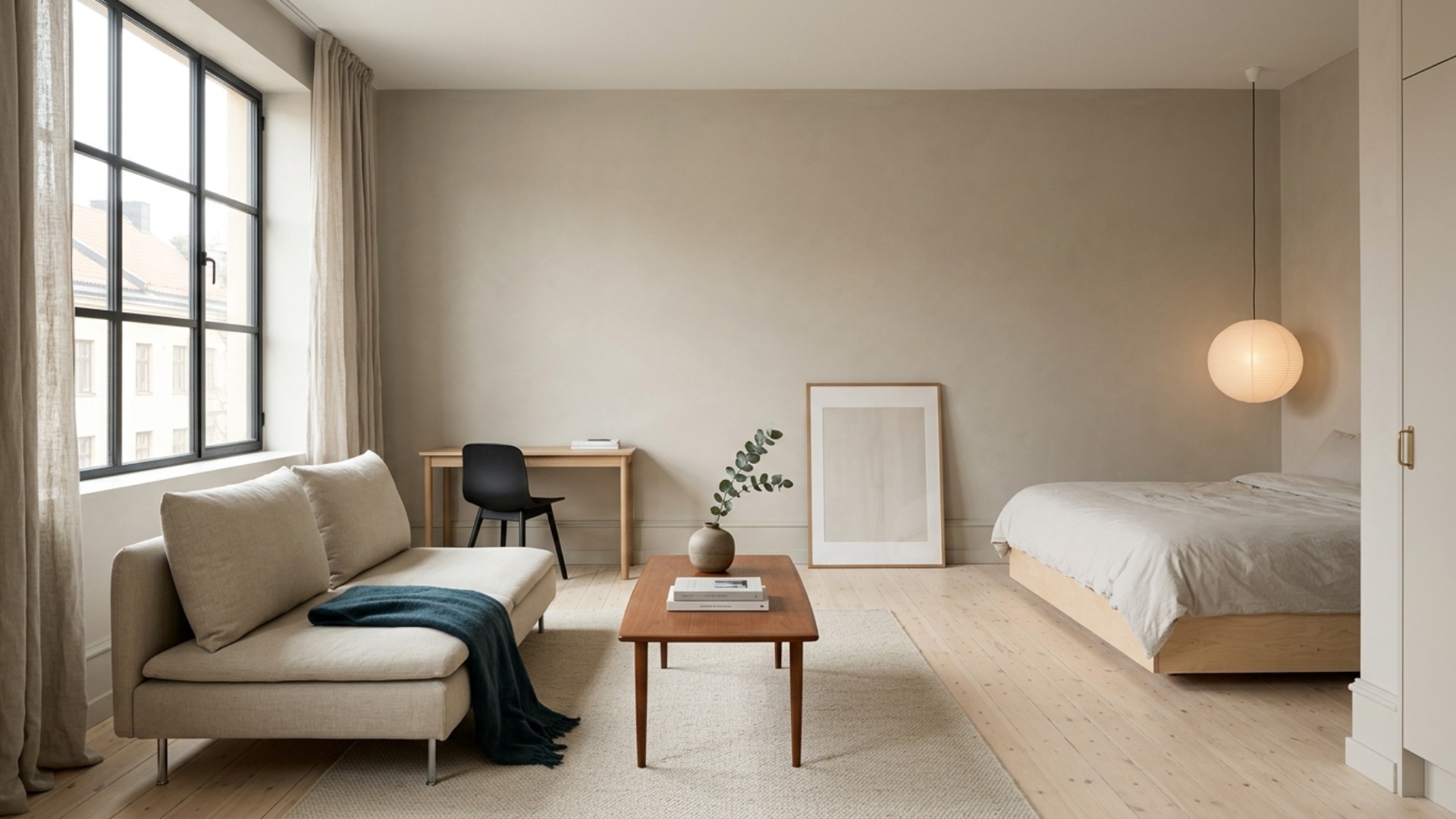
The real problem
Why this is harder than it looks
The usual reading of a minimalist studio on a budget is that you buy less stuff, so it should be easy. Then the room comes together and it looks unfinished rather than minimal: a bed, a sofa, bare walls, and a strange echo. The difference between minimal and empty is not the object count, it is whether the few objects present feel chosen.
What minimalism actually asks for is quality concentrated in fewer places. A $5,000 budget spread thin across fifteen mediocre pieces produces a room that reads cheap everywhere. The same money concentrated into seven or eight pieces, with real textiles and one vintage anchor, produces a room that reads far more expensive than it was.
Your starting point matters here. In a studio, the bed is in the same visual field as everything else, so it has to be held to the same standard as the sofa. Most budget studios fail at exactly this point: a good looking living zone and a mattress on a metal frame in the corner, which drags the whole room down with it.
The failure pattern is buying everything new, everything at once, and everything from one flat pack catalog. That spends the budget fast and produces a showroom, not a home. The better sequence holds back twenty percent of the budget for the second month, after the room has told you what it is missing.
A clear path
How to plan it
-
01
Set the split before you shop: 30, 20, 15, 35
Give about thirty percent to the bed and mattress, twenty to the sofa, fifteen to lighting and paint, and keep the rest for storage, textiles, a desk, and a buffer. On $5,000 that means roughly $1,500 where you sleep and $1,000 where you sit. A written split is the single best defense against the impulse buys that eat small budgets.
-
02
Paint first, and paint everything one color
A gallon of warm white, something like Sherwin Williams Alabaster, costs under $60 and does more for a minimalist studio than any furniture purchase. Paint the walls and trim the same color so the box reads as one calm volume. Skip the accent wall, which cuts a small room in half.
-
03
Buy the two anchors new, and buy them plain
The bed and the sofa carry the room, so spend there: a simple platform bed in wood or upholstered in a neutral, and a low sofa with clean lines, an IKEA SODERHAMN or a secondhand Muuto if one appears. Choose pieces with no tufting, no nailheads, and no curves you will tire of. Plain is what ages well.
-
04
Add one vintage piece and real textiles
One secondhand item with some age, a teak coffee table, a worn leather chair, a heavy wood stool, keeps the room from reading as a catalog page, and usually costs under $200 at auction or on Facebook Marketplace. Then put $300 into textiles: washed linen or percale bedding, a wool throw, and a flatweave rug. Texture is what makes minimal feel warm.
-
05
Render the room in Framehouse before releasing the budget
On a hard budget every purchase has to land the first time, because a return window missed is money gone. Framehouse shows your actual studio in a minimalist scheme, so you can check that the sofa scale, the rug size, and the wall color work together before you commit the $5,000 to orders.
Built for budget under 5k
Moves that pay off
A tight budget rewards sequence over speed. These are the moves that stretch $5,000 furthest in a studio.
- Spend where your body spends time: mattress and sofa first, decor last or never.
- Hold back twenty percent of the budget for month two. The room will tell you what it needs.
- Buy the vintage piece before the new pieces, so the new pieces can answer to it.
- One good $250 rug beats three cheap ones. Size it so the front sofa legs sit on it.
- Skip the matching furniture set. Sets read as rented; mixed plain pieces read as chosen.
- Put $60 into paint before putting $600 into anything else. It is the highest leverage dollar in the room.
modern minimalist cues
What to keep, what to skip
Minimalism lives or dies on discipline, not on emptiness. These cues keep a budget studio reading as intentional.
- Palette: one warm neutral family, wall to wall. Warm white or greige, never stark white.
- Materials: pale wood, washed linen, wool, and one aged element like teak or leather.
- Every piece low and legged, so floor shows and the studio reads larger than its plan.
- One structural signature: a paper globe pendant or a single oversized leaning art print.
- Hidden storage only: under the bed, inside the ottoman, behind one closed cabinet front.
- What to skip: open shelving displays, gallery walls, accent walls, and decor bought to fill space.
Use it for
What people plan with Framehouse
- Check that a full sofa and a queen bed both fit before ordering either
- Test warm white against your floor tone before buying the paint
- Compare a $400 rug and an $800 rug size in the real room before choosing
- See the room with and without a desk zone before giving up the floor space
- Show a skeptical partner that minimal will not mean empty
Quick answers
Common questions
Make a plan you can act on
Skip the spiral of mood boards. Three minutes in the Aura Quiz turns your taste into a direction.
Take the Aura Quiz