Japandi Kitchen Ideas on a Budget Under $5K
Japandi looks expensive because it is disciplined, not because it is costly, which makes it one of the few high-end styles you can genuinely fake on five thousand dollars. This page shows where that budget actually goes in a kitchen and where spending more buys you nothing.
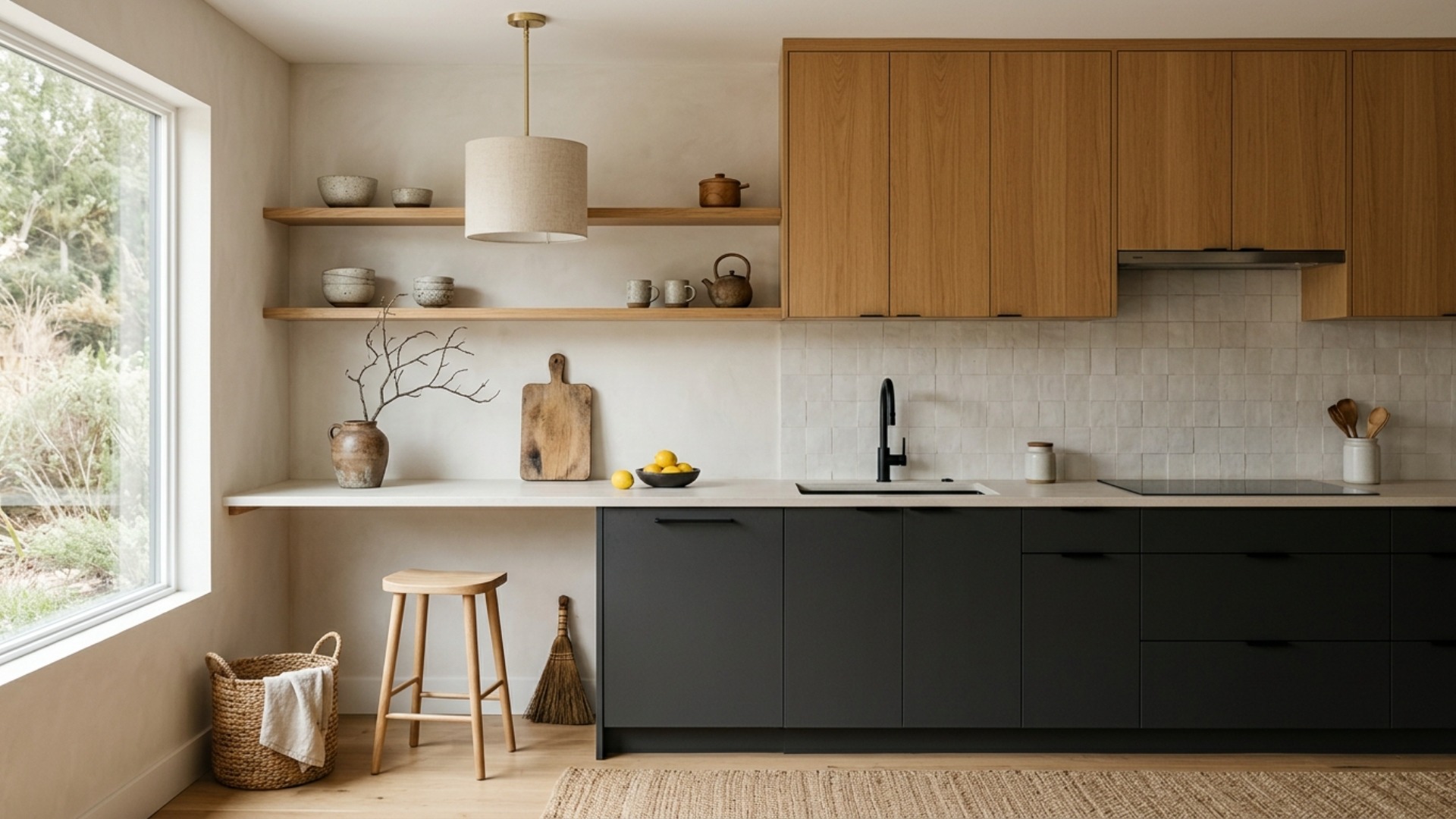
The real problem
Why this is harder than it looks
The trap with a budget Japandi kitchen is thinking the look lives in the cabinets, then discovering that new cabinetry alone eats your entire five thousand dollars and then some. So people either blow the budget on one big thing or, more often, freeze and buy nothing. Both outcomes miss what actually makes Japandi read the way it does.
Japandi is a restraint style. Its whole effect comes from a narrow material palette, warm wood against matte black, uncluttered counters, and a few honest handmade objects, held with real discipline. None of those are expensive on their own. What is expensive is replacing things that only needed refinishing, and what is free is the editing that most kitchens need more than they need new stuff.
Your real starting point is almost always a kitchen with dated but structurally fine cabinets, busy counters, and hardware and lighting from a different era. That is a good starting point for Japandi, because the style rewards subtraction. The question is not what to install but what to strip back, refinish, and quietly upgrade.
The failure pattern to avoid is spreading five thousand dollars thinly across everything and landing on a kitchen that looks slightly newer but not transformed. Concentrate the money: fix the two surfaces the eye lands on, swap the small things that date a room, and spend nothing on the parts Japandi wants bare anyway.
A clear path
How to plan it
-
01
Refinish the cabinets instead of replacing them
New cabinets will swallow the whole budget, so refinish the ones you have. If they are wood, strip and re-stain to a warm oak tone; if they are laminate or painted, a matte finish in warm white or a soft greige reads Japandi and costs a few hundred dollars in materials. Paint the uppers light and the lowers a deep matte charcoal for the signature two-tone contrast.
-
02
Put the biggest single spend into the counter or a wood element
The counter is the surface the eye lands on, so it earns the largest slice, roughly fifteen hundred to two thousand dollars. A honed light quartz or a butcher-block run in oak both read Japandi and are within reach for a small kitchen. If the counter is fine, redirect that money into a length of open oak shelving to replace one upper cabinet, which is the most Japandi move you can make.
-
03
Swap the hardware, faucet, and lighting
These are the details that quietly date a kitchen and the cheapest to change. Slim matte black cabinet pulls, a simple matte black or bronze gooseneck faucet, and one linen or paper pendant over the sink together run under six hundred dollars and do a disproportionate amount of the work. Keep every finish in the same matte family so nothing shouts.
-
04
Edit the counters and add three honest objects
This step costs almost nothing and matters most. Clear the counters completely, then add back only what earns its place: a wooden cutting board left standing, a stoneware crock of utensils, a single ceramic vessel. Japandi lives in the empty space, so resist refilling it. This is the difference between a kitchen that looks styled and one that looks cluttered.
-
05
See it in your kitchen before you spend
On a tight budget you cannot afford a wrong guess, and cabinet colors, wood tones, and two-tone splits look completely different in a real kitchen than on a swatch. Before you buy paint or commit to a counter, visualize the finished Japandi kitchen in Framehouse using a photo of your actual room, so you can test the charcoal-on-white split and the wood tone against your real light and lock the plan before any money leaves your account.
Built for budget under 5k
Moves that pay off
A five thousand dollar kitchen is a budgeting exercise as much as a design one. Put the money where the eye goes and refuse to spend it where Japandi wants restraint.
- Set a hard split before you shop: roughly forty percent to the counter or main wood element, twenty to refinishing, twenty to hardware and lighting, and a buffer for the things you will forget.
- Refinish before you replace. Cabinets, if the boxes are sound, should be refaced or repainted rather than torn out.
- Do the labor you safely can. Painting cabinets and swapping hardware are approachable weekend jobs that save the biggest line items.
- Skip appliances unless one is broken, since new appliances alone can exceed the whole budget and rarely change the look.
- Buy hardware and lighting in one order so the finishes match, instead of accumulating a mismatched set over months.
- Keep a few hundred dollars in reserve for the plaster patch, the extra quart of paint, or the outlet cover you did not plan for.
japandi cues
What to keep, what to skip
Japandi is where Scandinavian warmth meets Japanese restraint. On a budget, the discipline matters more than the spend.
- Palette: warm white or soft greige uppers, a deep matte charcoal or black lower, natural oak, and off-white stone, with nothing glossy.
- Materials: real or convincing wood, matte stone or butcher block, stoneware, linen, and matte black metal.
- Contrast: the signature move is warm wood against matte black, so let those two do the talking and keep everything else quiet.
- Openness: swap one upper cabinet for open oak shelving and leave counters bare, since visible empty space is part of the look.
- One craft object: a single handmade vessel or a wooden board reads as intention, where a dozen accessories read as clutter.
- What to skip: glossy finishes, ornate hardware, busy backsplashes, and warm brass overload. Japandi is matte, calm, and spare.
Use it for
What people plan with Framehouse
- Test a charcoal lower against a warm white upper before buying any paint.
- Check a butcher block counter against your floor and cabinets before ordering.
- See how open oak shelving looks in place of one upper cabinet before removing it.
- Compare matte black hardware against bronze so you commit to one finish.
- Preview the bare, edited counters so you know the restraint will feel right.
Quick answers
Common questions
Make a plan you can act on
Skip the spiral of mood boards. Three minutes in the Aura Quiz turns your taste into a direction.
Take the Aura Quiz