Minimalist Home Office Ideas Under $5K
A minimalist home office is not an empty one, it is an edited one, and that difference is where most budgets get spent twice. This page maps a real workspace for less than five thousand dollars, from the one piece worth splurging on to the three you can skip.
The real problem
Why this is harder than it looks
Most people read minimalism as subtraction and stop there. They clear the desk, paint the wall white, buy a slim metal frame, and wait for calm to arrive. It rarely does, because an empty room and a considered one look nothing alike in person. The empty version reads as unfinished, a little cold, and faintly like a space you are apologizing for.
What makes minimalism feel expensive is not the absence of things, it is the quality and restraint of the few things that remain. One honest material, repeated, does more than five cheap ones competing. That is also why minimalism and a tight budget pull against each other: the look depends on getting a small number of pieces right, and getting them right usually costs more per piece, not less.
If you are furnishing a spare bedroom or a corner of the living room to actually work in, your real constraint is not style, it is that this space has to function eight hours a day and still disappear when you close the laptop. Five thousand dollars is plenty to do that well if you spend it in the right order, and nowhere near enough if you spend it on the wrong things first.
The common failure is buying the trophy first: a sculptural designer desk that eats half the budget, then filling the rest of the room with whatever is cheap and available, which is exactly the clutter minimalism is meant to remove. The room ends up neither minimal nor comfortable. Spend on the chair and the light before the desk, and the whole thing holds together.
A clear path
How to plan it
-
01
Start by subtracting, not buying
Before a single purchase, clear everything off the surfaces and out of the sight lines, then run every cable to one spot behind the desk. A ten dollar pack of adhesive channels and a power strip mounted under the desktop removes the biggest single source of visual noise. This step costs almost nothing and quietly decides how minimal the room can ever look.
-
02
Spend on the chair, because you sit in it
This is the one place to put real money. A used Herman Miller Aeron or Steelcase Leap runs three hundred to six hundred dollars secondhand and will outlast three cheap chairs. In minimalist black or graphite it reads as intentional rather than office surplus, and your back will notice the difference within a week.
-
03
Anchor with one honest desk
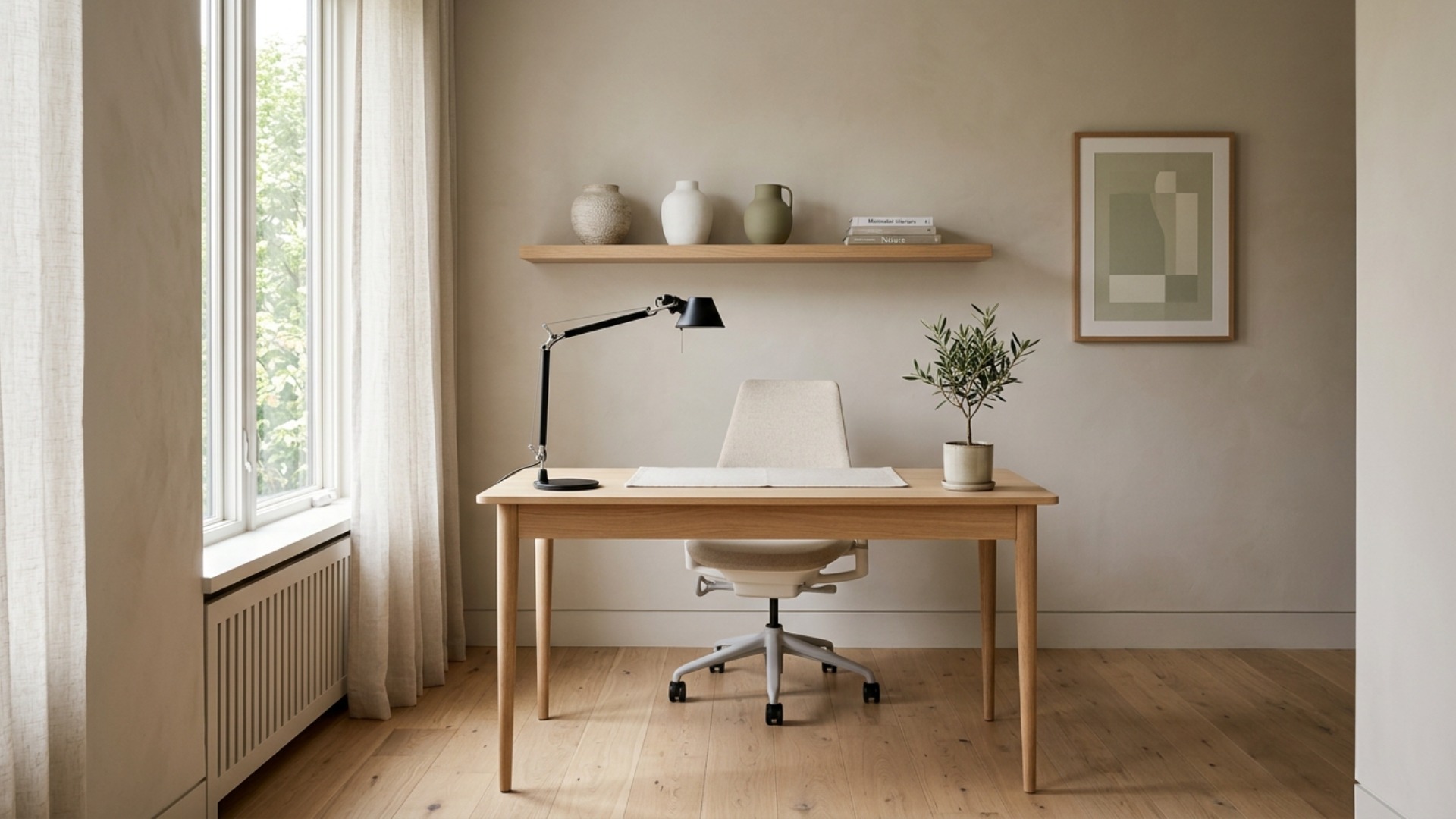
Pick a desk in a single real material with clean legs and no visible hardware: a solid or white oak top on slim steel legs for six to nine hundred dollars, or an IKEA Karlby oak top on Alex drawer units for under four hundred. Depth matters more than width. Thirty inches deep keeps the surface calm and gives the monitor room to breathe.
-
04
Control the light and hide the storage
Add one matte black task lamp with a warm 2700K bulb for evenings, and put everything that is not beautiful behind a door. A single closed cabinet or a two drawer unit does more for the feeling of order than any amount of styling. Then leave exactly one object out on purpose: a plant, a stone, a short stack of books.
-
05
Visualize it in Framehouse before you commit
Wall color and wood tone are almost impossible to judge from a chip or a product photo, and repainting a whole room is the expensive mistake here. Drop your actual space into Framehouse, test the oak against your floor and the paint against your light, and confirm the room reads calm rather than bare before you spend a dollar on finishes.
Built for budget under 5k
Moves that pay off
Under five thousand dollars, sequence is everything. Buy in the order that protects your body and your budget, and defer the pieces that only look like progress.
- Buy the chair first and secondhand. A used ergonomic chair at $400 beats a new $150 one on every measure that matters, and it holds its resale value.
- Set a hard cap per category before you shop: chair $600, desk $500, light and cables $150, storage $400, styling $100. That leaves roughly $1,750 for a rug or art later.
- Defer the standing desk. A quality sit-stand base is $500 or more on its own. Live in the space first and add it next year if you actually miss it.
- Skip the matching set. Furniture sold as a coordinated office suite costs more and looks less considered than three well chosen separate pieces.
- Do not buy open shelving yet. Open storage demands constant tidiness and usually becomes clutter. One closed cabinet is the safer first move.
- Save the last few hundred dollars for a single good rug or one framed print, bought after the room is set, not before.
modern minimalist cues
What to keep, what to skip
Minimalist is a discipline, not a color. These are the moves that make a small workspace read intentional instead of empty.
- Palette: warm white and greige walls, one wood tone, and black used sparingly as a line, not a mass. Skip cool gray, which reads clinical in a work room.
- Materials: matte over gloss everywhere. Honed wood, powder coated steel, wool, and linen. One texture repeated beats several fighting.
- One focal material: let the oak of the desk be the single warm note the eye lands on, and keep everything around it quiet.
- Structural signature: uninterrupted surfaces and hidden hardware. No visible cords, no exposed brackets, nothing with a logo facing the room.
- Styling restraint: one plant, one object, one piece of art. Three things placed well, not a shelf of small ones.
- What to skip: the second monitor arm you do not need, decorative trays, motivational prints, and anything sold as an organizer that is really just more stuff.
Use it for
What people plan with Framehouse
- Test a warm off-white against your existing floor before you commit to paint.
- Compare a used ergonomic chair against a new budget one on total cost over five years.
- See whether a 30 inch deep desk fits your corner before it arrives.
- Show a partner what the finished, cable-free workspace will actually look like.
- Decide whether the room needs a rug or reads calmer without one.
Quick answers
Common questions
Make a plan you can act on
Skip the spiral of mood boards. Three minutes in the Aura Quiz turns your taste into a direction.
Take the Aura Quiz