Coastal Bedroom Ideas Under $5K
Coastal is one of the few styles that gets better when the budget is tight, because it runs on light and texture rather than expensive furniture. This page shows where $5,000 actually goes in a bedroom, and what you can leave out without anyone noticing.
The real problem
Why this is harder than it looks
Coastal gets misread as nautical. People search for a calm, sunlit bedroom and come home with a rope mirror, a navy stripe duvet, a framed sailboat print, and a jar of shells on the dresser. The room ends up costumed rather than coastal, and no amount of additional shopping fixes it, because theme has been substituted for atmosphere.
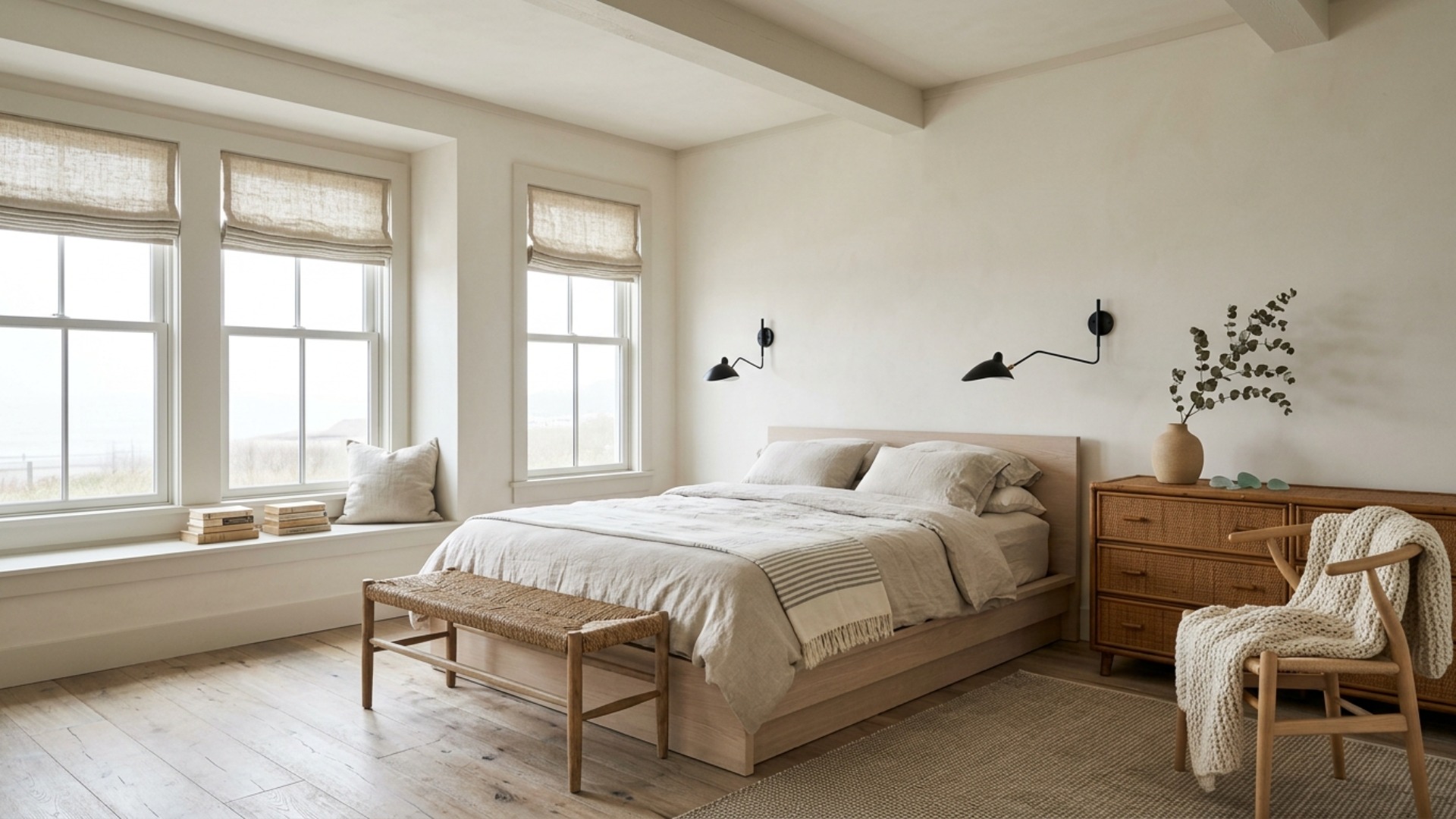
What actually makes a coastal room work is light behaving a certain way. Every surface is either matte and pale enough to bounce daylight or rough enough to catch it: lime plaster, bleached oak, unglazed ceramic, washed linen, seagrass, cotton. There is very little gloss and almost no high contrast. Blue is optional. Most of the coastal bedrooms people save to Pinterest are 90 percent sand, chalk, and driftwood with a single cool accent somewhere near the window.
The starting point for most readers is a standard builder bedroom: beige wall to wall carpet, one window with a vinyl blind, a dark stained bedframe left over from a first apartment, and a ceiling fixture that throws hard white light straight down. That room fights the style at every surface. It is also completely fixable for well under $5,000, as long as the money goes to the surfaces before it goes to the furniture.
The failure pattern is spreading the budget evenly. Five hundred dollars of accessories on top of an unchanged room reads as clutter, not coastal. The move that changes a bedroom most per dollar is the least photogenic one: kill the overhead light, get something soft on the floor, and hang curtains high and wide. Do those three first and the cheap bed you already own starts to look intentional.
A clear path
How to plan it
-
01
Fix the light before you buy any furniture
The single overhead fixture is what makes a bedroom look rented. Cap this at $400 and buy three warm sources instead: two bedside lamps or plug in sconces in white ceramic or oak, and one floor lamp in the far corner. Use 2700K bulbs everywhere, and if the ceiling fixture has to stay, put it on a dimmer and leave it off after dark.
-
02
Hang linen curtains high, wide, and to the floor
Mount the rod four to six inches below the ceiling and extend it eight inches past each side of the window frame. Use unlined off white linen or a linen blend, two panels per window so they stack outside the glass. This costs $120 to $250 and does more for the coastal feeling than anything else on the list, because it raises the apparent ceiling and softens the only hard edge in the room.
-
03
Cover the carpet instead of replacing it
Refinishing floors is not a $5,000 move in a bedroom, and it does not need to be. A large flat weave wool or wool blend rug in sand or chalk, sized so it runs at least two feet past each side of the bed, will hide most of a beige carpet. Budget $400 to $900 for an 8 by 10. Jute is cheaper but scratchy underfoot next to a bed, so save jute for a hallway.
-
04
Spend the biggest line on the bed and real linen bedding
This is where roughly half the money goes: $900 to $1,600 for a low platform or slatted frame in pale oak or a natural upholstered frame, plus $300 to $500 for washed linen bedding in oatmeal, chalk, or the palest greige. Skip the tall padded headboard. Low horizontal lines are the actual coastal signature, and rumpled linen reads as expensive in a way that cotton sateen does not.
-
05
Test the palette in Framehouse before you commit the last of the budget
Warm off whites and pale sands are almost impossible to judge from a two inch chip, especially in a room with one window, and a wrong white pushes a coastal bedroom straight to yellow or straight to grey. Upload a photo of the room, try Benjamin Moore White Dove, Swiss Coffee, and Farrow and Ball Slipper Satin against your actual light, and see the rug and bedding in place before the last $1,500 is spent.
Built for budget under 5k
Moves that pay off
A five thousand dollar bedroom works if you sequence it. Buy in this order and every purchase makes the next one look better.
- Spend in this order: lighting, curtains, rug, bed, bedding, then one piece of art. Stop when the money runs out, because the list is already sorted by impact.
- Put roughly 50 percent of the budget into the bed and mattress and refuse to go over. Everything else here is cheap by comparison.
- Buy the mattress before the frame. A $250 frame with a good mattress sleeps better than the reverse, and no one photographs a mattress.
- Defer the dresser. Secondhand rattan and cane fronted dressers turn up constantly on Facebook Marketplace for $150 to $300, and a new one at $900 is the easiest thing to cut.
- Do not buy art yet. An empty wall above the bed is calmer than a filler print, and the right piece usually shows up after the room is finished.
- Keep $300 unspent for two months. Something will be wrong, usually the rug size or the lamp height, and the fix costs less than the mistake.
coastal cues
What to keep, what to skip
Coastal is a set of material rules, not a color scheme. Get these right and the room reads coastal even with no blue in it.
- Palette: warm off white on the walls, sand and oatmeal in the textiles, driftwood or limed oak on the wood, and one quiet accent in sea glass green or faded chambray.
- Materials: washed linen, cotton, seagrass, rattan, unglazed ceramic, bleached or limed oak. Everything matte, nothing lacquered.
- The structural signature is horizontal: low bed, low dresser, curtains hung tall to stretch the wall, art placed lower than instinct suggests.
- Texture is the budget hack. Two woven elements, usually a rug and one rattan or seagrass piece, do the work expensive furniture would otherwise have to do.
- Keep contrast low. The darkest thing in a coastal bedroom should be a slim black lamp arm or a single dark frame, never a full dark wall.
- What to skip: navy and white stripes, rope detailing, shells in a jar, anchors, driftwood signs with words on them, and cool grey blue paint. All of it reads as theme rather than place.
Use it for
What people plan with Framehouse
- Test warm off white against your existing carpet before buying paint
- See whether a sand rug or a chalk rug settles the room better
- Check curtain height and width before drilling a single hole
- Show a partner the finished bedroom before the furniture budget is spent
- Compare a low oak frame against an upholstered one in your own room
Quick answers
Common questions
Make a plan you can act on
Skip the spiral of mood boards. Three minutes in the Aura Quiz turns your taste into a direction.
Take the Aura Quiz