Japandi Bedroom Ideas for an Awkward Layout
Japandi is the calmest possible answer to a bedroom with a sloped ceiling, an off-center window, or a door that swings into the only good wall. Its low furniture and quiet palette turn the constraints of an odd room into the whole aesthetic.
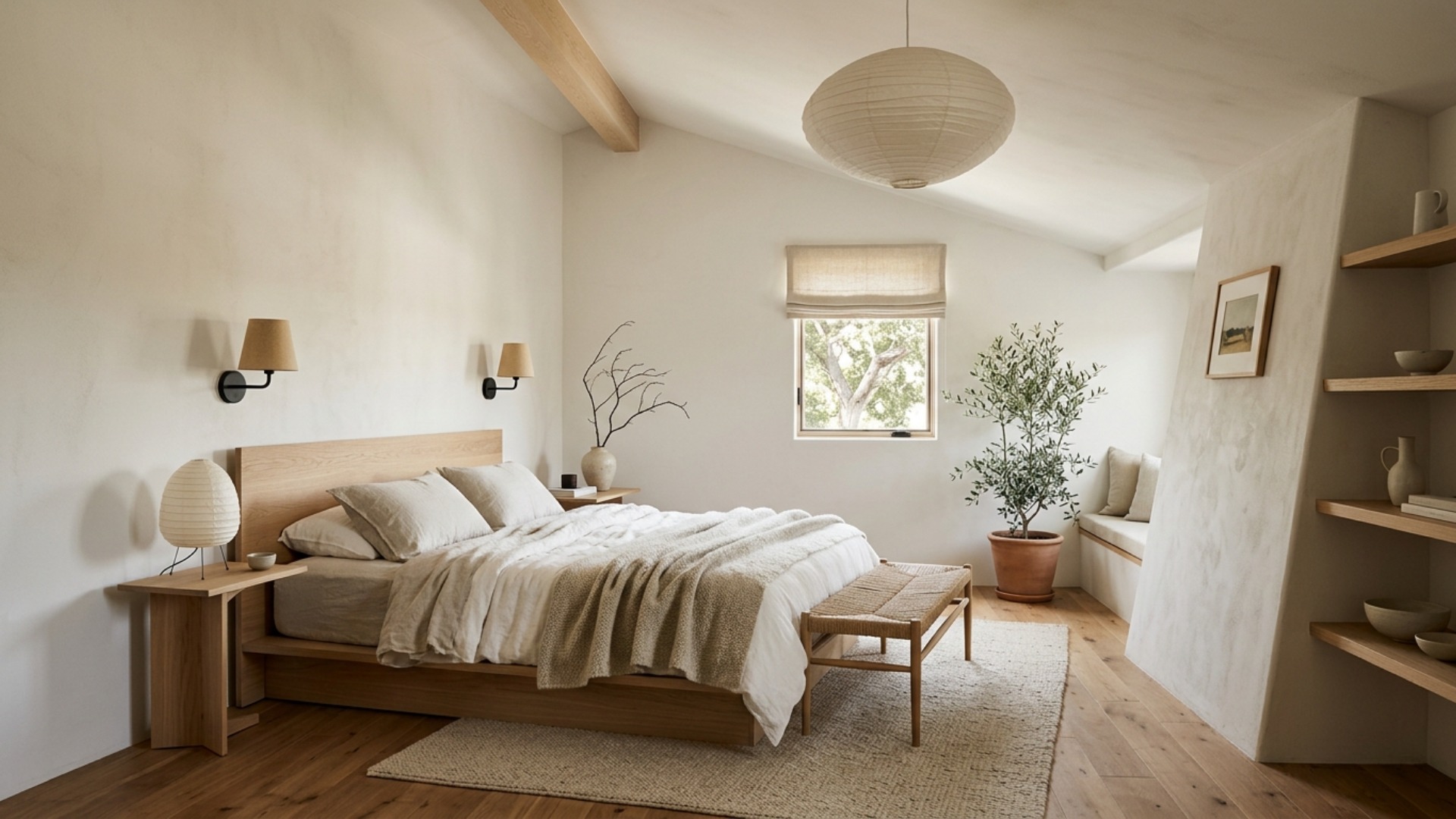
The real problem
Why this is harder than it looks
An awkward bedroom is usually one that fights you on where the bed goes. A sloped attic ceiling eats the headboard wall, a window sits dead center on the only long wall, a closet door swings across the corner you wanted for a nightstand, or a radiator claims the spot under the sill. Most styles try to hide these facts. Japandi does the opposite, and that is exactly why it suits the situation.
What is really happening is that japandi is built on low horizontal lines and empty air, and low furniture is the single best tool for an awkward bedroom. A platform bed that sits close to the floor slides under a sloped ceiling where a tall headboard never could, and it leaves the upper wall calm rather than crowded. The style wants negative space anyway, so the corners an odd room leaves unusable become a feature instead of a failure.
The specific bedroom problems repeat. A low ceiling on one side wants the bed pushed into the slope, not marooned in the center. An off-center window wants symmetry built by the bed and two nightstands rather than forced onto the wall. A tight room wants wall-mounted lights instead of table lamps that steal surface. Each of these is a japandi move already, so you are not compromising the look to fit the room.
The failure pattern is treating an awkward bedroom like a normal one and buying a tall upholstered bed, a pair of bulky nightstands, and floor lamps, then wondering why the room feels cramped and lopsided. Go low, go spare, mount the lighting, and let the empty wall breathe. The same room that felt broken starts to feel intentional and restful.
A clear path
How to plan it
-
01
Put the bed low and let it take the slope
In a room with a sloped or low ceiling, choose a platform bed that sits near the floor and place it where the ceiling is lowest. A low light-oak frame slides under the slope comfortably and turns the awkward angle into the quiet backdrop the style wants. Tall headboards fight the ceiling; a low one makes peace with it.
-
02
Build symmetry with the bed, not the wall
If the window or wall is off-center, stop trying to center the bed on the architecture. Center the bed on itself: flank it with two matching slim oak nightstands and two identical sconces so the eye reads a balanced composition. The room can be lopsided while the sleeping zone looks perfectly composed.
-
03
Mount the lighting to save every surface
Awkward bedrooms are usually short on floor and surface, so take the lighting off both. A pair of matte black wall sconces or slim plug-in reading lights frees the nightstands for a book and a glass of water and keeps the low, uncluttered lines japandi depends on. Warm 2700K bulbs keep the mood soft.
-
04
Use one low bench or a woven basket, then stop
Resist filling the odd corner with storage furniture. A single low bench at the foot of the bed or one woven basket handles the overflow and holds the horizontal line. Japandi reads expensive because it leaves things out, so let the leftover corner stay empty rather than cramming a dresser into it.
-
05
See the layout in Framehouse before you buy the bed
A bed is the one piece you cannot easily return or restage, and an awkward room often needs two or three tries to place it. Photograph the space and use Framehouse to test the bed under the slope, or against the off-center window, before you order. It is far cheaper to reject a placement on screen than after a platform bed is built in the wrong corner.
Built for awkward layout
Moves that pay off
An awkward bedroom is solved by going low, building symmetry into the bed itself, and leaving the odd spaces empty. Plan the placement before you buy.
- Choose a low platform bed so a sloped or low ceiling stops being a problem.
- Place the bed where the ceiling is lowest and keep the taller wall for standing and dressing.
- Create symmetry with matching nightstands and sconces rather than centering on the architecture.
- Mount reading lights on the wall to keep nightstands and floor clear.
- Let awkward corners stay empty; negative space is part of the style, not wasted room.
- Test the bed placement before ordering, since a platform bed is hard to move once built.
japandi cues
What to keep, what to skip
Japandi blends Japanese restraint with Scandinavian warmth: low lines, light wood, matte black, and visible craft. Aim for these.
- Palette: warm white and light oak, oatmeal and stone textiles, a few matte black accents.
- Materials: solid light wood, linen and wool, paper and ceramic, nothing glossy or ornate.
- Signature: low horizontal furniture and a strict, uncluttered line that makes a small room feel calm.
- Lighting: a paper lantern pendant plus matte black sconces, all in warm 2700K light.
- Craft over quantity: one well-made object, a ceramic vase or a woven throw, instead of many small ones.
- What to skip: tall headboards, bulky nightstands, busy patterns, and clutter on every surface.
Use it for
What people plan with Framehouse
- Test a low platform bed under your sloped ceiling before buying it.
- Check whether two nightstands and sconces balance an off-center window.
- See how much calmer the room feels with wall-mounted reading lights.
- Decide whether the awkward corner should stay empty or hold one bench.
- Show a partner the placement so the heavy bed only gets built once.
Quick answers
Common questions
Make a plan you can act on
Skip the spiral of mood boards. Three minutes in the Aura Quiz turns your taste into a direction.
Take the Aura Quiz